Thursday, 25 February 2021

Blue Composites, Chicory and Blue Sowthistle

 Blue Composites, Chicory and Common Blue Sowthistle.

A few photos of these two blue flowered composites.

The blue stamens look amazing with their dark blue edging. The white pollen coating the style and onto the curved stigma.  Chicory 12 July 2020, Guided Bus, near Rampton. 

Chicory, quite a tall thin plant with flowers on short stalks in clusters up the stem.

Basal leaves are lobed.

Stem leaves clasp the stem and have jagged edges.

Open flower plus new buds. 

Phyllaries in two rows, outer wide and overlapping. Ligules have glandular hairs which is an unusual feature of this species.  Chicory  12 July 2020

A similar species to Chicory (Cichorium intybus) in the UK is the Common Blue Sowthistle ( Cicerbita macrophylla) which is also regarded as a garden escape and is widespread in the UK. I had never seen one until a visit to the Peak District in August.


Pale mauve flowers about 30mm across. Common Blue Sowthistle, Peak District. 7th Aug 2020

Outer phyllaries overlapping and of very different lengths and have pale margins. Glandular hairs on phyllaries and stem but not on the pale mauve ligules.  

Mid Stem leaf clasping the stem with neat fine teeth on margins.

The Common Blue Sowthistle is a much more leafy plant than Chicory.  It originally came from the Urals. There are three other species of Blue Sowthistle in Britain, the native Alpine Blue Sowthistle found in a few high mountain gullies in Scotland, Hairless Blue Sowthistle a very rare garden escape from the Pyrenees and southern Europe and finally Pontic Sowthistle another garden escape from Georgia and north-eastern Turkey.


Peter Leonard, Rampton, Cambridgeshire, 7th Feb 2021


Sunday, 7 February 2021

Hieracium aviicola Many-toothed Hawkweed

 Hieracium aviicola   Many-toothed Hawkweed    Devils Ditch. Newmarket Heath.


Hawkweed on Devils Ditch, Newmarket Heath, Cambridgeshire.

There is a new Hawkweed book, Hawkweeds of South-East England by Mike Shaw recently published by the BSBI. It builds on the previous work by Vincent Jones with the ground breaking Yorkshire Hawkweeds published by the Yorkshire Natualists Union, now out of print.  Between these two books a large number of the hawkweeds in England can now be identified in theory. In practice the identification of Hawkweeds remains difficult. I had an advantage when shown this Hawkweed, in that I was with Alan Leslie (who has recently written the new Flora of Cambridgeshire, RHS 2019) and he knew what species it was. He had seen it in the past at this site and also knew that Peter Sell ( Co-author of Flora of Great Britain and Ireland, vols 1-5) had been involved in the original confirmation. Peter Sell was a great enthusiast and expert on Hawkweeds. He grew many Hawkweed species in the Cambridge Botanic Gardens to study them in detail.

The question is could I have, as a 'Hawkweed beginner' identified it myself, based on the photos I had taken?

Both books on Hawkweeds have keys and both books cover H. aviicola. I used the South-East England book as a test.

The first item in any Hawkweed identification is to check whether the plant has basal leaves when in flower and then the number of stem leaves. The photo above shows the basal leaves are certainly present and in full health. The single stem has three stem leaves and a fourth that might be regarded as a inflorescence bract. There is also a higher bract. The count of stem leaves plus inflorescence bracts going up one stem path is important, as the first question in the Key is are there more or less than eight.

We have five (maybe six) here.

The other factor is: Does the plant look well, robust and undamaged? - It does. 

Next key question is: Are the leaves covered in glandular hairs to exclude a group called Amplexicaulia?

Basal leaves.

These basal leaves have a few white hairs mainly along the margin and very few on the lamina surface.

So not Amplexicaulia.  Note the  basal leaves have quite a long petiole and have quite short teeth.

The next question relates to number of stem leaves. 

Stem leaves 0-1(2) : basal leaves numerous  in which case go to Hieracium group.

Stem leaves 2-8 : basal leaves usually few in which case go to group Oreadea or Vulgata.

We have about 5 stem leaves/bracts so looks like we can exclude Hieracium group. Also basal leaves are few but this seems a bit vague and a number would be better.

Oreadea has phyllaries that have predominant eglandular hairs whereas Vulgata has a mixture of eglandular and glandular hairs but glandular hairs usually predominant.


Glandular hairs predominant.

Phyllaries clearly are covered in glandular hairs so it looks as if the Hawkweed we have here is in the Vulgata group.

We hit two problems at this stage, one is that there are a lot of species in the Vulgata group and some are grouped together as aggregates as they are so similar. This is where the Vulgata key in the South-East England book fails, as its key does not include the aggregate groups ( H. maculate agg. , H. diaphanous agg., and  H. acuminatum agg.). These groups are covered but not linked by the key.

Fortunately in the Yorkshire book, Vulgata key does include aggregate groups (on page 101). 

I now use the Yorkshire book and its key.

Leaves unspotted takes us onto phyllaries with predominant glandular hairs and then we get into real detail. 

The next key split is dependent on the density of stellate hairs on the phyllaries. The photo above does show some stellate hairs but more magnification is needed.


Stellate hairs ( I normally call these cobwebby hairs)

Stellate hairs are certainly present especially on the margins of the phyllaries which moves us onto

the next question. Do the upper stem leaves have stellate hairs present on the lower surface? 


Lots of simple white hairs but no sign of any stellate hairs on the lower surface.
At this point the size of the teeth on the leaves come in and section 9 of the key gives following choice:-

Leaves entire to denticulate or with small teeth.                                            10
Leaves obviously dentate, often with mammiform teeth.                               H. acuminate agg.

-entire is lacking teeth, 
-denticulate means with regular small fine patent teeth, evenly spaced.
-dentate  means with large more or less patent teeth.
-mammiform with more or less rounded teeth which can vary in size and are pointed at the tip.

First problem here is what leaves are they referring to , basal leaves or stem leaves. I assume stem leaves. The basal leaves have quite small teeth but the stem leaves have quite pronounced teeth.

I would regard the teeth on the above stem leaf is large and pointed so I think we have arrived at 

H. acuminate agg. Having said that, there was a population of about 20 plants and there was quite a lot of variation in teeth size.

Whether we should just stop at H. acuminatum agg. rather than try and spit this group further is a good question. We all know that plants within a species can vary considerably in various features but strangely many Hieracium 'species' apparently have very little variation and this is some ways justifies their status as species.  It would seem we have been using quite tiny changes to arrive at H. acuminate agg.  The justification for continuing to split further would have to be based on consistent features over a geographical range. This would appear to be the case for these vulgata hawkweeds, which is the case of H. aviicola are widely recorded across England and Wales.

 These species reproduce by selfing, i.e. producing clones.  As a hawkweed beginner, all I can do is see how far I can go using these new books and see if I can work out  if the description and photos I have taken tie up with the description in the literature. 


The following species make up the H. acuminatum agg. :-

(H. acuminatum)    

H. consociatum

H. argillaceum

H. aviicola

H. nemophilum

H. chlorophyllum

H. festinum

H. cheriense

No Key is provided in the South-East England book but the Yorkshire book does cover the five species seen in Yorkshire, which includes H. aviicola. The leaf shape and dentition seems to be the main difference.


Basal leaf shows quite limited teeth 


Lower stem leaves seem to vary in the amount of teeth depending on what plant you look at.
This example has very limited teeth but is does vary from leaf to leaf.

Mid-stem leaf  July 2020 Devils Ditch. Newmarket.

A different plant in the same population has teeth that are very narrow and quite long.

The key talks about the teeth being longer than 6mm ( up to 10mm on stem leaves) or less than 6mm.

I think the plants at the Devils Ditch are typically below 6mm which leaves H. argillaceum, H. aviicola, and H. nemophilum.  At this point the very first photo shows the stem leaves gradually decreasing in size upwards which fits with H. aviicola. Result, happiness!- but the differences between these three species is very small in the terms of the key descriptions. 

In practice I looked at other features not in the key, to confirm the identification by reading the notes and photos about H. aviicola is both books.  The leaves tend to taper at both ends which fits in with the choice of all three species in the sub-group. 'The inflorescence with long lower branches from the leaf axils and with the lower peduncles making a wide angle with the stem and the upper being more or less erect, giving a large, broad panicle' fits well with H. aviicola and this is apparent in the structure seen in the very first photo and the photo below. However I lack experience of the other two species.


Styles are stated to be yellow in the Yorkshire and the South-East England books, so that matches with photo below.

Yellow stigma


In truth, without knowing what the species at the start ( thanks to Alan Leslie),   I would have struggled, in this final stage to get to the right result.  In reality you would need a lot of hard earned practice to get the expertise required.  This is hard to achieve but both books give sites where you can observe the various species and that it probably the only way to improve one's knowledge.  Both these regional books have great photos of example plants and these give as much insight as the keys, when you get close to the solution. Sometimes keys fail however and then a more multi-feature approach is needed.

 Early days but I have learnt a bit more on the detail needed to identify these difficult Hawkweeds. I suspect that this Vulgata group are not the easiest to make a start with. Without the books by Vince Jones and Mike Shaw I would not stand a chance. 


Resources:-

Hawkweeds of South-East England by Mike Shaw, BSBI Handbook No 20.

Yorkshire Hawkweeds by Vincent Jones , Yorkshire Naturalists' Union.

Flora of Great Britain and Ireland, Vol 4 by Peter Sell and Gina Murrell.   

Pedicles have stellate and glandular hairs.  7th July 2020


Peter Leonard

Rampton, Cambridgeshire.

22nd January 2021


Thursday, 21 January 2021

Hedypnois cretica

 Hedypnois cretica photos from Arrifana, Parque Natural Da Costa Vicentina,  Portugal.

Also known as Hedypnois rhagadioloides.

Note the stem thickens as it meets the capitula.

A lockdown task of looking through old photos and attempting to identify them was helped by the excellent web site Flora-On which covers the wild flowers of Portugal well. My interest in this particular species was driven by trying to find examples of the phyllaries ( involucral bracts) that show signs of swelling.  This seems to be a feature of many yellow composites including some Crepis and Sonchus species in the UK.

The phyllaries tend to swell as the achenes mature after the ligules have faded and may be some form of added protection to the achenes?

In the case of Hedypnois cretica the phyllaries are quite plump at an early stage as shown in the above photo.


In the photo above the ligules (petals) have faded and the achenes have developed their pappus hairs which stick out of the top. The  phyllaries have become more swollen which can be seen especially towards the tips compared with the previous photo. 


The third photo shows that the phyllaries in bud are not showing as much thickening.

Key features of Hedypnois cretica are the phyllaries being 'strongly incurved in fruit' which separate cretica from arenaria which also occurs in Portugal. Other features are the stems that thicken just below the capitula and in many plants, more than shown in these photos.

Hedypnois cretica is an annual plant with stems branched and many flower heads. Basal leaves may be present at flowering but on some plants I saw had already turned brown. Lower leaves can be entire to deeply lobed but in the case here were only shallowly lobed.  A variable feature.


The photo above shows a lower stem leaf with small lobes. Leaf is sessile (without a leaf stem) and has white simple hairs along the margin.


A mid stem leaf is clasping the stem, with auricles. The margin is showing the white hairs well.


Habitat was at the side of a track at Arrifana, on the West Coast of Portugal.

One of the most interesting features of H. cretica is one that the achenes share with Leontodon saxatilis, an outer row that lack the pappus hairs, which are replaced by short scales. This feature is shown on the Flora-On site.  https://flora-on.pt/#/1Hedypnois+cretica


Peter Leonard
Rampton, Cambridgeshire.
Jan 2021


Thursday, 29 October 2020

Acicles

 Acicles, Prickles and Stalked glands in Wild Roses.  Photos and thoughts.

Rosa rubiginosa showing pedicle acicles and stalked glandular hairs.

Since June I have been looking at Roses. A difficult group of species which often hybridise.

As a beginner I was advised to ignore hybrids, as even separating the species is hard enough for a first year. Anything which did not fit the species description in the BSBI Handbook no7, Roses of Great Britain and Ireland, was at first given the 'walk on by' treatment. Eventually, as confidence grew,  a guess was made to the possible parents of a hybrid plant. An example was a possible hybrid between Rosa micrantha ( Small-flowered Sweet Briar) and Rosa rubignosa ( Sweet Briar) which was somewhat dependent on the presence or absence of Acicles.

This raises the question of what actually does an acicle look like?   How do you separate an acicle from a stalked glandular hair or a straight prickle?  The term acicle is applied to the rigid version on the main stems and also to the soft versions seen on the pedicle and hypanthium and this can cause some confusion.


The handbook treats acicles as a type of prickle on the stems, however in the description of Rosa rubiginosa it describes the pedicles as glandular-hispid, the glands often mixed with small acicles.

The Rose handbook description for an acicle is :-  In a few species such as R. pimpinellifolia the larger prickles may be interspersed with much smaller ones called acicles. These are often straighter than the large prickles, and may come in all sizes down to what appear to be stiff bristles.  However unlike a true bristle ( or stiff hair), acicles always taper to a point from a broad base. Occasionally acicles are gland-tipped.
P. pimpinellifolia  All prickles or are there acicles as well?


Another definition from CTW is :- Very slender prickles or stiff bristles, not stout-based, sometimes gland-tipped. Stace defines acicle as - a slender prickle with scarcely widened base.

In practice these definitions hide the fact that stalked-glandular hairs, acicles and straight prickles could be said to form a continuum. 

Location.

The acicles can be present on the pedicle/hypanthium and the flowering stems although the stem version are hard and stiff whereas the versions on the pedicle are flexible.  Maybe separate names could be used for the types of 'hair' found on the pedicle/hypanthium vs stem.

R. rubiginosa hypanthium and pedicle (flower stem).This photo shows the longer non glandular acicles and the shorter glandular stalked hairs.

The above photo of R. rubiginosa clearly shows two types of hair. 

Glandular hair. Some are clearly stalked glandular hairs with the gland being of a size that forms a large ball whose diameter is several times that of the diameter of the hair tip, on which it rests.  

Acicle. The second type of 'hair' is generally longer, has a thicker tapering body and usually ends without a glandular tip.  I have regarded these as acicles. Occasionally these acicles have glandular tips but these are often not balls but just darkened ends. One feature is that the very base of these acicles is not enlarged by any great extent unlike a prickle. 

Since acicles are a feature of R. rubiginosa and are not seen on R. micrantha or the Downy roses like R. sherardii it might be worth looking at examples of pedicle/hypanthium hairs on these species.

R. sherardii  23rd September, West Cork.

The point of this photo is to show that no acicles are present which is what you would expect, but that the length of the stalked glandular hairs can include very long ones. Length cannot be used as a determining feature in distinguishing acicles from glandular hairs.


R. micrantha, 12th June, Cambridge.

 The above photo shows Small-flowered Sweet Briar with stalked glandular hairs and no acicles which conforms to the expected species description. These glandular hairs do not appear insect friendly.


R. rubiginosa. 14th October , Croydon.

The glandular tips are deteriorating rapidly turning white at this time when the fruit are going soft.  This photo shows how difficult it can be to distinguish between the stalked glandular hairs and the acicles which can be the same length. The lower right 'hair' had a large ball of sticky chemical whereas the one going left looks as if it just terminates in a point and is therefore a acicle.  The complication is that glandular hairs can lose their glandular tips and acicles can occasionally have glandular tips with a ball shaped gland on.

R. rubiginosa 14th Oct  Croydon.

A feature of R. rubiginosa is the unequal prickles on the stems.     This photo shows the variation of dense prickles, many of which are thin and narrow pointed and might be regarded as acicles. The more typical curved prickle is shown in the next photo which is part of the same plant. This variation in the shape of the prickles is typical of rubiginosa. 


R. rubiginosa 14th Oct Croydon showing more typical shaped prickles.

R. rubiginosa , stem just below pedicles

The descriptions in the literature do not clearly differentiate between an acicle and a straight thin prickle. I would regard the prickles on the main stem as thin prickles since they have a elliptical base. Strangely some have a tiny glandular tip. This is an example of the intermediate characteristics that  occur. The conflict in the description about the base being either wide or not wide, from the Rose handbook, CWT and Stace, adds to the confusion. My thought is that it's the shape of the base rather than the width, that to me seems to separate prickles from acicles.


14th Oct Hybrid R. micrantha/rubiginosa 

The above photo shows an acicle with three stalked glandular hairs. The glandular tips are deteriorating at this late stage. All have slightly wider bases but this is limited compared with a true prickle. 


Example of accicle with round base on stem just below pedicles.

Stalked glandular hair on hypanthium ( R. tomentosa)


Intermediate in that the base appears somewhat elliptical but tiny glandular tips are present.


A straight prickle, based on its elliptical base. 


Fig 1. Possible difference between stalked glandular hairs, acicles and narrow straight prickles.

 Length is variable although acicles are often longer than stalked glandular hairs on the pedicle/hypthanium. Bases can be smaller than shown as proportions are for short versions.

Glandular hairs sometimes lack the glandular tip and acicles occasionally have glandular tips. Surprisingly even straight prickles have been seen with glandular tips on one occasion so all three types are not absolute in their features. Approximate colouring is late season, hairs and acicles are green at flowering time. Prickles are rigid when mature, acicles and stalked glandular hairs remain flexible on the pedicle.  Acicles have a tapering tip, sometimes darker or occasionally a glandular ball which might be slightly smaller than usually seen on adjacent stalked glandular hairs.  Since no absolute difference is 100%, check more candidates on the plant to determine the presence of acicles.  

With roses, no rule is 100%, so careful consideration has to be given to the complete range of features.  

I have avoided using the term 'pricklet' as in the handbook it is used to describe the smaller prickles that occur on the petiole and rachis ( leaf stems).  


Pricklet on rachis

Another term used is bristle, which is used in place of acicle in Harrap's wild flowers.

Peter Leonard   Rampton     18th October 2020

Please comment if you can add anything to this possible interpretation or let me know if I have misunderstood the literature.  The rose season is just about over so it will be next year before I can learn more about this difficult group. 


Reference:-  Roses of Great Britain and Ireland by G.G. Graham and A.L. Primvesi, BSBI Handbook No 7.


Monday, 12 October 2020

Leaf edges in Cambridgeshire Roses

Leaf edges in Cambridgeshire Roses.


On the 3rd June I had zero knowledge of roses. A chance encounter with Rosa micrantha (when looking at Crested Cow-wheat), initiated a quest to see and photograph all the possible rose species to be found in Cambridgeshire.

The main problem with wild roses is they all hybridise with each other and I took good advice to ignore hybrids, at least to start with.  I looked for pure examples of each species, based on the principle that I need to learn the features of each basic species, before one could even consider examining hybrid plants. This involved rejecting examples which did not conform exactly to the handbook description.

I ordered Sell and and Murrell Volume 2 which arrived on the 5th June. This volume contained somewhat disturbing news, quote ' We support John Lindley's remark of two hundred years ago that the study of Roses has been so detailed that one can no longer distinguish species. They are in a taxonomic and nomenclatural mess. All we have been able to do is follow Graham & Primavesi's (1998) Roses of Great Britain for species and hybrids, but we believe that this is a dumbing-down which produces aggregates that could be ecological and geographic non-sense'.

Roses of Great Britain and Ireland, BSBI Handbook No7 by Graham and Primavesi would appear to be a very good starting point despite the rather negative comments by Mr Sell.
Over the summer I have managed to photograph the possible species to be found in Cambridgeshire using the handbook No7 as a guide, in an attempt to find 'pure' non-hybrid examples. Actually all the roses are derived from hybrids and what are regarded as species are just stabilised and widespread plants that share the same features. The BSBI handbook is well laid out, has good line drawings and is concise covering species and hybrids and remains the essential reference text. More recent Dutch work still uses much of its content.

This blog shows leaflet edges of the species and compares them with the stated description in the handbook, as either uni-serrate, bi-serrate or multi-serrate.

Handbook descriptions are stated for each species and the photos compared to see if they agree with that description. Definitions from handbook :-

A) A Uniserrate  leaflet has sharp teeth, all more or less the same size.

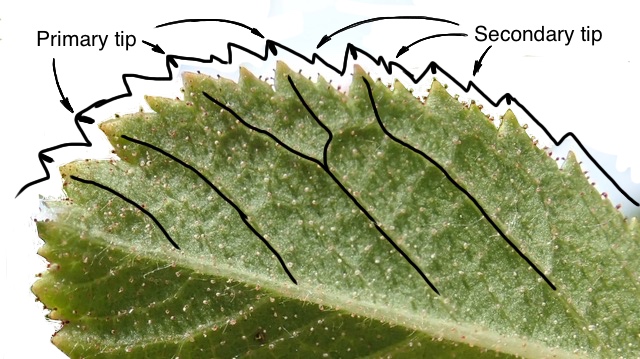
B) Biserrate is defined as having large teeth, from the lower side of each of which a single smaller tooth arises.

C) A Multiserrate leaflet has large teeth, on the lower side of which, and sometimes also on the upper side, two or more smaller teeth arise, these secondary teeth being usually gland-tipped. This type is not as well defined as the previous ones, because in some cases the secondary teeth are little more than rounded protuberances tipped with glands, and the larger primary teeth are sometimes not noticeably sharp-pointed.


One immediate problem when looking at leaf edges is that there is variation even on a single leaflet, which for example may have uni-serrate teeth on one part and bi-serrate on another.

1) R. arvensis Field Rose


Temple dome shape with base convex and concave point.
R arvensis leaflet tip showing dome shape teeth with the tips having a hydathode.

Described as crenate-serrate. Crenate means rounded. The hydathode is a hard red tip, not glandular.

Dome shape only present towards tip of leaflet.

This is not a clear cut difference but pure R. arvensis tends to have the dome shaped teeth at least on the sides near the tip. Other species share this temple dome shape but the convex base is often not quite as pronounced. Burnet Rose also has these temple dome shaped teeth but it does not occur wild in Cambridgeshire. Some Dog Rose and hybrids also show this dome shape. 
A R. arvensis  that does not show this shape might well not be pure. Those with occasional stalked glands would suggest some influence of some other species. Note also the example above has some bi-serrate sections which are less temple dome shaped.
R. tomentosa
R. canina.


2) R. stylosa Short-styled Rose


Described as uniserrate. R. stylosa  shares the dome shaped teeth but not as perfect as in R. arvensis.

R. stylosa showing Uni-serrate edges

Hydrathodes only , no stalked glandular hairs should be present.


3) R. Canina agg.  Dog Rose


Example of a Dog Rose with red tips ( hydathodes) only without any glandular tips. The secondary tips when probed were hard and did not show the normal soft sticky balls that glandular tips have. They seem to be hydathodes rather than glandular hairs. This leaf edge could be regarded as bi-serrate with alternate main teeth and secondary smaller teeth.


Example of a Dog Rose with red tips plus some stalked glandular hairs. This edge might actually fit the description of a bi-serrate edge with its primary teeth and smaller secondary teeth..
Dog Rose is an aggregate of several different variations. The additional problem in Cambridgeshire, is that the Northern Dog Rose R. cassia has hybridised with R. canina agg. and these hybrids are the most common (but variable) plants to be found.
Dog Rose showing that different parts of a leaf may have a different types of edge.
R. canina agg. can have uni, bi and multi serrate leaf edges depending on type although so far I have not found a example with a multi-serrate edge ( group Dumales).

4) R. obtusifolia now called tomentela  Round-leaved Rose.


Described as finely biserrate with numerous small, reddish-brown glands on the teeth.
The glands tend to have formed their own tips giving a multi-serrate appearance but note the glandular tips tend to occur on only one side of the main teeth. This might just about pull the description back to being biserrate. Tricky as the clear sides main tooth edge has a single glandular tip on three of the teeth seen in this photo against only two which have no secondary teeth. Secondary teeth, number two rather than the single tooth as suggested in the description of bi-serrate. I think these definitions are starting to struggle with this leaf edge. I would call this multi-serrate because the glandular hairs are generating tips of their own and not just formed straight onto the edge. 
This example has glands on the underside but this feature is lacking in several of the Cambridgeshire sites.

R. obtusifolia 22nd June Burton End, Cambridgeshire 
This example has very round leaflets but this does not guarantee a obtustifolia as hybrids can have same rounded shape. The edge appears very spiky as the teeth are quite narrow.
R. tomentella (R obtusifolia).  5th July 2020 Gamlingay Wood.
The small leaflets have some tendency towards a bi-serrate edge but it is not consistent. Leaflet shape not quite so round but still typical, with lots of overlap and hairs on both sides.

R. obtusifolia except middle hybrid leaf.  4th August Gamlingay Wood

R. obtusifolia except middle hybrid leaf.  4th August Gamlingay Wood
Many plants are hybrids Rosa canina x obtusifolia ( R. x dumetorum) so it is quite hard to find examples that really fit with Round-leaved Rose 100%.  The leaflets overlapping is probably more important than the rounded shape which is present in some of the hybrids. R. obtusifolia leaflets tend to have a dark shinny green surface with at least some white hairs on upper surface although canina agg. can have some white hairs on upper surface but normally limited to near the mid-rib. Not an easy species to nail down and not common at all in Cambridgeshire. Most of the plants at Gamlingay Wood were not 100% conforming to the required feature set of Round-leaved Rose, but a couple of plants on the east edge did seem to fit.

5) R. rubiginosa Sweet Briar


Described as strongly glandular-biserrate.  This photo above does show a bi-serrate edge. A second leaf photo below does show this with primary teeth and slightly smaller secondary teeth. It is certainly strongly glandular.


Glandular hairs are stalked and often do not form tips on leaf edge.

The bi-serrate edge  is clear  with many glandular hairs on the edge which rarely form a point of their own. R micrantha seems to have glandular hairs that form tips but at a low density, but a much larger sample of plants would be needed to see if this feature is consistent and it's a very subtle difference given the leaf to leaf variation. Whereas R. rubiginosa seems to have a bi-serrate edge, R. micrantha seems to lack this being multi-serrate. Probably not a reliable difference but worth looking for.

6) R. micrantha Small-flowered Sweet Briar

Described as glandular multi serrate. I would agree as the glandular hairs are often forming their own tips  but the quantity of glandular hairs is quite low with typical just one on the leading edge and two on the trailing edge.


R. micrantha showing glandular hairs on tips.
R micrantha showing sparse glandular tips without stalks.


7) R. tomentosa  Harsh Downy Rose


Described as irregularly biserrate.
Underside of leaflet very hairy with white matted hairs. Edge has red tipped hydathodes on the teeth tips and the teeth sides have short stalked glandular hairs which are mostly formed on small teeth of their own. Zero to a maximum of three glands per trailing edge tooth side. The leading or clear edge of each primary tooth in this case has no glandular hairs.
 Biserrate is defined as having large teeth, from the lower side of each of which a single smaller tooth arises. It is a fine distinction to multi-serrate. In this example the primary large teeth are dominant whereas the next species examples of multi-serrate edges, the secondary glandular tips make the primary teeth less dominant. This could be regarded as multi-serrate.
This is partly down to tomentosa having fewer glandular tips.
Note the lack of tiny glandular on the underside leaf surface which are hard to see at the best of times but appear to be missing in many R. tomentosa in Cambridge. Sometimes a few leaves have the tiny stalked glands whereas as many lack them on the same plant. Due to the hairs on both sides of the leaflet it can be hard to see the margin clearly but in conclusion I would say the leaf edge is bi-serrate to multi-serrate so irregularly biserrate is not far off.

8) R. sherardii  Sherard's Downy Rose.


Described as glandular-multiserrate.
Red hydathode tips as usual plus glandular short stalked hairs on tiny teeth (most of the time) do give a multi serrate look to the leaflet edge.   Between one and four glandular hairs per main tooth side. Glandular tip quite variable in size. A rather messy edge.
R. sherardii  1st September 20  Fourwentways. Cambridgeshire


9) R. agrestis Small-leaved Rose


Described as glandular-multiserrate.  The tips have the usual red hydathodes  and short stalked glandular hairs which are on the sides of the teeth without forming a separate tip of their own.  One to four glands occur on each side of the tooth. In some ways the leaflet edge is uni-serrate with additional glands as these glands only have formed on tiny teeth of their own to a very limited extent.
Without this level of magnification the leaflet edge would look glandular multi serrate. No clear edge of the main teeth appears with secondary glandular teeth on both sides although the shape indicates the right hand edge is the clear one which on average also has less glandular hairs. The leaflet tip will be to the right, indicated by the clear edge being on the right hand side.

R. agrestis 22nd August 2020 


Conclusion.

The descriptions for bi- and multi serrate  are tricky. This is recognised in the description on Multi-serrate in the handbook and I suppose the authors were somewhat constrained by previous work.
The think the main problem is due to the glandular hairs either just being on the leaflet edge or forming a point on their own. If the point is large you get the multi-serrate appearance even if the basic leaf edge is uni-serrate or bi-serrate. The example above for R. agrestis has a basic uni-serrate edge with all primary teeth the same size. The glandular hairs are mainly not forming any tips and the few that do are tiny. Because the glands are quite large in the field this edge would look multi-serrate but when enlarged and looked at in this level of detail a better description might be uni-serrate with additional glands. And that is before we consider variation.

I can't say I have found any new insights into separating these species but I am now at least more aware of the current descriptions and will pay more attention next season. Hydathodes are solid whereas glandular hairs have a ball of sticky stuff at the tip but as the glandular hair ages it will lose some of its stickiness so that it can be hard to tell them apart unless examined under a microscope. Hydathodes  tend to have a vein running up to them. As ever, you can't name a rose by only looking at its leaves, as all features have to be examined.

Peter Leonard
23rd August 2020
Rampton
Cambridgeshire.

Update  More pictures of R. micrantha.

R.  micrantha  28th October 2020. Castle Camps, Cambs.

R. micrantha  20 Oct 20 Langley Wood, Cambs