Showing posts with label Violet Identification. Show all posts

Tuesday, 24 June 2025

Fen Violet? Viola stagnina

 Fen Violet ( Viola stagnina ) or a hybrid?.  

This was one species of Violet that I had never seen. The local population in Wicken Fen has not been seen for many years and it would appear to have gone from Woodwalton Fen. A trip to the Burren in May 2018 had failed to definitely find one, although a possible hybrid with Heath Dog Violet ( V. canina) was seen in a grike.

The Burren,  below Mullagh More. May 2018

That potential Fen Violet looked good in terms of flower colour, but didn't quite in other details.

Potential Fen Violet May 2018

Another chance to see Fen Violet  occurred in June 2025, when I was able to visit Mullagh More and its adjacent turloughs again.  An even better candidate was found, however it would seem that Fen Violet at this site has largely hybridised with the more common Heath Dog Violet. This hybrid is called Viola x ritschliana.  A search south west of the road near the start of the walk to Mullagh More in a turlough, which had previous records, produced zero violets, which was disappointing. Despite the dry weather there was still water in the turlough and the edges looked like suitable habitat.

It was during a lunch break that our luck changed and a small population of about six violets was found near the turlough below Mullagh More.  R 3107 9456

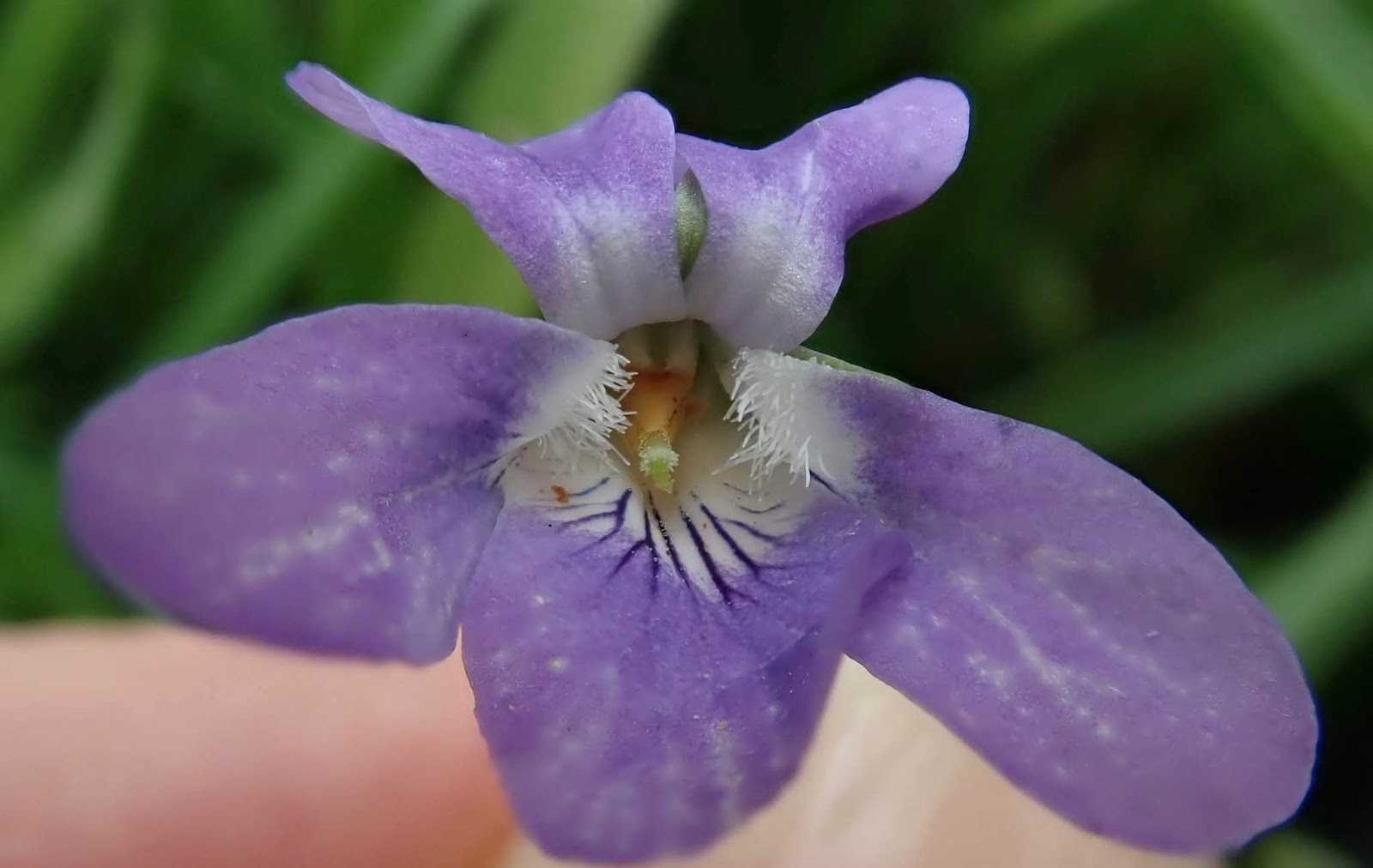
Flower Plant 1 ,  28th May 2025. 

The flowers of Fen Violet are supposedly flat but the backward upper petals on this example do not conform to that description.  The tinge of violet on the petals is perhaps slightly more than typical for Fen Violet?

Spur and sepal appendages. Plant 1. 

Fen Violet is supposed to have a short straight pale green spur, whereas V. canina typically has a trace of pale yellow. The hybrid apparently has slightly longer whitish spurs which may be decurved. This spur looks good for Fen Violet. The backward pointing sepal appendages are very big but so are those on V. canina. In fact I find that the big sepal appendages are a really good feature in V. canina when separating from other Dog Violets.  

Stipules. Plant 1.
About all I can say is, that the stipules are coarsely toothed, but so are V. canina and the hybrid. The Violet Handbook suggests that Fen Violet has hairy stipules and are up to 20mm long. The 2nd Ed. Vegetative Key to the British Flora says; Stipules to 8mm x 1 mm, usually less than half as long as the leaf stalk (petiole) but does not mention hairy.  Stipules can be useful but can vary so I don't think this photo is much help.  The literature is inconsistent regarding hairy.

Leaf Shape Plant 1.

 
Leaf Shape Plant 1.

Leaf shape, was as seen from the two photos above, a bit variable but within the 2 to 4 times as long as wide, needed for Fen Violet. The base shape also looks good. V. canina has leaves 1 to 1.6 times as long as wide. The hybrid 2 to 3 times. Our Plant 1, had leaves 3.75 as long as wide. The dimensions would support Fen Violet however descriptions of Fen Violet often refer to the leaves being very thin and pale green compared with V. canina. These leaves did not seem very thin compared with Heath Dog Violet, V. canina.

Final nail in the coffin.

Not far (2m) from Plant 1 was another group of violets.

This group seemed to fit with Heath Dog Violet with blue flowers and shorter leaves except note the pale flower to the bottom left.

Two colour flowers on same stem.

I think this photo demonstrates the classic problem with plant identification, beyond the normal problem with variation. A single plant with its genetic code, has on a single stem produced two very different flowers. The genetic code can be modified by the environment to change features know as Phenotypic Plasticity. However this plant has produced two different flowers on a single stem, so environmental conditions are the same. This is not Phenotypic Plasticity, something else is going on and I think this points to hybrids, having more variability across a single plant.  Hybrids can be fertile and features can lie anywhere between their parents. In this case, the hybrid contains features of both parents and which one wins out is anybody's guess. 

This phenomenon is common in Roses. Wild roses are all derived from hybrids thanks to reticulate evolution* and often 'species' that have been stable, have consistent features, whereas if you find a rose bush with different features on different stems it is often a more recent hybrid. This might be chimerism, a term I was not familiar with in plants. It would appear that chimera are not fully understood and quite what would explain these two different flowers on the same stem remains a puzzle.

"In plant biology, chimera is often used to denote a specific case of visible variegation called Genetic mosaicism, which is a phenomena where cells of different genetic load are present within the tissue of one plant. "


Conclusion.

The fact that all the violets were in a small group with different coloured flowers would point to all of them being hybrids. To claim a Fen Violet I think I would have to find a population of consistent plants with very pale flowers and thin leaves. It would appear that the Fen Violets around Mullagh More have been hybridised out by the V. canina and another turlough in the Burren might be a better place to search. 

Plant 2. Pale flower on stem with blue flower.

Plant 2. Blue flower on stem with pale flower.

Life is never simple.

Peter Leonard 24th June 2025

Ref BSBI Handbook No 17 Violas of Britain and Ireland. 2017 by Michael Porter and Micheal Foley.


* Reticulate evolution, also known as network evolution, describes evolutionary processes where lineages merge and exchange genetic material, creating a network-like pattern of relationships rather than a simple tree structureThis contrasts with traditional evolutionary trees, which depict a branching pattern from common ancestors. Reticulation can occur through various mechanisms, including horizontal gene transfer, hybridization, and symbiogenesis. 

A paper on Chimerism in plants can be found :-

Plant chimeras: The good, the bad, and the ‘Bizzaria’

https://doi.org/10.1016/j.ydbio.2016.07.003

Sunday, 7 April 2019

Viola reichenbachiana and V.riviniana Hybridise?

Common ( V. riviniana) and Early Dog ( V. reichenbachiana) violets have been a much debated subject in regard to intermediate plants being either variation or the result of hybridisation.

The BSBI Viola handbook covers the problems and attempts to provide a practical approach based on morphological features but concludes 'more work needs to be undertaken on the taxonomy of this group'.


I found a paper on the internet (abstract only unfortunately ) that has an interesting claim that in Europe there is no evidence of hybridisation, or that's what I understand it means. Whether this result would apply to plants in the UK is not known.  The paper was written in Eastern Europe and the UK appears not to have been one of the four countries sampled. (I have not been able to review the full paper and would not have the knowledge to understand it anyway. )

It was published in the July 2017 edition of Plant Biology.  The abstract is below the following photos of Viola reichenbachiana variation.  These plants had quite pale spurs and remarkably sharp ends to the purple veins but within the limits of variation. Short sepal appendages well within normal range of V. reichenbachiana. Just an example of variation in Early Dog Violet.


Viola reichenbachiana with quite pale spur , Brinkley, Cambridgeshire, 6th April 2019
Viola reichenbachiana with clear ends to dark veins. Brinkley, Cambridgeshire, 6th April 2019


Plant Biol (Stuttg). 2017 Jul;19(4):542-551. doi: 10.1111/plb.12571. Epub 2017 May 17.No evidence of contemporary interploidy gene flow
between the closely related European woodland violets
Viola reichenbachiana and V. riviniana (sect. Viola,
Violaceae).
Migdałek G1Nowak J2Saługa M2Cieślak E2Szczepaniak M2Ronikier M2Marcussen T3Słomka A4Kuta E4.Author information
Abstract
Viola reichenbachiana (2n = 4x = 20) and V. riviniana (2n = 8x = 40) are closely related species widely distributed in Europe, often sharing the same habitat throughout their overlapping ranges. It has been suggested in numerous studies that their high intraspecific morphological variability and plasticity might have been further increased by interspecific hybridisation in contact zones, given the sympatry of the species and the incomplete sterility of their hybrid. The aims of this study were to: (i) confirm that V. reichenbachiana and V. riviniana have one 4x genome in common, and (ii) determine the impact of hybridisation and introgression on genetic variation of these two species in selected European populations. For our study, we used 31 Viola populations from four European countries, which were analysed using AFLP and sequencing of a variable plastid intergenic spacer, trnH-psbA. Our analysis revealed that V. reichenbachiana exhibited larger haplotype diversity, having three species-specific haplotypes versus one in V. riviniana. The relationships among haplotypes suggest transfer of common haplotypes into V. riviniana from both V. reichenbachiana and hypothetically the other, now extinct, parental species. AFLP analysis showed low overall genetic diversity of both species, with V. riviniana showing higher among-population diversity. None of the morphologically designated hybrid populations had additive AFLP polymorphisms that would have indicated recent hybridisation. Also, kinship coefficients between both species did not indicate gene flow. V. riviniana showed significant population subdivision and significant isolation by distance, in contrast to V. reichenbachiana. The results indicate lack of gene flow between species, high influence of selfing on genetic variability, as well as probably only localised introgression toward V. riviniana.


An interesting abstract for fans of Violets. 
Peter Leonard
Rampton, Cambridgeshire.
7th April 2019 


Update 7th May 2020.  The full paper was sourced and the headline is not quite what the results showed. (The sample did include the UK  with about 20 plants involved from two sites. A small sample.)
 Although plants taken from what were considered hybrid populations, they did not show an sign of hybridisation. Three plants out of several hundred were regarded as hybrids.
A toxic site in Poland also did not show hybridisation unlike a toxic site in Germany which had been previously studied and did show hybridisation.

The conclusion has to be that very occasionally hybrids can occur and this is not really surprising as this study suggests that the V. reichenbachiana is a parent of V. riviniana. The other parent being unknown, probably extinct.


Friday, 20 April 2018

Hairy Violet Identification

Hairy and Sweet Violet, how to tell them apart.

A good clue is in the names of these close species, Hairy Violet has hairy leaf stems whereas Sweet Violet has either no hairs or very short hairs. Although this is basically true, in practice it is often difficult, not only because Sweet Violet is very variable but also these two close species do hybridise.
As with many challenges there is nothing like a little practice to gets ones eyes tuned in by closely looking a few plants of each species. The real problem is the hybrids can occur anywhere and are probably more common than the distribution map would indicate. Intermediate plants will occur and  many will not be the vigerous F1 type but long term stable variations produced by back-crossing. The BSBI Plant Crib 1998 states these hybrids can be quite variable and not easy to tell from either parent.

Basic ID Features.
First step is to check the sepals are blunt ended to exclude all the dog violets. This is (as far as I can tell) an absolutely reliable feature and also Dog Violets are a separate enough never to hybridise with the Hairy/Sweet Violet pair. See previous blog for diagrams of this feature.

Second feature of the Hairy/Sweet pair is that all stems come from a basal rosette unlike Dog Violets that have stems that divide (with leaves and flowers).

Sweet Violet (and the hybrid) do push out stolons ( shoots that stay close to the ground which the form another basal rosette a few cm from the parent plant.) The presence of stolons is diagnostic for Sweet Violet ( also the hybrid often have them).  Small plants of either species of course may have not developed stolons yet, also they can be hard to find if the plant is growing in grass.

What is Hairy.


Above photo shows leaf of Hairy ( Viola hirta) and Sweet Violet ( Viola odorata). The leaf stem ( petioles) are clearly different in the length of the hairs.  If all leaves were this simple.

First problem is that not all leaf stems in Hairy Violets have these long hairs, many have no hairs especially early grown leaves.  I have seen plants that have only one stem hairy and four without hairs, so it must be possible that occasional plants could completely lack this feature. Fortunately at least one stem usually shows it true hairiness.

Photo above shows Hairy Violet basal rosette with lower leaf stem showing no hairs ( lower right) and other stems with very prominent hairs. The key feature of these hairs is the length at about 50% of stem thickness (or even slightly more up to about 1mm long) and the way they sick out at 90 degrees (patent).  Best to look for the new leaves that are also hairy and have the most hairy stems. Go by the most hairy stems as the indicator.

   Hairy Violet ( V. hirta) Madingley. 31st March 2014

Example of really hairy leaf stem. Leaf shape tends to be more pointed than Sweet Violet which has a more rounded end. Any plant with these more pointed longer leaves is worth a closer look as it is a good pointer for Hairy Violets, however some pure Sweet Violets can have untypical leaf shape very similar to Hairy.  Leaves can be quite hairy as well as stems. Both species have hairs on the margin of the leaf.

Three examples based on the most hairy leaf stems present on a plant.


Photo above is a Hairy Violet leaf stem with typical hairs about 50% of stem thickness and pointing out at right angles (patent) giving it a quite spiky appearance. Some plants can have even longer hairs.


Photo above is a Sweet Violet. Short length hairs  (15% of stem thickness) are about as long as these hairs get on Sweet Violet. many plants have no hairs on leaf stems.


Photo above is a hybrid known as Viola x scabra  Intermediate length hairs  (25% of stem thickness) can occur on some stems of Hairy Violet but if this the longest hair type present probably indicated a hybrid  Hairs approx at 45 degrees to stem which gives a much less spiky appearance. Combination of quite long hairs at about 45 degrees seems a very good feature of hybrids. Hybrids are often vigorous with large leaves but not always.

The highly vigorous F1 hybrid normally have these medium length hairs at 45 degrees.

Example follow to show this.


14th April 18. Bedford Gap, Fleam Dyke, Cambs. Example from vigorous hybrid clump showing long angled hairs.

Same plant , example of flower. The very pale throat of this example is found in both Hairy Violet and the hybrids. It is also probably present in some Sweet Violet. In fact flower colour and amount of violet streaking in the throat or whether lateral hairs are present or not does not seem to help in separation of Sweet and Hairy Violets. Just too much variation present. At the tip of the orange conal appendages which terminate the anthers ( the pale part just visible ) is the style which is normally bent down at the tip. On the right of this photo is a part eaten flower as some bug has decided not to enter by the front door to get at the nectar but just eating through the spur. Quite a common route.


How do you spot a F1 hybrid, see next photos. Not that difficult. Group of Hairy Violets at Madingley.  30th April 2014. Both Sweet and Hairy are present at this site plus a few vigorous hybrids.


Secondary feature  Sepal appendage direction.
The leaf stem hairs are the key ID feature however the BSBI Handbook no 17 , Violas of Britain and Ireland lists a couple of interesting secondary features to help in separating these species. One is that the sepal appendages in Sweet Violet are patent ( that is they stick out from the stem) whereas the sepal appendages of Hairy Violet are appressed.  An immediate problem is that sepal appendages are very variable, the top one might be smaller than the side ones and they can vary in shape etc. Having taken quite a few photos of this feature, provided you only use the top sepal appendage it does seem to work. At least it holds up in the two Cambridgeshire sites I have checked , Fleam Dyke and Madingley.  I suspect that this feature is not 100% reliable?

Example of a Sweet Violet V. ordorata var. dumetorum  below


Sweet Violet sepal appendages which run parallel to the stem. In this case all the appendages are about the same in size and shape.


Sepal appendages of a Hairy Violet. Not quite the best angle but the appendages tend to bend into the stem rather than staying parallel.


Sepal appendages of a Hairy Violet ( Possibly a hybrid)  which shows appendages adpressed. This plant has the upwards end of the spur which is a common feature of Hairy Violets.

This plant was on a roadside verge near to Dungate Farm TL5599 5277 and a whole group of plants showed intermediate leaf hairs.

Based on the non patent hairs this look like a candidate for a Hybrid despite none of the plants were showing any F1 vigour.   The other strange feature was the leaf shape was not that pointed and more like Sweet Violet. The combination of leaf shape and leaf stem hairs does suggest these plants are hybrids.

Another example of a non-vigorous hybrid.


15th April 2018. Taken at East Hatley, Churchyard on a Cambridge Flora Group walk and found by Steve Hartley who immediately noticed that this small group of plants were probably hybrids.

Photo of flower follows.


Secondary Feature, Position of bracteoles on flower stem.

Mentioned in the new Viola BSBI Handbook as a feature to distinguish between Sweet and Hairy Violet, I took some measurements of 10 plants at Madingley of each species and found  it works. Sweet Violet has the bracteole above the mid point whereas Hairy has them below the mid point.
In fact there was no overlap so this looked like good news and we could forget all those problems with stem hairs.  Unfortunately increasing the sample to other sites started to point to a more complex picture, with many plants having the bracteole at 50 % whether Sweet or Hairy.  Having said that plants with the bracteole at 30% of stem hight or less were always Hairy and plants with bracteole at 70% up were always Sweet Violet so there is definitely something going on.  


Example of a white flower Sweet Violet ( var. dumetorum) showing bracteoles just below the flower ( the tiny green leaf like structure on the flower stem).


Example of Hairy Violet with bracteole at 20% of stem height. Hard to see but just possible.

Conclusion.

Based on a few years attempting to learn about the various species of Violets I have to conclude that nothing is straightforward with the identification of these species. Dog Violets are well known to present problems but probably less known is how hard it can be to separate Sweet and Hairy Violets.
Some populations can be straight forward but many are not and are probably stable hybrids. The main feature which is missed in the field guides is that Hairy Violets only have some leaf stems that are fully hairy and this adds a massive variable. This in addition to the hybrid problem really can make ID difficult.

Peter Leonard. Rampton, Cambridgeshire.  20th April 2018


Monday, 2 April 2018

Sweet Violet ( Viola ordorata ) and variants


Sweet Violet  ( Viola odorata )

Sweet and Hairy Violets form a pair of species that are distinct from the Dog Violets in having very blunt ended sepals.


The sepals are attached so a smaller part points backwards towards the stem called the Sepal Appendage and the majority points forward to protect the petals. The petal end is blunt and rounded in both Sweet and Hairy Violets.

The various species of Dog Violets have pointed sepals. The length of the sepal appendage can be important in separation of Dog Violets.


Violets can be tricky to identify as species are prone to considerable variation and hybridisation but the sepal shape is consistent and reliable to determine Sweet/Hairy Violets from Dog Violets.

This post looks at the variation in Sweet Violets based on the BSBI Handbook. 
Usually regarded as native, however the Sweet Violet has a long history of been grown in gardens and in horticulture.  Violets were grown on a massive scale in France and in Britain they were harvested for chemicals (used as an indicator and later as a scent extract) and also as cut flowers. There is a book that covers this subject , Violets The History and Cultivation of Scented Violets  by Roy E. Coombs and its covers the many of the cultivars that resulted in all this horticultural activity.

Types covered are:-
Viola odorata var. odorata  ( Standard type, violet flowers)
Viola odiorata var. imberbis   ( White variation found in southern half of Britain)
Viola odorata var. dumetorum ( White variation occurs widely, especially common at edge of range) 
Viola odorata f. lilacina ( often found where violet and white forms occur together)

I guess that at least three native forms of Sweet Violets were present before man started to breed different versions. First is the classic violet coloured Viola odorata var. odorata  and the second is the white version Viola odorata var. imberbis.  Fortunately both grow in the field behind my house plus a mixture of the two which might fit Viola f. lilacina.


Viola odorata var. odorata.      1st April 2018  Rampton, Cambridgeshire.

The standard type with violet petals has inner hairs on side petals, some hairs on flower stem, violet spur. 


Viola odorata var. odorata  2nd April 2018. Rampton,  Close up to show hairs on side petals and a bold pattern of purple veins splitting into thinner veins but still clearly defined. 


Viola odorata Var. imberbis 


Voila odorata var. imberbis     2nd April 2018, Rampton, Cambridgeshire.


A lot of flowers can have white variants but the flower colour is not the only change here, so more is going on. It might suggest variants or sub-species of Sweet Violet are evolving into separate species but have not quite reached that point.  Several differences seen on this white form are the lack of hairs at the entrance to the inside of the spur on the side petals and the lack of hairs also on the flower stem or leaf stems.  No purple veins present. Typical of this variant is the pinkish spur. This adds up to quite a few differences apart from the white petal colour.


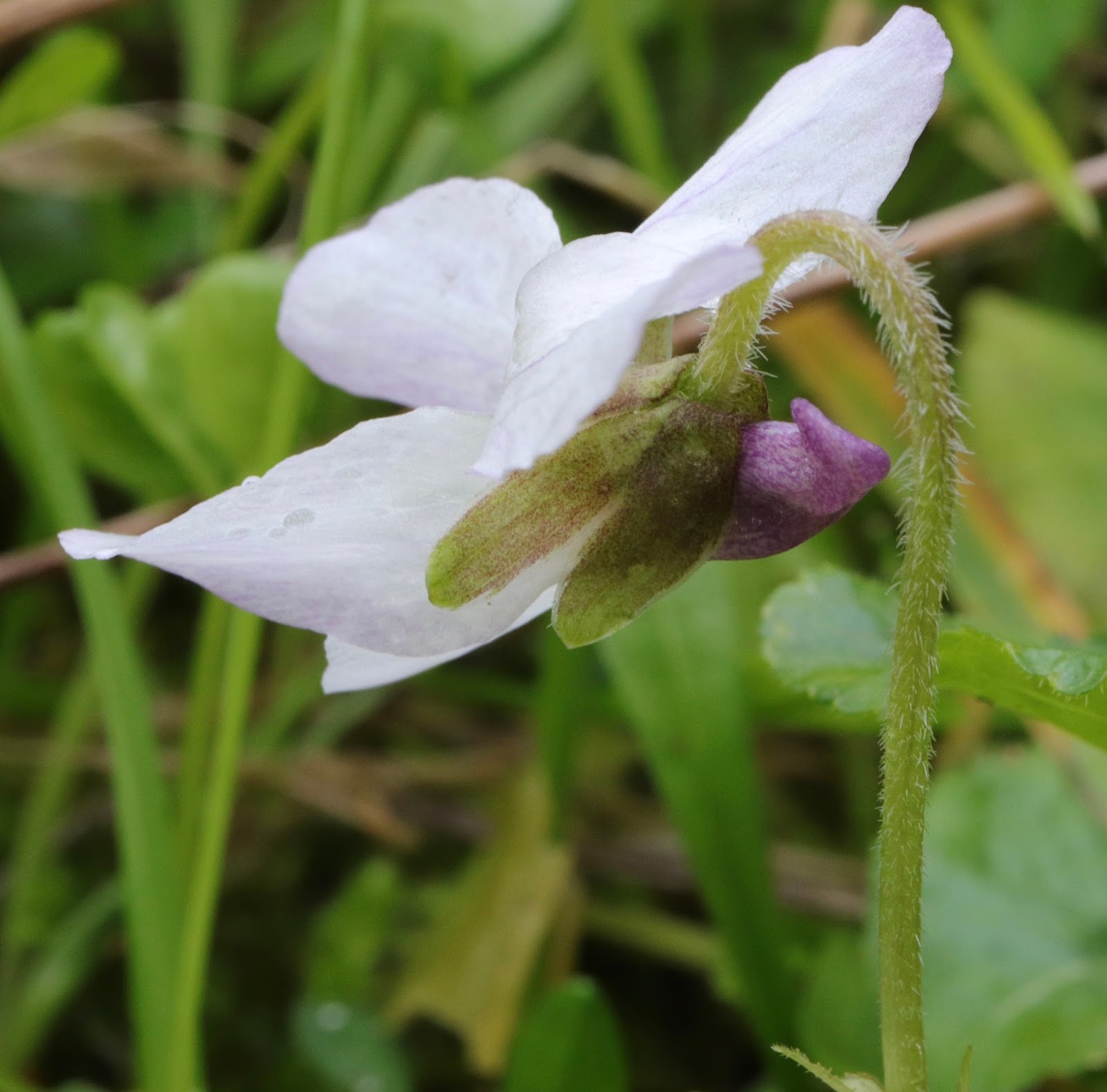
Side View of V. odonata var. imberbis showing pink spur, blunt sepals, pure white petals without any hint of purple streaking and lack of any hairs on the flower stem.


Detail of flower showing lack of inner hairs on side petals.   31st March 2018, Rampton.

Viola odorata f. lilacina (a form, possibly a mix of the above variants?)

A form rather than a variant. This particular flower was selected as it is at the palest end of the range present and grows about 20m from the normal violet and white types present in Rampton. Other plants have a more purple flushed appearance. This intermediate form may not be related to the presence of purple and white types nearby, all I can say is that they have been present for at least six years and were not planted while I have lived in the house ( 25 years).


Viola odorata f. lilacina , a pale example showing inner white hairs to side petals and hairs on flowering stem. Almost white with a few purple streaks. Spur is purple.   1st April  2018, Rampton.


Same flower but side view showing slightly distorted spur ( odd shaped spurs are often a feature of Hairy Violet  (Viola hirta ) but this may be in this case due to this form being a mixture of two variations ?. )  , purple spur colour, quite hairy stem and of course the blunt round ended sepals.


Different flower showing more purple streaking to show a more typical example. Note the inner hairs are prominent on the side petals.


Viola odorata var. dumetorum  


Not in Rampton but photographed on the Devils Ditch near Stetchworth, Newmarket. 25th March 2018.  Similar to ver. imberbis with pure white petals but different as this var. has inner side petal hairs.  Spur colour is purple and flower stem with some hairs.


Side view of same flower.

Conclusion.
Sweet Violet has several variants which have consistent characteristics and these are covered in the BSBI Handbook.  The examples covered here are more likely to be native, with other colour types probably likely to be either introductions or escapes from horticulture. Sweet Violet also hybridises with Hairy Violet ( Viola hirta ). Hairy Violets 'always' have some new leaf stems with longer and often more patent hairs however it is not always easy to separate them. The hybrids have intermediate hairs and are often vigorous but the real problem is that the hybrid can backcross and form types that range from Sweet to Hairy in their characteristics.

 Quite how two variants came to be in the field behind my house in Rampton is not known, but the intermediate form was one of the first plants I attempted to identify when I started getting into botany and this lead onto my attempts to understand Violets. I thought this would be an easy group but was totally wrong as the Dog Violets are a very complex group.  See previous blogs for more on Dog Violets.


Peter Leonard
2nd April 2018


Reference.
Michael Porter and Michael Foley.  Violas of Britain and Ireland  BSBI Handbook No 17

Tuesday, 16 May 2017

Pale Dog Violet at Lough Allua, West Cork.


Pale Dog Violet ( Viola lactea) is a rare violet in County Cork and Lough Allua is its only inland site, with some costal records from the Mizen and Sheeps Head peninsulas (ref BSBI maps).

On this years visit on 10th May only one plant was found but non flowering plants would have been easy to miss and  V lactea tends to flower later than other violets into June.


Almost pure white flower with a hint of violet, upper petals tend to be quite thin 2-3 times as long as wide. A feature which is mentioned in the new BSBI Viola Handbook is the lower petal has slight point to it (apiculate tip)  and this is clearly shown in this photo. I have not seen that in feature in other species and this a new feature to look for. The veins on the lower petal have clear purple veins with quite a lot of branching and no blurring. They are also quite long reaching about 75% down the petal before fading out.
All this looks good for a pure 100% Pale Dog Violet.


Side view of same flower showing pale yellow green spur, notched and quite short in length. Sepal appendages are just longer than stem thickness , estimate about 1.2 mm so are not as large as in Heath Dog Violet.  Sepals are pointed as in all Dog Violets.  Again all looks good.


Photo of whole plant showing leaves with tapered base ( cunate base) and apiculate tip ( broad point at tip). Leaf texture is thick and some slight purple veins showing but not as prominent as on some plants. The purple veins can also occur in Common Dog Violet.


Final shot shows habitat. Pale Dog Violet grows in gaps in the longer vegetation between the wet waterlogged shallow lake and the Gorse covered bank. This area is not the edge of main Lough Allua but a backwater.
A hundred meters south on the main Lough the violets are a different story, with Heath Dog Violets on the shore and Common Dog Violets on the dryer ground plus complications with hybrids.

Peter Leonard
16th May 2017


Wednesday, 26 April 2017

Heath Dog Violet ( Viola canina) Norfolk

Heath Dog Violet ( V. canina)  The search continues.

Armed with the new BSBI Viola Book (recently published ) I though it was time to find some pure 100% Heath Dog Violets.  I had noticed that the BSBI map was showing a few dots on the Norfolk coast in an area where I have been birdwatching in the past. The sand dunes just west of Holkham Pines is a great place  and good for a walk. Late April is a bit early for Heath Dog Violets but on arrival on 23rd April there were several hundred plants scattered over the dunes.  Not having seen violets in a dune habitat I was surprised how small the plants were, tiny leaves but almost normal size flowers.

23rd April 2017, North Norfolk Coast TF856458.  Side view showing the pointed sepals having large sepal appendages, short pale yellow spur and small leaves.


23rd April 2017.  Lower petal showing thin but very clearly defined veins. In full thickness they only continue about half way down the petal but they do continue very faintly almost to the end. No darker terminal band to the white throat. Pale yellow spur just showing and tiny leaves.


Habitat photo. Soil almost pure sand. No competition from grass yet.

This next shot shows the leaf. The largest leaf seen was only 12mm long and 7mm wide, many much smaller. Shape not typical in that only a few were seen with cordate ( heart -shaped) bases or the squared off base of more triangle shaped leaves. No basal rosette  of leaves present which was easy to see on plants growing in pure sand without any other plants around them. Thick with shallow crenate edges.    I was happy these were 100% V. Canina as all the plants looked the same without any variation.  There again nothing is 100% in Violets.

Final photo shows stipules with mainly forward pointing teeth (fimbriae) which are quite thick. In comparison a Common Dog Violet has stipules which have thinner fimbriae more hair like than tooth shaped and tend to stick out at right angles to the stipule (although some do point forward).
Leaf base on right showing slightly cordate (heart shaped) base. Due to the very small size of all the leaves at this site none seemed to have the triangular  shape often seen with Heath Dog Violet growing on better ground.


Peter Leonard.  26 April 2017