Stinking Hawk's-beard Crepis foetida Subsp. rhoeadifolia in Cambridgeshire.
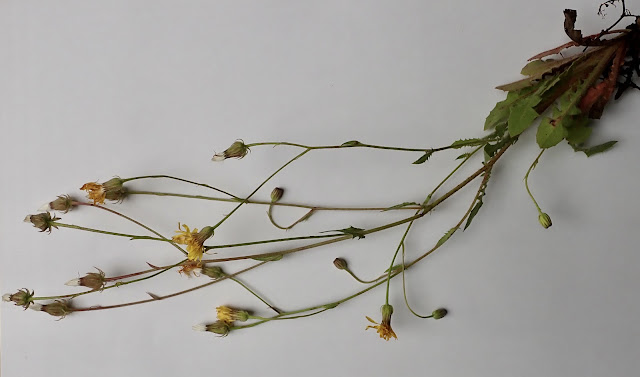 |
| Crepis foetida subsp. rhoeadifolia |
In late July 2023 the BSBI County Recorder, Jonathan Shanklin found an interesting Crepis at Hobson's Park next to Addenbrooks Hospital. With the help from Alan Leslie and his vast library, it was identified as Crepis foetida subsp. rhoeadifolia. Unlike the native species Crepis foetida subsp. foetida which hangs on at Dungeness and Rye, rhoeadifolia is a plant of central and south-eastern Europe. One has to assume it arrived in a seed mix. This sub-species has not been recorded in Britain for many years.
The crepis group are complex, with a large number of species displaying "reticulate evolution via hybridization across lineages or of incomplete lineage sorting". Where have I heard of that before? Roses!
Anyway if you want to know about the genetics of Crepis foetida and other species in this group, a PHD thesis by a lady from Libya was done at the University of Giessen in Germany and its conclusions make interesting reading even if the detailed genetics are in my case, above my pay grade and understanding.
http://geb.uni-giessen.de/geb/volltexte/2017/12573/pdf/EsklualGhalia_2017_02_20.pdf
I think the conclusion of her work, is that Crepis foetida subsp. foetida and Crepis foetida subsp. rhoeadifolia should remain as sub-species but that the third subsp. Crepis foetida subsp. commutata should be regarded as a separate species Crepis commutata.
Where both subspecies grow together, intermediates do occur. Having said that, in many places there are distinctive features that separate the two subspecies. Flower size is 20-30mm diameter in rhoeadifolia and 15-25mm in foetida, the outer phyllaries (involucral bracts) are longer in rhoeadifolia and also wider being 1-1.5mm wide against only up to 0.75mm in foetida. Both lack the translucent scales on the receptacle that are present on Crepis commutata. In practice, the outer phyllaries of subsp. foetida can be up to 1.25 mm wide at Rye Harbour.
Description.
First impressions were that this was not like any of the normal species found in Cambridge. The capitulum had a rather wide onion shape and it was still in flower at this late date. The flowers were up to 32mm in diameter, bright yellow with some red banding on outer ligules. Plants had a basal rosette of leaves and several stems with few middle and upper leaves which branch to support the flower heads.
The first photo above shows structure and some flower buds are drooping, although at this stage most flowers are beyond the 'drooping in bud' stage and are held upright. The involucre, stems and leaves all had simple grey hairs which gave the plants a grey look.
 |
| The first plant, found beside the path with prominent white pappas extending well beyond the phyllaries. |
 |
| Typical plant showing many upright stems and the greyish look. |
Crepis vesicaria ( Beaked Hawk's-beard) had long ago finished flowering and even its seed heads had lost their achenes. Crepis biennis (Rough Hawk's-beard), although later than vesicaria, had also finished flowering, except for a few late examples. Crepis capillaris (Smooth Hawk's-beard) was still in flower but with much smaller flowers.
 |
Comparison of C. biennis against Crepis foetida subsp. rhoeadifolia showing wide capitulum and
very prominent white pappus. 25th July 2023. |
Jonathan had also spotted that the outer achenes were a shorter length and less beaked compared to all the inner ones. This is a feature which excludes all native Crepis except for a sub-species of C. vesicaria called Stellata, a native of Morocco which according to Sell and Murrell, has been found in Cambridgeshire. There would be some doubt over this tentative identification, which is named subsp. gigantea in Alan Leslie's Flora of Cambridgeshire. Stellata did not fit with the plants at Hobson's Park but it took some time to exclude it. It has according to Sell and Murell, involucral bracts with dense , long and short , greenish or dark glandular hairs. It also has discoloured stigma.
 |
| Achenes of subsp. rhoeadifolia. |
The shorter outer achenes are clasped by the inner involucral bracts (phyllaries).
 |
Shorter outer achenes are held in the involucral bracts long after the longer inner achenes have blown away.
Note the cillate hairs on the receptacle. |
Flowers.
Note the yellow stigma matching the yellow of the ligules. Some darkening did occur as the flowers aged. The diameter of flowers was up to 33mm which fits the range of rhoeadifolia against foetida which has range 15-25mm.
 |
| Variation in the amount of straight simple white/grey hairs present on the phyllaries (involucral bracts) with most plants having quite dense white/grey hairs. The outer bracts are held quite close and some are quite long and the longest well over 50% of the inner bracts. This is another feature of the subspecies rhoeadifolia. |
 |
| Outer bracts are very variable in length but the longest are well over 50% of the inner. |
 |
| Phyllaries have simple grey hairs and cobwebby hairs. At this stage the phyllaries are starting to spread in the cup and saucer shape typical of some Crepis species. |
Leaves.
 |
| Basal rosette of leaves. |
The basal leaves of some Crepis species can be highly variable and highly complex. Crepis biennis ( Rough Hawk's-beard) being especially variable making leaf shape not very useful as an identification feature. It would appear that Crepis foetida has a more consistent basal leaf shape in that the basal leaves have a spade shaped tip which tapers down to its base, with triangular lobes at least for British illustrations of both sub-species. This may not be true over its whole range, as a publication on Bulgarian Flora has illustrations which show a much more irregular shape.
 |
| Crepis foetida ssp. rhoedifolia. |
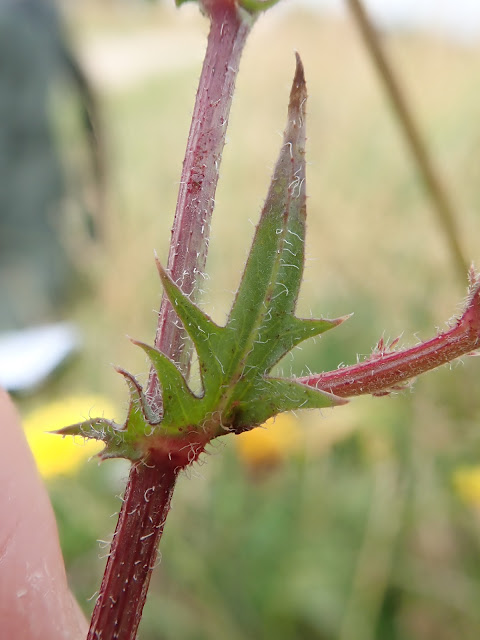 |
| Mid Stem leaf . A more pointed version of the basal leaf. |
 |
| Many hundred plants present at this site suggests it has been present for several years. It has also spread into the adjacent field. |
Differences between the two sub-species foetida and rhoeadifolia.
Not having seen foetida in the wild, puts me at a major disadvantage, so maybe next year a trip down to Rye in Sussex would be a good idea. Strangely, the re-introduction program of C. foetida subsp. foetida used plants grown at the Cambridge Botanic Gardens, however none seem to have escaped and the area around has been well covered over many years.
Rhoeadifolia can grow to 80cm whereas foetida is usually limited to 50cm. It would appear from photos of foetida at Dungeness and Rye, that it is often a smaller plant and may be greener and not so grey. Maybe the density of the grey hairs on the leaves, is a particular feature of the Hobson's Park population.
Photo Cartoon showing ID features to separate the two sub-species.
 |
| C. foetida subsp. foetida |
 |
| C. foetida subsp. rhoedifolia |
Hopefully the above photos help to document this sub-species, which was a great find by Jonathan Shanklin and he has written up a short account for the April 2024 edition of BSBI News.
Peter Leonard
Rampton, Cambridgeshire.
November 2023
UPDATE.
Visit to Rye Harbour in August 2024 was really too late in the season, but some brown remains of plants were seen of subspecies foetida. Many plants were quite small compared to the rhoedifolia plants in Cambridge, the largest is in following photo.
Crepis foetida subsp. foetida.
 |
Seed head of subsp. foetida. Rye Harbour 16th Aug 2024
|
 |
| Inner fully beaked achene of subsp. foetida. |
 |
| Outer row (less beaked) achene held within inner phyllary. |
These would appear to be same as the achene of the subsp. rhoeadifolia.
Further Update in June 2025.
Examination of plants of subsp. foetida from Rye Harbour in early June found the glandular hairs on the phyllaries were very hard to see and only 1-5% of hairs had a glandular blob of liquid. Best place to see glandular hairs was at the tips of the inner phyllaries where they were most frequent. None were seen on the stem. However by Mid-June many more glandular hairs were present suggesting that these glandular hairs develop to protect the seeds as they mature or maybe just more rain?
 |
| Close up of phyllaries from 19th June showing glandular hairs. |
Another problem with the above photo cartoon is that, in practice the outer phyllaries of subsp. foetida at Rye could be up to 1.25mm wide rather than limited to 0.75mm based on a very small sample.
 |
| Outer phyllary (Involucral bract) can be up to 1.25mm on Rye Harbour plants, Scale bars 0.5mm. |
 |
| Crepis foetida subsp. foetida flower head. 3rd June. |
Phyllaries show long grey hairs and cobwebby grey hairs on the surface but limited glandular long hairs except for some hairs at the tip of in inner phyllaries which had yellow blobs showing.
 |
| Inner phyllaries had some glandular hairs near tip, also the tips appear darker due to the tiny black dots. |
 |
| 3rd June. Two plants showing drooping buds. |
As the buds develop they turn to face upwards. The lower leaves of subspecies foetida had very thin sections between the lobes with the leaf surface cut back to the stem in some places. The terminal lobe is large and the whole leaf is hairy. The lower basal leaves tend to turn brown at flowering.
 |
| Lower leaf of foetida subsp. foetida. 3rd June. |
 |
| C. foetida subsp. rhoedifolia basal leaves. 19th June 2025. Cambridge. |
The basal leaves of the subsp. rhoedifolia at the Cambridge site did not show the very narrow sections of subsp.
foetida but had more regular triangular lobes but again the large terminal lobe was prominent.
The leaf shape may vary in Eastern Europe as indicated by various flora, so caution needed when comparing leaf shapes on any new populations if found.
The subsp. rhoedifolia appears to flower about 3-4 weeks later than the subsp. foetida at Rye.
Conclusion.
On June 19th 2025 the Cambridge site was visited and at least 40 plants were found, much fewer than in 2023 but still surviving in very dry conditions. Some local spread has occurred from the original site up to about 250m and might expand further if disturbed ground is available.
As subspecies some overlap in features might be expected but it would appear than several features can identify these two being:-
Flower diameter. Typically foetida has flowers up to 20mm diameter whereas rhoedifolia is up to 30mm, even slight more.
Length of outer phyllaries. Good to look at more than a single flower but recent photographs show much longer outer phyllaries present in rhoedifolia.
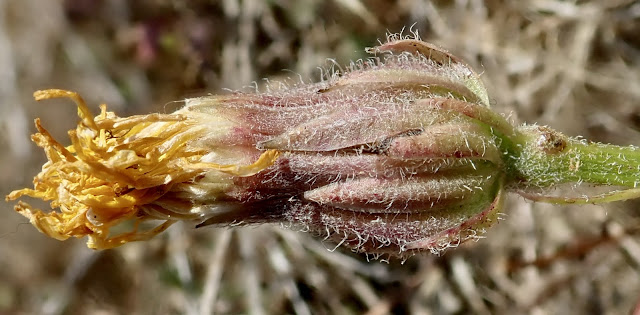 |
| Subsp. rhoedifolia showing some long outer phyllaries. |
Width of outer phyllaries. Photos and measurement has shown some overlap with subsp. foetida having widths up to 1.25mm however typical rhoedifolia has some phyllaries at 1.5mm or more.
Phyllaries having glandular hairs. This feature may be hard to see and on a very small sample seems to develop as the flower matures, but foetida has them and rhoedifolia does not.
Add in later flowering. Finally always worth checking the receptacle just in case you find scales which would indicate Crepis commutata.
 |
| Comparison shot. |
 |
| Crepis foetida subsp. foetida showing glandular hairs. Note these are do not have a separate spherical cell ( the gland) at the top but are a single celled stalk which produce a secretion. This can dry out making these 'glandular' hairs hard to see. |
June 2025.
 |
| Crepis commutata, showing scales between the achenes. April 26, Crete. |
 |
| Crepis Commutata, April 2026 Crete. |
For more details of
Crepis Commutata see separate blog.


