Showing posts with label St John's Wort. Show all posts

Wednesday, 28 September 2022

Toadflax-leaved St. John's-wort. Hypericum linariifolium.

Toadflax-leaved St. John's-wort.  Hypericum linariifolium. 

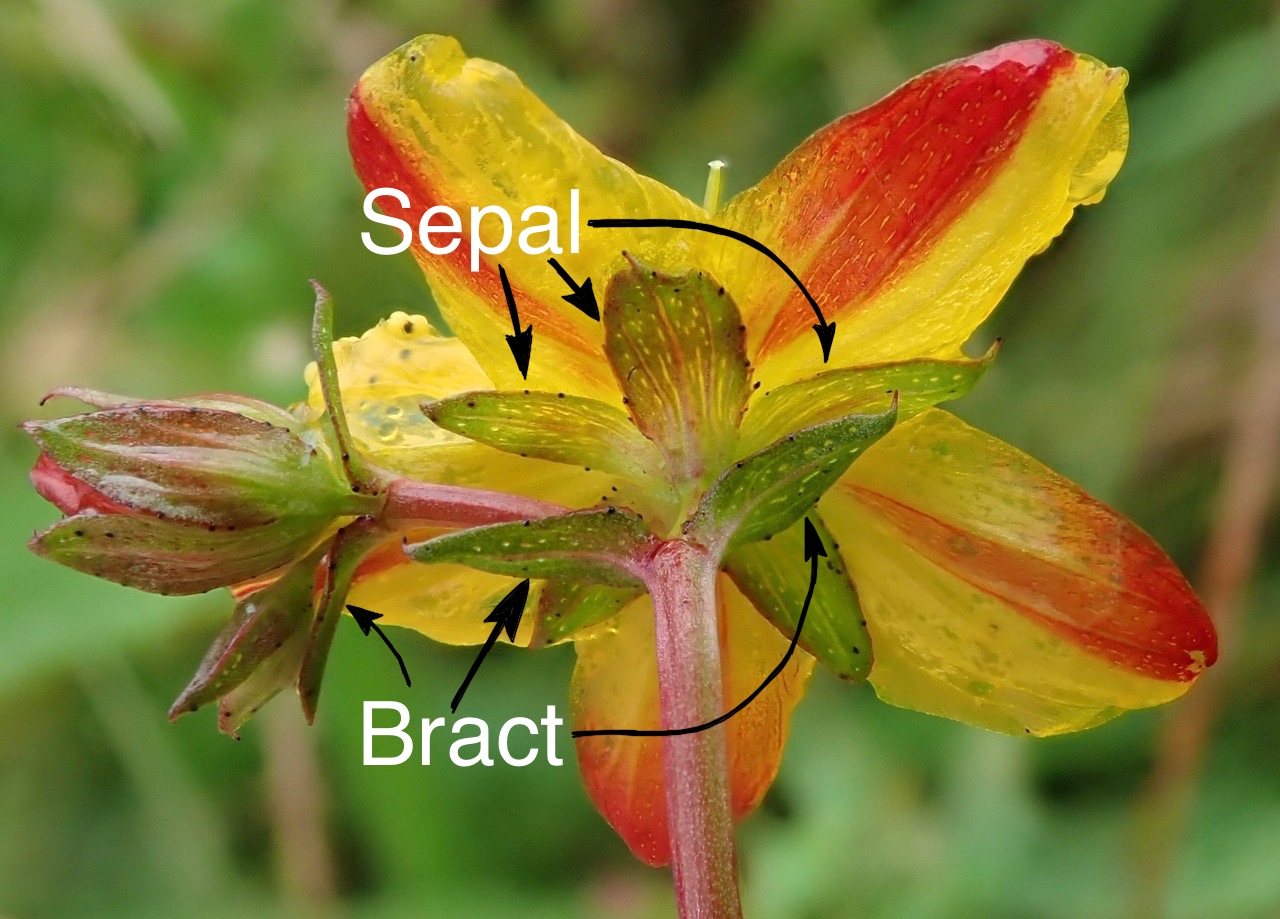
Toadflax-leaved SJW underside of flower showing sepals.

This rare St. John's-wort might be called narrow-leaved St John's-wort since this is its main feature difference, compared with other species of SJW.

 In my previous blog on SJW ID features I had to use photos from Northern Portugal since I had not seen this species in the UK.  This is not ideal as some features might be slightly different, so I decided to visit the Teign Valley in Devon to update my photos.

I had a tip off that a site close to Fingle Bridge on the upper path to Castle Drogo had a good population but this was back in 2017. In fact the BSBI database had no records in the Teign Valley since 2017.

The site was visited on the 19th July 2022. The valley side is mainly wooded but the grid reference aligned with a clear area. No plants were found but the area was very dry.

The next day I went to Dunsford Wood which has the most records on the BSBI database. This site is slightly downstream of the Fingle Bridge site but is similar in being a wooded steep valley with occasional rocky outcrops which are free of tree cover.  Several sites were checked but no plants were found. A final area just upstream of Dunsford Wood was checked and I climbed up a steep wooded slope to a clear area.

Again this site was very dry, even the heather was struggling to flower.

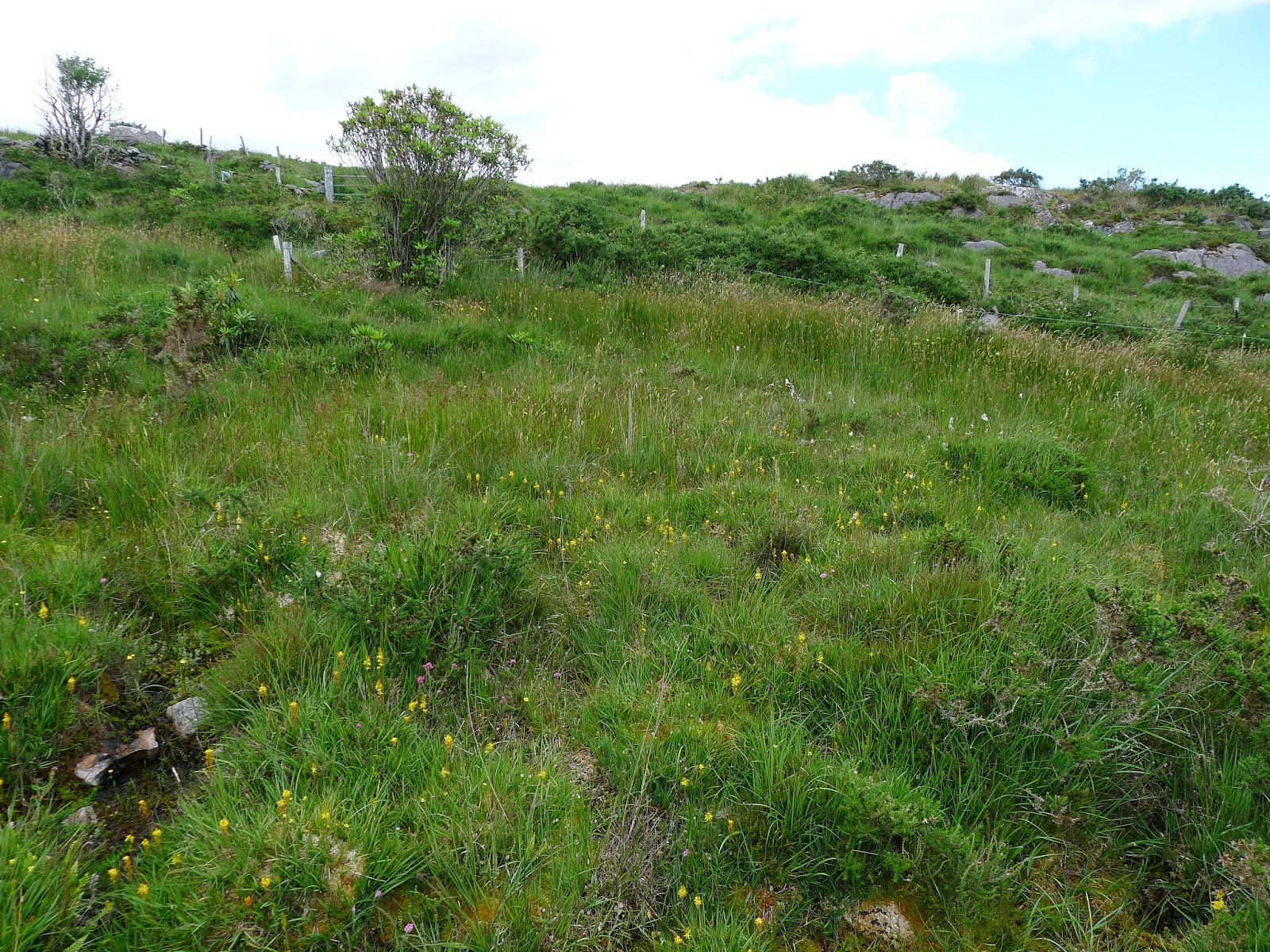
Rocky outcrop being suitable habitat.

This site was my lucky break. Three plants were found and one was in full flower.

Toadflax-leaved St. John's-wort. 20July2022

The above photo shows the main feature of the narrow leaves. The main stem is upright but other stems were prostrate. One plant was looking very dry and had no open flowers.

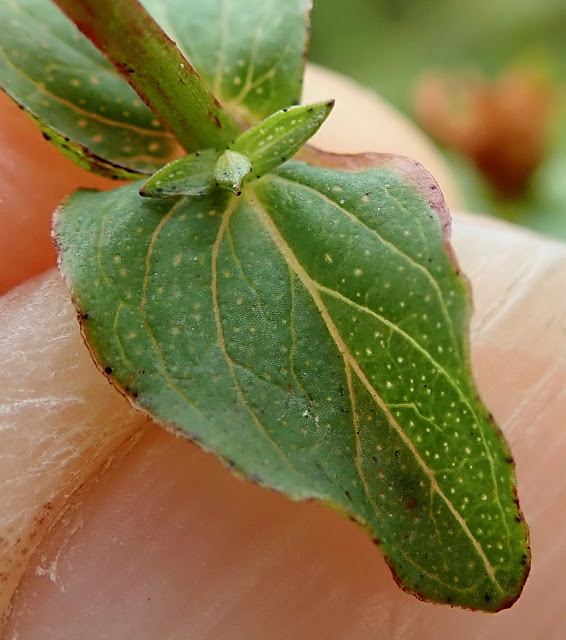
The narrow leaves were about 1-1.5cm long and had a prominent pale central vein.


Close up views of a backlit leaf shows prominent central vein and thiner secondary veins which run up the leaf. The leaves have black glands (dots) mainly on the margin but also some on the inner parts. No perforations were seen but according the the literature some can occasionally occur. The stem can be seen as round in section.The leaves are sessile and have no petiole.

The only other St. John's-wort with narrow leaves is the Irish SJW but this has no black dots anywhere.

Underside of flower. Teign Valley, Devon. 20July2022
The length of the sepals were about half the petal length, much longer than the plants I had seen in Portugal. The sepals in both countries have very long stalks tipped with the black glands. The length of these stalks seems to vary from long to extremely long as shown in above photo. Based on a limited sample of plants this would appear to be a distinctive feature. The sepals also have black lines (glands), present in both countries and the petals have lots of black glands on the margin.

This flower also has two sepal like bracts just below the sepals, a feature which seems to be common in many SJW's. The above flower is not showing any red lines on the petals which may have faded out as in bud, the petals can look red. You can just see two-three yellow anthers poking out from behind the petals.

Toadflax-leaved SJW Northern Portugal. 2017

Toadflax-leaved SJW, 20Jul 2022. Teign Valley, Devon

Final shot showing top view of flowers.

Conclusion.

I was very lucky to find any plants this year. The preferred habitat of the rocky outcrops was very dry. Maybe in a wetter year more plants would have been showing, however with no BSBI Database records from the Teign Valley since 2017, it is possible than this species is becoming less frequent. It should be well adapted to dry conditions since its range is more southerly in Europe (France and Iberian Peninsula) and Britain is at its northern limit. 

Dr Robson in his article 'British and Irish St. John's-worts' published in ' A Guide To Some Difficult Plants' by the Wild Flower Society suggests that plants on mainland Britain, seem to be pure without any signs of hybridisation with Trailing SJW (Hypericum humifusum).  Plants on the Channel Islands and a previous population on Cape Cornwall (now extinct), had either been thought to be a form called var. approximatum or possible the result of hybridisation. More recent informatiom from the 'Hybrid Flora of the British Isles', 2015 by Stace, Preston and Pearman show hybrids have been recorded from Pembrokeshire and the Lleyn peninsula, Caernarfonshire. 


Peter G. Leonard

July 2022


Thursday, 23 June 2022

St. John's-wort identification

St. John's-wort identification. Beginners Guide.

Britain and Ireland have 12 non-shrubby species of St. John's-worts plus a few shrubby species like Tutsan. All have attractive yellow flowers and many are widespread.  


Separation of these 12 species is fairly straightforward in Britain and Ireland. Species that are usually easy to identify as seperate species in Britain may not be so easy in Europe. The best comprehensive and expert guide to 'British and Irish St. John's-worts'  was written by Dr N. K. B. Robson and published by the Wild Flower Society in it's  'A Guide to some difficult plants' reprinted by Summerfield Books in 2006. The strength of this paper is that it gives a European wide perspective, written by the leading expert. 

Following, is my non-expert attempt to produce a set of identification features to separate these 12 species, based on photos I have taken.  The idea is to use it as an addition to your field guide which will include other information like flowering time and distribution maps. It attempts to give more detail than normally possible in a field guide. 

The weasel word 'fairly' appears above because this group of species has pairs that can hybridise. This is especially true of the most common Perforate SJW and the Imperforate SJW and their hybrid know as 'Des Etangs' Hypericum x desetangsii.   David J. Barden wrote an excellent paper on this hybrid, Hypericum maculatum-Hypericum perforatum complex in Cambridgeshire ( V.C. 29) published in Nature in Cambridgeshire Volume 52 2010 and available on their website.

 The key finding for me in this paper, was the range of intermediate plants that David Barden separated into five groups.  It showed me that some plants I had photographed and labelled as pure H. perforatum, were in fact not pure. It is however possible to find populations of Perforate SJW which appear pure and have no aberrant features, the 'perfect perforate'.  

As always, plant ID should be based on a range of features, as no single feature is always 100% reliable.

This Key covers leaves (perforations and black dots), petals and sepals with attention to black glands and stem profile which should be looked at mid-stem, not just at the top. Use of X10 or X15 eyepiece will be expected unless you have very good eyesight. 

Where the ID Key species boxes touch, this indicates that hybridisation can occur.

Finally the exact definition of a gland, is that it has a zone of secretion and this is clearly the case for the stalked glands on the sepals. The black dots on the leaves are also glands but I prefer to call them 'dots' because they just look like dark dots. Perforations which can be dots or lines are a feature of St John's-wort and are also glands. Glands contain hypericin and other chemicals which are an attempt to repel insects. These chemicals have been of medical interest and tend to dominate any web searches for any information regarding St. John's-wort's. 

Peter G. Leonard   May 2022 (Updated September 2022 with changes to Wavy and Toadflax-leaved SJW following visits to Devon and Pembrokeshire) 

To print each page, click to highlight and save to downloads, then print from downloads. One correction needed is the difference in perforations between tetrapterum and undulatum which looking at more plants, does not really hold. See photo below Key. A more important point would be the flowers of tetrapterum are normally very crowded (except in shaded positions) and undulatum are not. The sepal shape and the number of black glands does really seem to work.


Left is Wavy (undulatum), right is Square-stalked (tetragonum).

No difference in perforations that I can see.  The example of Wavy SJW is from a plant grown from seeds given to me at a BSBI Conference but it is possible that these were hybrid plants and the size difference seen on the real undulatum photographed in Wales, is a possibly a useful feature.

Monday, 11 April 2022

Wavy St. John's-wort. Hypericum undulatum

Wavy St. John's-wort.   Hypericum undulatum 

Wavy St. John's-wort was a species I had never seen. It has a distribution in Cornwall and Devon with some in Pembrokeshire and a very few near the coast in Mid-Wales. A trip to Ireland via Fishguard provided a chance see it, although mid-September was getting rather late in the season, some records seemed to suggest this species could still flower through September.

We failed to find any at the first site near Newgale, where we were staying. It was late by the time we arrived and started raining, so it was not a intensive search. The next day we headed off to a site near Carnhedryn;  a large area of rough wet pasture with just a few cattle.

 This provided a suitable habitat and previous records suggested it might be a good place. We only found three plants despite an intensive search but that might have been due to it being late in the season. Later that day a search on the coastal path near Tresinwen also failed to locate any plants. The site looked rather overgrown.

H. undulatum shares some features with H. tetrapterum ( Square-stalked SJW) both having a square stem with wings and these two species can have intermediate forms in the western Mediterranean. This is according to the best article on St. John's-worts, British and Irish St. John's-worts by Dr N. K. B. Robson, published by the Wild Flower Society in 'A Guide to some difficult plants'.

 In the UK hybrids have been found although they are very rare.

Wavy SJW hiding in long grass. 13Sept21 

Wavy SJW- top view of flower showing the usual yellow and black anthers.

The good news was that the odd flower was still showing petals so I could see the main characteristic of this species, the red undersides of the yellow petals. See photo below.

Note the sepal like bracts (with a thick main vein) just below the flower where the second stalk breaks off the to the left. This is also present on the bud on the left and made photographing the sepals difficult.

Although several species of St. John's-worts can have red on the underside of the petals, which give the unopened buds a red look, none have the extent of red which Wavy SJW exhibits, as shown below. This and the square stem are good features to identify this species. The petals are showing none or maybe just one black dot near the margin suggesting that black dots are few. 

Wavy SJW 13th Sept 2021


Sepals are both pointed with a distinct tip and oval in shape, with the widest point in the middle. They are also quite wide. Compare with Square-stalked SJW below.


Square-stalked SJW sepals. Narrower and very pointed with a more tapering shape. Same pale perforation lines and veins just visible and just a few black glands.  A maximum of three glands is suggested in the literature for Square-stalked SJW , whereas Wavy SJW has three plus.

Wavy SJW different plant showing wide sepals.

A different example shows sepals with more black glands on the surface. Note the oval shape, where the widest point is about half way on the sepal on the middle bud. Some tips have been lost on the sepals on the open flower. 

 Wavy SJW showing sepals and bracts. 13 Sept 21

Here again there is a sepal like bract getting in the way and hiding one of the sepals on the open flower. 

The shape of these sepals is still wide and oval and they do not just taper down from a wide base as in Square-stalked SJW. 

Stem.

Wavy SJW square stem.

Stem shape  at mid level shows a square stem with wings. Sometimes these wings have black edges.

This is similar to Square-stalked SJW which can have slightly larger wings apparently.

Wavy SJW Leaf.

Leaf showing wavy edge, a feature that was not as easy to see on these late season plants, partly due to the lack of lower leaves at this late date. The leaf is sessile but not clasping. It has many quite prominent perforations and some net veins can be seen between the major veins. It also has black dots mainly along the edge.

Wavy SJW leaf showing net veins.

Some comparison shots of Square-stalked SJW.

Flowers

Square-stalked SJW flowers. 

Flowers are crowded at the top of plant. Petals are pale yellow with no or very limited red.

Sepals are tapering and pointed and can have a few black glands, if any. 

Square-stalked SJW. 

Stem is square and winged.  The leaf is sessile but not clasping. It has many quite prominent perforations and some net veins can be seen between the major veins. It also has black dots mainly along the edge. All similar to Wavy SJW except the perforations are smaller and denser but this difference is tiny and may be too subject to variation.

Detail of leaf of Square-stalked SJW showing density of perforations.

Detail of leaf section of Wavy SJW showing lower density and slightly larger size perforations .

 Conclusion.

The combination of lots of red on the petals, less crowded flowers and a wavy edge to some of the leaves, especially lower down, separate Wavy St. John's-Wort from Square-stalked SJW. The size of the leaf perforations and density are also a feature, with Square-stalked having smaller and denser perforations but as the photos show above, this is a subtle difference and may not be reliable.

The literature suggests that the winged square stems have more prominent wings in Square-stalked but this is hard to judge and there may be some overlap in this feature. On the sample of only three plants,  it is hard to judge the sepal shape but it does appear that the sepals are more oval in shape than most Square-stalked SJW .

Separation of these two closely related species is therefore fairly straightforward however, finding a hybrid between them would be quite difficult and would require very close inspection. We are fortunate that flowers in Britain have the prominent red flushing because plants in for example Portugal, have just yellow petals. 

The literature suggests that the flower diameter is 12-20mm for Wavy SJW and 9-13mm for Square-stalked SJW. A featureI did not check on my visit.

Peter Leonard

Rampton , Cambridgeshire.

15 March 2022

Square-stalked SJW leaf showing small and dense perforations.

Wavy SJW leaf showing slightly less dense perforations.

Note the wavy edge to these leaves especially near the base of the leaf. Not easy to see. 


Friday, 9 June 2017

Hypericum linarifolium . Flax-leaved St.John's Wort

Flax-leaved St. John's Wort in Northern Portugal

9th June 2017

While on a walking holiday a brief rest stop allowed enough time to photograph a St John's Wort that did not did not look familiar. Only when looking through the photos on returning to Cambridge that I realised that I had been looking at a species I had never heard of, but one that does occur in the UK.


  The flower was typical St John's Wort and I was thinking Perforate St John's Wort as the petals had the black glands and the anthers were yellow, but the stem was round without the two ridges and the leaves were very thin. Something odd about this plant so I took some more photos.

It is always good to get a photo of the underside of a flower and this photos shows the sepals are less than half the length of the petals. The sepals have black glands on short stalks and black lines along the veins. The petals have black glands and red lines on the back. The stem is hairless and the narrow leaves are opposite on the stem and have the black glands but no translucent dots.


The leaves on the very upright stem were very narrow, almost like the Irish St John's Wort seen in Glengarriff , West Cork, but they only have three veins which run parallel up the leave and these have a more normal vein pattern.


Final shot of flower shows the five petals and the stamens , over 30 with yellow anthers. You can just make out the two of the three divergent styles with the red tips almost horizontally sticking out each side.

Hypericum linarifolium (  Flax-leved St John's Wort ) has a distribution from the North of Portugal , north through Spain and the western edge of France , especially Brittany and runs out with populations on the Channel Islands and just a few places in England and Wales as its most northern limit. Its stronghold in England is South Devon with a few outposts in Cornwall and Wales. It is also found on Maderia.

A full description of Hypericum linarifolium was found on line in the Journal of Ecology 1963 by R.B. IVIMEY-COOK.

This plant was found on 1st June on the granite hills near Chorense, Northern Portugal, on the old Roman Road.  Thanks to On-Foot Holidays for suggesting the route.
Trailing St John's Wort was also present on this Road.


Peter Leonard  9th June 2017


Monday, 2 February 2015

Irish St.John's Wort

 Irish St. John's Wort (Hypericum canadense)

Glengarriff, West Cork.   8th July 2014

I went searching for this rare plant since we were
 passing through Glengarriff while on holiday.
 It is unusual, in that it is an American plant widely
 distributed across the eastern half of Canada and the
USA.; but only found wild in two areas of Ireland.
A few locations in Europe have been found and put down to movement of  American military in the World Wars.
 More recently another site has been found in Northern England..

It was originally found in 1954 by the notable botanist,
 D.A Webb around Lough Mask in County Mayo at
 several sites. This created quite a bit of interest and
 in 1970 a visiting couple of botanist , Mr and Mrs
 Butcher found a site in Glengarriff, County Cork.

Webb and Halliday  visited the Glengarriff site in
 August 1973 and found six stations all within a 1km
 of the town.

 The story was written up in Watsonia and
from this I got directions to re-visit the site
found by the Butchers. The hillside has changed
since the early 70's with additional houses
and a deterioration of the small fields no longer being
farmed. However walking up the track we came across an wet flush area which held several
100 plants in flower.

A second site was found later that afternoon just
to the East, but both sites are being invaded
by Rhododendron and it is possible that within just a few years these sites will be lost. I pulled up a few small Rhododendron as a token effort  at control.

There is still controversy about whether Irish
St.John's Wort is a native of Ireland as argued
by D.A.Webb but to date the only sites remain
Lough Mask and Glengarriff . I find this
surprising,  if really native. There is a parallel
on the West Coast of the USA where it has also
been found, but in America these remote sites
are not treated as native.

 Ref: Wildflowers of Cork City and County.
by Tony O'Mahony The Collins Press