Wednesday, 21 November 2018

Leontodon Achene Photos

Comparison of L. saxatilis ( Lesser Hawkbit) and L. hispidus (Rough Hawkbit) achene to see if they can be used to separate these close pair of species. 


According to P. Sell in his section on L. saxatilis " The pappus of the outer achenes is the only characteristic that will always separate this species from L. hispidus. (Flora of Great Britain and Ireland Vol 4.) It would be nice to find an alternative difference, especially when confronted with
hybrids between the two species.

Previous blog on looking at hybrids between Leontodon saxatilis and Leontodon hispidus, see Hawkbits ( Leontodon) 22 Dec 2017 looked at various features of both species and their hybrids.
Shape of achene ( seed) was noted in the two following photos of the central achene.


In L.saxatilis the outer achenes have the pappus replaced with a short ring of scales. See photo below, with the outer achene lying in the bracts, often remaining long after all the other seeds have flown.


The achene shape of the outer ring of is usually curved and lacks the beaked attenuation of the central achenes.

As previously shown in the top two photos, the shape of the central achenes is different with the L. saxatilis achene being beaked or at least semi beaked. The achene has a upper section that is thinned down, unlike the L hispidus achene which gradually tappers down over two thirds of its length.

In practice there are complications. Many achenes are sterile and can be thin and pale (strange these non-viable pale seeds are often longer that the viable ones).  Others are the normal colour brown but withered and thin. There is also variation with some curved and some straight. A more detailed look at the different shape of the achenes, showed with enough magnification, the upper end of the achene where the pappus hairs spread, has possible features that are more reliable than the overall shape.
Only thick and brown viable achenes could be checked, thinner ones need to be disregarded.


L. hispidus ( Rough Hawkbit)
Achene tapers down gently to an abrupt end where the pappus hairs radiate out from the outer edge of the achene cylinder. In this photo there is no necking ( thinning) at all.
The pappus hairs radiate out and up, being quite thick structures at their base but they thin down quite quickly with thin white side hairs sticking out. The pappus hairs are pale brown. The literature says there are two rows which I found a confusing comment, until I realised, what is being referred to as a 'row' is in fact not a row at all. It is an occasional short and thin hair which sticks out just below the main ring of pappus hairs. See the lower thin and short hair sticking out to the left in this photo.


L. saxatilis ( Lesser Hawkbit)
Achene is beaked ( thinned down ) but its termination before the pappus hairs is very different in that the achene diameter thickens slightly making a definite bulge which is a paler colour. I call this a sub-terminal bulge. Then the diameter reduces quite rapidly to where the pappus hairs radiate out. The structure of the pappus hairs seems to be the same as in L. hispidus and also have the lower 'row' of shorter hairs, which can be seen in this photo.


L. hispidus pappus showing how the pappus hair structure thins down quite rapidly into a thiner but long section that has very thin side hairs sticking out.  This pattern is the same in saxatilis as far as I can see. The lower row of hairs is hardly a row but just the odd shorter hair, three visible in this photo.

This lower 'row' of shorter hairs is not present in Autumn Hawkbit ( Scorzoneroides autumnalis ) but easier differences are present to separate that species.


L. hispidus, Soham 28th October 2018
L. hispidus seed head showing the following features:-
Pale non- viable achenes, Thin brown achenes also probably not viable and healthy thick chestnut brown achenes.
The main feature is that the outer achenes have the full pappus so this is not L saxatilis.
None of the achenes have the sub terminal bulge and shape fits with normal pattern.   
All looking good so far.


L.saxatilis ,7th September 2017, Cork Ireland
In comparison, An example of L. saxatilis shows outer achene with short ring of scales rather than the full pappus and central pappus with more of a semi-beaked thinning down and just visible is the pale sub-terminal ring. The achene shape is quite limited in terms of being beaked so this is a variable feature and this photo was taken in Cork, Ireland to add a bit of geographical variation.
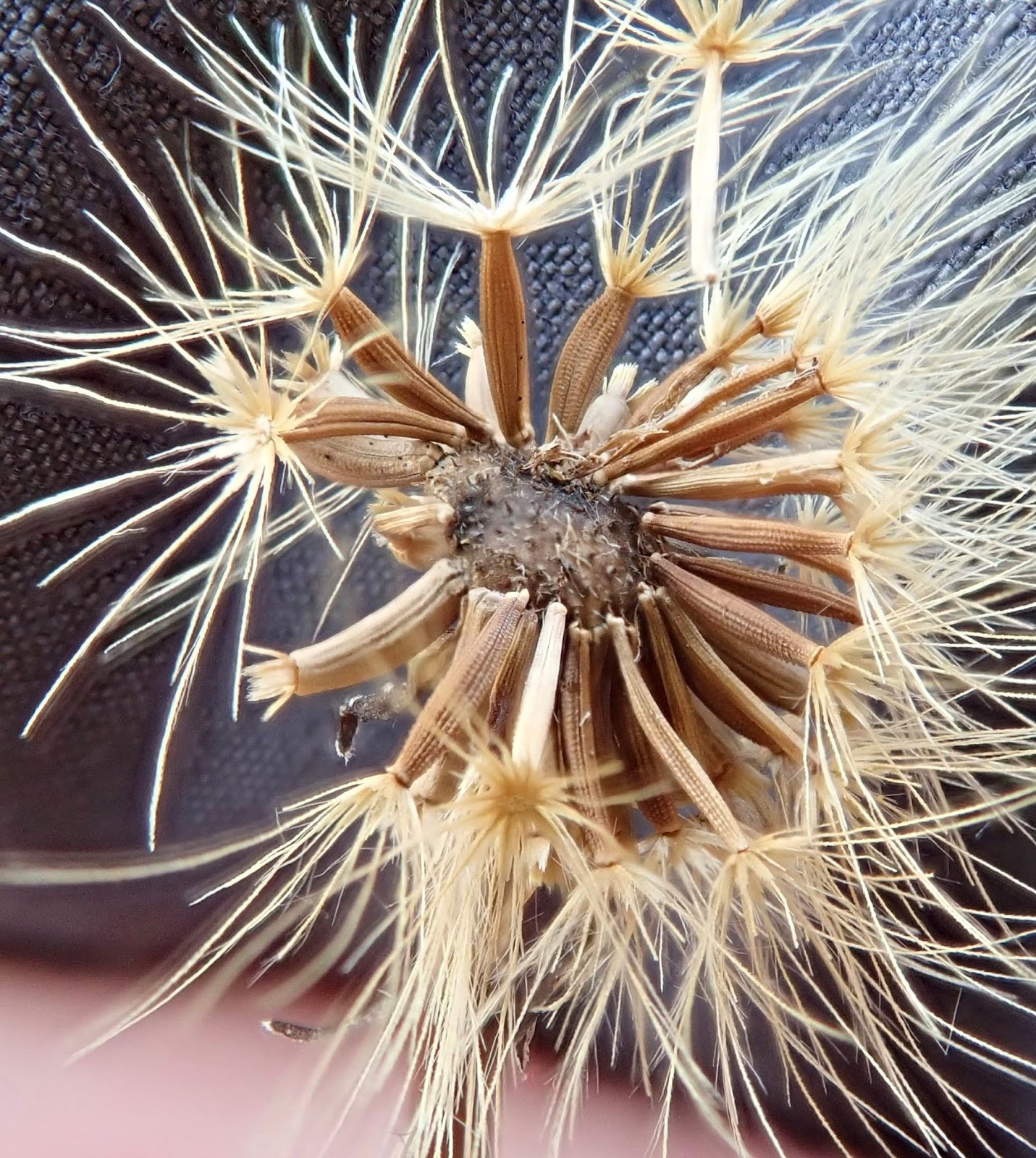


L. saxatilis  Picos, Northern Spain 6th July 2018

To go even further afield , next photo of L saxatilis was taken in the Picos Mountains of Northern Spain.  The outer achenes are clearly showing the short scales but the more central achenes are not showing the beaked shape and are more like the shape of the UK hispidus with a gentle tapering down.
Enlarged , just shows sub-terminal pale bulge.


Conclusion.    In Cambridgeshire there does seem to be a consistent difference in the shape of the achenes at the pappus end. In L. saxatilis  the beaked achenes have a sub-terminal pale band that bulge out slightly.  The problem with this feature is that it is reduced by variation when photos from Cork and Spain are considered. I suspect that if enough plants are examined in the UK some L. saxatilis will also not have beaked central achenes.
The enlarged photo above shows the achene shape is not a reliable separator as no beak is present but interestingly even this achene has a slight pale sub- terminal ring of a very subtle type, so maybe more investigation is required and the search should continue?   Or maybe P. Sell was correct all along.

One possibility is that L. saxatilis not having the sub-terminal bulge are not pure and have some L. hispidus in them which might not always show up in having mixed scales/pappus hairs in the outer achenes.  The relationship between these two species is complex. It does appear that plants which are hybrids, have achene shaped as in L.hispidus.


Peter Leonard
Rampton, Cambridgeshire, 12th November 2018
Some additional photos follow.


L. hispidus from Soham. (21st June 18)  Although most of the achenes are sterile the good ones have logitudinal  ridges more pronounced that the original example photo above. Another example of variation.

 L. saxatilis taken in County Kerry, Ireland showing sub-terminal bulge.


Example of L. saxatilis in Southern Spain (near Ronda) show sub-species longirostris which has a much more beaked achene.


Achene much more beaked  L.saxatilis  subspecies longirostris
You can just about see an outer achene on the left of this photo (at 6 o'clock ) with the short scales indicating L. saxatilis but the normal achenes are much more beaked than the more widespread sub species L. saxatilis saxatilis which occurs throughout the whole range of the species, whereas sub-species longirostris is limited to Southern Europe.

L. saxatilis sub species longirotris ( Ronda, Southern Spain)
L. saxatilis sub species longirotris ( Ronda, Southern Spain) 


L. saxatilis sub species longirotris ( Ronda, Southern Spain) 


L. saxatilis longirostris, Near Ronda , Southern Spain, 27th Oct 2015


Updated 3rd Feb 2019 with photos from Spain.


Thursday, 6 September 2018

Picos Wild Flowers (3) Western St John's Wort

Holiday in the Picos de Europa, Northern Spain ,  Day 4   July 2018.

Walking through the Garganta del Cares ( Cares Gorge) from the tiny and remote village of Cain was a spectacular walk and quickly produced a species of St John's Wort I had never seen before.


Western St John's Wort ( Hypericum nummularium )  

First Impression:   Flower was typical SJW but the leaves were very unusual.


Open Flower and bud showing sepals. 4th July 2018


Yellow petals without any streaks, margin with black glands on short stalks regularly arranged along margin (ciliate).  Petals long 8-18mm according to the Hypercium online site. This plant approached the 18mm in length.

http://hypericum.myspecies.info/taxonomy/term/849/descriptions short, amazing site by Natural History Museum professionals.

Sepals, short less than a third or quarter of the petal length, can be unequal in length, blunt ended and with margin with ciliate black glands. Bracts (tiny leaves just below flower) had ciliate black glands.


Leaves, small round discs, green on top, pale glaucous underneath with a red edge, very short stalk about 1mm long. Stems red.

Overall appearance of plant
This plant really stood out due to its very strange leaves. At least ten plants were growing right beside the main path through the gorge. I am confident in the identification as the leaves and flowers line up with the excellent description on the Hypercium online site and it is also covered in the Alpine Flowers of Britain and Europe.  It has quite a limited distribution taken from the online site map with the Picos and the Pyrenees being its main haunt and a few sites in South Western Alps in France.


Peter Leonard   6th September 2018


Friday, 31 August 2018

Picos Wild Flowers (Part 2)

More flower photos from our holiday in the Picos de Europa, Northern Spain.
30th June- 6th July 2-18

From previous blogs you might tell my two main interests are violets and yellow 'dandelions' so when I came across a slightly odd violet on the track from Puerto de San Gloria, see image below, I took a few photos. The attempted ID based, on the Alpine Flowers field guide suggested it could be Pyrenean Violet ( Viola pyrenaica ) . How wrong I was.

Track near Collado de la Guarde  


Like a Common Dog Violet with pointed sepals and a white spur, this violet lacked the slightly darker band at the limit of the white throat and overall petal colour was quite pale.


The veins are very clear and thin with some forking and extend just over half way suggesting V. canina ( Heath Dog Violet) however the leaves were rounded and definitely not V. canina.  The sepal appendages were massive and this and the lack of the darker throat band suggested this was not a Common Dog Violet ( V. riviniana).  The Alpine Flowers of Britain and Europe was consulted  and Pyrenean Violet ( V. pyrenaica ) appeared to fit. The key feature to separate it from all the other violet species seems to be the heart shaped shiny-green leaves.


The leaves on this plant certainly had large, flat heart-shaped shiny green leaves.  The leaves also seemed not to have any hairs or at least only a few short ones.

Bracteole high up on flowering stem and massive sepal appendages.


One feature that does not quite fit, is the spur colour which was white maybe with slight yellow/green tinge. The Flora Europaea suggests this species should have a pale violet spur. The description in the Flora Europaea had a more serious problem in that the sepal is blunt in V. pyrenaica which puts this species into the Sweet/Hairy group rather than the Dog Violet group.  The illustration in the Alpine Flowers book is misleading as it shows pointed sepals. More investigation using the internet shows the Flora Europaea to be correct. This plant is therefore not a V. pyrenaica. It does highlight the problem of using a single field guide to make an identification in difficult groups like violets. Also identification has to be based on the full range of features.
Dog Violet Sepal structure with backward appendage and pointed end.
In our plant the sepal appendage was larger than normally found in Common Dog Violet.


So where does this leave us.  The backward pointing sepal appendages are too large for most Dog Violets.   The leaves are unusual being as wide as they are long.

With a bit of help,  another candidate was suggested, one I had not heard of before. Viola mirabilis.
Key features are:-
 Leaves as long as wide, heart shaped, YES, margin crenate.
 Spring leaves in basal rosette, in photos all stems seem to come from the base, so YES
Stems with a line of hairs, not observed or apparent on the photos taken.  ?
Stipules. Photos not taken so don't know if conform. ?
Petals, pale violet, YES
Sepals acute and with conspicuous appendages, YES
Spur 6-8mm white.  YES


This all looks good however , habitat is mainly in woodland, on base rich soils and they are not recorded in the Picos. nearest place recorded is Eastern Pyrenees.  Looking at some of the better images of V. mirabilis  on the internet, shows details like side petals having hairs in the throat very like the example and similar vein pattern , thin with limited splitting.  One concern is that all the photos on the internet show the leaves having a pointed apex whereas the above photo shows a very blunted ended leaf shape. The other concern is that although the flower stems are not expected to have hairs, the leaves are often shown as having quite hairy stems and none of my photos show this.


Identification  will have to remain uncertain but suggestions are welcome. This is a real puzzle as nothing quite fits.

Time to look at less difficult plants ?

Further down the track and off to the right  near an outcrop of a pebble- based conglomerate rock I found a patch of a St. John's Wort. There are many species of St John's Wort.


The Petals.
The black streaks on the yellow petals exclude many of the species of St John's Wort and two possible candidates are Imperforate St. John's Wort ( Hypericum maculatum ) and Alpine St. John's Wort ( Hypericum richeri) .
The Sepals.
The sepals of the plant I found were marked with black streaks/dots all over -see photo above.   The sepals of Imperforate St. John's Wort do not have black dots/streaks just occasional black glands. The plant I found had very pointed sepals and this is a feature of Alpine SJW.


Close up of leaf base also shows the stem is round. Imperforate SJW would have a square stem. Alpine has round stem so still looking good for Alpine. The base of the leaf also clasps the stem without any sign of a stalk and this is a good feature of the H. richeri subspecies. burseri  which occurs in the Pyrenees and Picos.

Final close up shot of a unopened flower which shows the sepals with 'acute' pointed tips and cilate - ( regular arranged  hairs projecting from the margin), hairs with black tipped glands. This fits the description of  H. richeri subspecies. burseri  in Flora Europaea.  ID confirmed as Alpine St John's Wort subspecies burseri   .


One Violet lost but one St John's Wort added to the species list.


Peter Leonard    31st August 2018

Saturday, 25 August 2018

Picos Wild Flowers

Picos Wild Flowers.

The Picos de Europa , in Northern Spain  was visited from 30th June to 6th July 2018.  The main attractions are a wide range of Alpine plants and the spectacular scenery.


View north from Puerto De San Glorio


This was my first visit and under researched.  Despite this a lot of interesting flowers were seen and photographed. We stayed in Potes which was ideal being lively and well placed to visit the  main attraction of the Fuente De cable car which takes you up 800m directly to the alpine plant zone. Also visited were the Garganta del Cares ( Cares Gorge) which can be walked from Puente Poncebos to the tiny and remote village of Cain and finally the Puerto De San Glorio, a high pass south west of Potes. Ten photos follow as examples of what was seen in Cares Gorge and in the Alpine Zone at the top of the cable car.

 Day 1    Garganta del Cares.   


Little Robin ( Geranium purpureum ) which is quite a rare plant in the UK and has smaller flowers than the common Herb Robert ( Geranium robertianum).  Rather nice to see plants that occur rarely at home.
Pink Petals and yellow anthers
Shiny and no hairs
Herb Robert, Purple or orange anthers,
 petals with three pale lines.


Herb Robert, Similar shape but hairy giving it a duller look.


2) Pyrenean Germander  ( Teucrium pyrenaicum). Mint family.

Quite common from alpine zone to lower levels.


3) Alpine Toadflax ( Linaria alpina ssp. filicaulis )  A sub species found in the Picos mountains.
Bright pink toadflax growing beside the main track with grey-green leaves.

3a) Chaenorhinum Chaenorhionum origanifolium  ( Linaria origanifolia )

Another small pink Toadflax but the spur is very short and has green oval leaves.


4) Common Columbine ( Aquilgia vulgaris )?

 ID of this one is not so certain as there are several Columbine which occur in the Picos. The Common Columbine  usually has hairy stems  whereas the Pyrenean Columbine (Aquilegia pyrenaia) is more or less hairless.  A third possibility A. argonensis has densely hairy stems and flowers with short spurs. (Ref Alpine Flowers of Britain and Europe by C. Grey-Wilson.)
A closer look at the stems show these plants to be densely hairy but the spurs do not look short hence the probability that this plant is Common Columbine.

Day Two ,  Fuente De  to the Refugo de Aliva ( Alpine Zone)


5 Rock Jasmine (Androsace villosa)


The strange feature of this plant is that the centre of the flower starts yellow and turns pink then red as it matures.

6) Thyme-leaved Globe-daisy also called Creeping Globularia  ( Globularia repens)


7) Pyrenean Trumpet Gentian ( Gentiana occidentalis)


My first 'Trumpet Gentian', not the most subtle plant but distinguished from the similar Trumpet Gentian ( G. acaulis)  by the very pointed petals however there are several similar species of Trumpet Gentian and they do not look easy to tell apart. G. occidentalis  would   appear from botanical trip reports to be the only one present in the Picos mountains.

8) Fairy Foxglove ( Erinus alpinus )

This plant gave me considerable problems in my attempts to work out what is was. The upper petal is split whereas the side and lower petals are notched and this is a very odd feature. What I had not appreciated is that the split upper petal is considered to be two petals and this is a five petal flower.
When you limit your search to exclude five petal flowers and concentrate on four petal flowers you do not get very far.  Fortunately Jenny Field came to the rescue and suggested Fairy Foxglove, an alpine plant from the mountains of Spain and south and central Europe and also found as an escape in the UK. No sub-species are recognised.

9) Spring Gentian ( Gentiana verna )


This plant that I had seen before, on a trip to the Burren, Ireland in late May. Unlike the Burren where Spring Gentian is the only Gentian, and probably its most famous plant, mainland Europe has quite a few Blue Gentians and a bit more care was  required to ID the plants in the Picos. The Calyx was narrowly winged and G. verna seemed the best fit.      

10) Pygmy Hawksbeard ( Crepis pygmaea )


Final plant of the Alpine Zone was a yellow composite growing in the rocks beside the main track.
Grey hairy leaves and red tipped petals made this a very distinctive plant.

The Alpine Flowers of Britain and Europe by Christopher Grey-Wilson and Marjorie Blamey proved very useful in identification of these plants.


Peter Leonard   25th Aug 2018

Friday, 20 April 2018

Hairy Violet Identification

Hairy and Sweet Violet, how to tell them apart.

A good clue is in the names of these close species, Hairy Violet has hairy leaf stems whereas Sweet Violet has either no hairs or very short hairs. Although this is basically true, in practice it is often difficult, not only because Sweet Violet is very variable but also these two close species do hybridise.
As with many challenges there is nothing like a little practice to gets ones eyes tuned in by closely looking a few plants of each species. The real problem is the hybrids can occur anywhere and are probably more common than the distribution map would indicate. Intermediate plants will occur and  many will not be the vigerous F1 type but long term stable variations produced by back-crossing. The BSBI Plant Crib 1998 states these hybrids can be quite variable and not easy to tell from either parent.

Basic ID Features.
First step is to check the sepals are blunt ended to exclude all the dog violets. This is (as far as I can tell) an absolutely reliable feature and also Dog Violets are a separate enough never to hybridise with the Hairy/Sweet Violet pair. See previous blog for diagrams of this feature.

Second feature of the Hairy/Sweet pair is that all stems come from a basal rosette unlike Dog Violets that have stems that divide (with leaves and flowers).

Sweet Violet (and the hybrid) do push out stolons ( shoots that stay close to the ground which the form another basal rosette a few cm from the parent plant.) The presence of stolons is diagnostic for Sweet Violet ( also the hybrid often have them).  Small plants of either species of course may have not developed stolons yet, also they can be hard to find if the plant is growing in grass.

What is Hairy.


Above photo shows leaf of Hairy ( Viola hirta) and Sweet Violet ( Viola odorata). The leaf stem ( petioles) are clearly different in the length of the hairs.  If all leaves were this simple.

First problem is that not all leaf stems in Hairy Violets have these long hairs, many have no hairs especially early grown leaves.  I have seen plants that have only one stem hairy and four without hairs, so it must be possible that occasional plants could completely lack this feature. Fortunately at least one stem usually shows it true hairiness.

Photo above shows Hairy Violet basal rosette with lower leaf stem showing no hairs ( lower right) and other stems with very prominent hairs. The key feature of these hairs is the length at about 50% of stem thickness (or even slightly more up to about 1mm long) and the way they sick out at 90 degrees (patent).  Best to look for the new leaves that are also hairy and have the most hairy stems. Go by the most hairy stems as the indicator.

   Hairy Violet ( V. hirta) Madingley. 31st March 2014

Example of really hairy leaf stem. Leaf shape tends to be more pointed than Sweet Violet which has a more rounded end. Any plant with these more pointed longer leaves is worth a closer look as it is a good pointer for Hairy Violets, however some pure Sweet Violets can have untypical leaf shape very similar to Hairy.  Leaves can be quite hairy as well as stems. Both species have hairs on the margin of the leaf.

Three examples based on the most hairy leaf stems present on a plant.


Photo above is a Hairy Violet leaf stem with typical hairs about 50% of stem thickness and pointing out at right angles (patent) giving it a quite spiky appearance. Some plants can have even longer hairs.


Photo above is a Sweet Violet. Short length hairs  (15% of stem thickness) are about as long as these hairs get on Sweet Violet. many plants have no hairs on leaf stems.


Photo above is a hybrid known as Viola x scabra  Intermediate length hairs  (25% of stem thickness) can occur on some stems of Hairy Violet but if this the longest hair type present probably indicated a hybrid  Hairs approx at 45 degrees to stem which gives a much less spiky appearance. Combination of quite long hairs at about 45 degrees seems a very good feature of hybrids. Hybrids are often vigorous with large leaves but not always.

The highly vigorous F1 hybrid normally have these medium length hairs at 45 degrees.

Example follow to show this.


14th April 18. Bedford Gap, Fleam Dyke, Cambs. Example from vigorous hybrid clump showing long angled hairs.

Same plant , example of flower. The very pale throat of this example is found in both Hairy Violet and the hybrids. It is also probably present in some Sweet Violet. In fact flower colour and amount of violet streaking in the throat or whether lateral hairs are present or not does not seem to help in separation of Sweet and Hairy Violets. Just too much variation present. At the tip of the orange conal appendages which terminate the anthers ( the pale part just visible ) is the style which is normally bent down at the tip. On the right of this photo is a part eaten flower as some bug has decided not to enter by the front door to get at the nectar but just eating through the spur. Quite a common route.


How do you spot a F1 hybrid, see next photos. Not that difficult. Group of Hairy Violets at Madingley.  30th April 2014. Both Sweet and Hairy are present at this site plus a few vigorous hybrids.


Secondary feature  Sepal appendage direction.
The leaf stem hairs are the key ID feature however the BSBI Handbook no 17 , Violas of Britain and Ireland lists a couple of interesting secondary features to help in separating these species. One is that the sepal appendages in Sweet Violet are patent ( that is they stick out from the stem) whereas the sepal appendages of Hairy Violet are appressed.  An immediate problem is that sepal appendages are very variable, the top one might be smaller than the side ones and they can vary in shape etc. Having taken quite a few photos of this feature, provided you only use the top sepal appendage it does seem to work. At least it holds up in the two Cambridgeshire sites I have checked , Fleam Dyke and Madingley.  I suspect that this feature is not 100% reliable?

Example of a Sweet Violet V. ordorata var. dumetorum  below


Sweet Violet sepal appendages which run parallel to the stem. In this case all the appendages are about the same in size and shape.


Sepal appendages of a Hairy Violet. Not quite the best angle but the appendages tend to bend into the stem rather than staying parallel.


Sepal appendages of a Hairy Violet ( Possibly a hybrid)  which shows appendages adpressed. This plant has the upwards end of the spur which is a common feature of Hairy Violets.

This plant was on a roadside verge near to Dungate Farm TL5599 5277 and a whole group of plants showed intermediate leaf hairs.

Based on the non patent hairs this look like a candidate for a Hybrid despite none of the plants were showing any F1 vigour.   The other strange feature was the leaf shape was not that pointed and more like Sweet Violet. The combination of leaf shape and leaf stem hairs does suggest these plants are hybrids.

Another example of a non-vigorous hybrid.


15th April 2018. Taken at East Hatley, Churchyard on a Cambridge Flora Group walk and found by Steve Hartley who immediately noticed that this small group of plants were probably hybrids.

Photo of flower follows.


Secondary Feature, Position of bracteoles on flower stem.

Mentioned in the new Viola BSBI Handbook as a feature to distinguish between Sweet and Hairy Violet, I took some measurements of 10 plants at Madingley of each species and found  it works. Sweet Violet has the bracteole above the mid point whereas Hairy has them below the mid point.
In fact there was no overlap so this looked like good news and we could forget all those problems with stem hairs.  Unfortunately increasing the sample to other sites started to point to a more complex picture, with many plants having the bracteole at 50 % whether Sweet or Hairy.  Having said that plants with the bracteole at 30% of stem hight or less were always Hairy and plants with bracteole at 70% up were always Sweet Violet so there is definitely something going on.  


Example of a white flower Sweet Violet ( var. dumetorum) showing bracteoles just below the flower ( the tiny green leaf like structure on the flower stem).


Example of Hairy Violet with bracteole at 20% of stem height. Hard to see but just possible.

Conclusion.

Based on a few years attempting to learn about the various species of Violets I have to conclude that nothing is straightforward with the identification of these species. Dog Violets are well known to present problems but probably less known is how hard it can be to separate Sweet and Hairy Violets.
Some populations can be straight forward but many are not and are probably stable hybrids. The main feature which is missed in the field guides is that Hairy Violets only have some leaf stems that are fully hairy and this adds a massive variable. This in addition to the hybrid problem really can make ID difficult.

Peter Leonard. Rampton, Cambridgeshire.  20th April 2018