Tuesday, 24 September 2019

Dovesfoot Cranesbill vs Small-flowered


Additional notes and photos on flowering Geraniums to support the ID Key features Blog.
Hedgerow Cranesbill

The ID Key features blog, August 2019 is a reduced set of features to distinguish between all the wild Geraniums found in the UK when in flower.
Additional features and photos are included here to give a more complete picture of the differences.

Three species are covered in this blog which share a common feature in that they do not have extension tips to the sepals.
The leaves are cut to 2/3rd towards base and are of a similar shape.
Dovesfoot Cranesbill ( Geranium molle)
Small-flowered Cranesbill ( Geranium pusillum)
Hedgerow Cranesbill ( Geranium pyrenaicum )


1) Dovesfoot Cranesbill ( Geranium molle)

Petal colour is often the first clue in separating G. Molle from G. pusillum, normally being a deep pink, however white forms are common with intermediate colours also common, including some with a pale purple tinge.
Small-flowered, (G pusillum) often have a blue tinge in the petals which are also often narrow with a gap between them.

Small-flowered G. pusillum in all the photos I have taken, have had a pale off-white stigma whereas G. molle have had a pink or reddish purple stigma, only once has a plant been found with a pale stigma.
White form but still with re/purple stigma. 


Stigma colour is not mentioned in the literature as a method of identification which is surprising but  some Dovesfoot Cranesbill rarely may have a pale stigma.  An example follows but they are infrequent.
G. mollie with pale stigma. 15th May 2020. Cambridge

Occasionally the petals may not have the notch, see the comments and photo at the end of the ID Key August blog.

The style splits into 5 curved stigma arms at the centre of the flower, with the stamen filaments holding the anthers arranged round the stigma in two rows. G. Molle has ten anthers whereas G. pusillum has only five of its ten stamen filaments having anthers. Anthers do fall off (after splitting to reveal pollen) so this feature may not be a clear cut in some flowers.


A pale pink version that is quite unusual. 24th June 2019, Cambridge.

Normal deep pink colour, Ten blue anthers present.

Each petal has five pale green veins from the green base.  Only five of the ten anthers showing probably because the first five have already fallen off having split. This can occur quite quickly and possibly most flowers are self-pollinating in these smaller geraniums.
Ten anthers present , 5 have split and have revealed their pollen and the other 5 are held lower into the flower and line up with the petal centre lines.   22nd Sept 2019 Rampton.
Note the overlapping petals have 5 veins which can be paler or darker than the pink of the petal and this may be dependent on the angle of the light. Some veins do split but not as much as the veins in the larger flowered Hedgerow Cranesbill ( G. pyrenaicum)  which shares quite a few features with G. Molle.  A significant difference is that the sepals on G. molle have long hairs whereas G. pyrenaicum has only short hairs ( many glandular ) .
Hedgerow Cranesbill (G. pyrenaicum) has flowers twice the size of  Dovesfoot Cranesbill (G.molle) and the sepals are shorter relative to the length of the petals. Size is always a dangerous parameter in plants as growing conditions can change some features more than others. Often flower size is largely maintained even when produced from tiny malnourished plants.

Hedgerow Cranesbill (G. pyrenaicum ) with short hairs on sepals. 

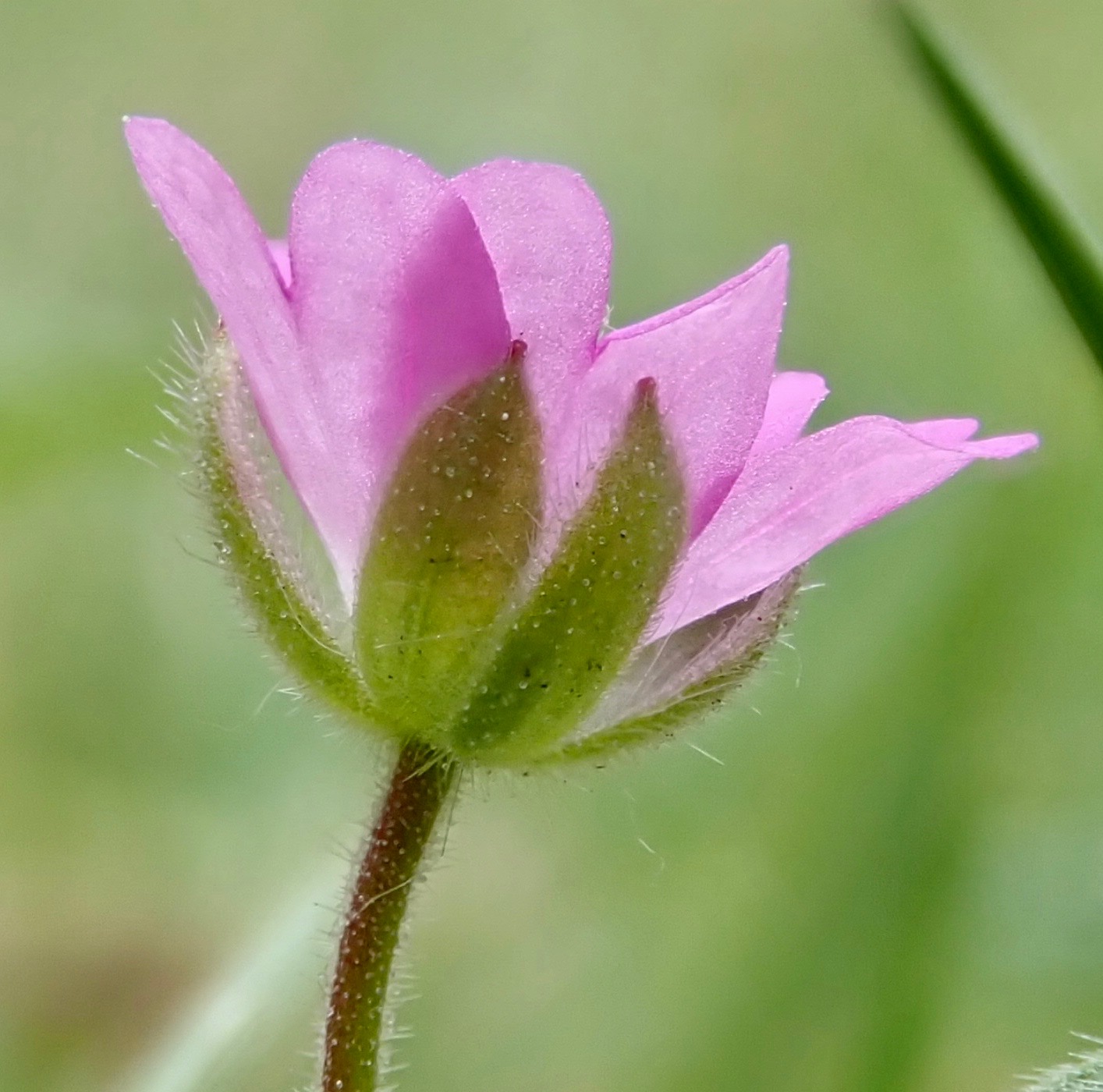
Side view showing tips of the sepals just short of the petal notches, approx 2/3rd of the lengths of the petals.
Side view, note long hairs plus short glandular hairs on sepals, a feature shared with G. pusillum.


Flower and leaf stems have 3 hair types, short glandular hairs, short simple hairs and very long hairs.
Mericarp at base of beak showing wrinkled groves and the impossibly small hairs which the photo does not show.
The seeds are held inside the mericarp case.  G. Molle.
Comparison of mericarp at same stage showing the lack of groves and abundant hairs for Geranium pusillum.
The both cases a sepals has been pulled back to show the mericarp.


2) Small-flowered Cranesbill ( Geranium pusillum)

Small flowers and no long hairs on flower and leaf stalks, separate pusillum from molle.  Leaf shape has been used in non flowering plants, as a identification feature but I found this too difficult. Much easier to use hair length.
 The leaves are split to 2/3rds towards base and are very similar to G. molle.   The flowers are small and the three veined petals have either no or very limited overlap. G Molle petals often overlap but there is variation with some having no overlap.  The sepals have long hairs plus short glandular hairs much like G. molle. 


G. pusillum, white 5 pointed stigma with 5 anthers only as the other 5 stamen lack anthers. Hard to see in this photo.
Side view showing sepals nearly as long as petals. Long hairs on sepals.
G. Pusillum showing pale stigma and five anthers. 13th June 2019, Rampton


G. pusillum, leaf stalks which have no long hairs, just short hairs (glandular and non-glandular).


Section of flower stem and sepal at base of flower showing hairs.

Flower stem hairs, a dense combination of straight simple hairs and glandular hairs , all short.


Typical leaf from a small plant growing in a gravel drive.
More complex leaf of G. pusillum growing in good soil.
Leaf shape is variable but certain features hold, like the 2/3rd cut towards base.

Hairy mericarps attached to the beak. G. pusillum, Rampton 24th Sept 2019


3) Hedgerow Cranesbill ( Geranium pyrenacum)

In practice this is not a difficult species to identify. It is much larger than G. molle and the flower colour is more normally purple/pink  than red/pink.  It does share quite a few features with G molle  hence its inclusion here.

G. pyrenaicum showing similar shape to G. mollie but much larger and with more prominent veins.


Geranium pyrenacum pale form
Side view of pale form of G. pyrenaicum 


Normal pink flower showing the inner 5  anthers having split and the outer 5 still intact.
Note the stigma has not opened. 

The photo above shows the Hedgerow Cranesbill follows other larger cranesbills in that the stigma is not open to receive the pollen from the split anthers at least at first, suggesting pollination is dependent on insects rather than self-pollination that may occur in the smaller species like G. molle.


First 5 anthers have fallen off and the second set of 5 have split open. Stigma has also opened with its 5 pale pink arms. The Hedgerow Cranesbill seems to have a more complex timing arrangement of pollen and stigma availability,  but from a identification view only, the stigma is pale pink and has thinner longer arms than G. molle.


Short hairs, mainly glandular on flower stalks.


Leaf stalk has 3 types of hairs, with short glandular and non-glandular plus long simple hairs which are slightly
stronger and less wispy than those of G. molle.


G. pyrenaicum .  Leaf split into in this case 7 sections by cuts up to 2/3rds. 

Leaves can be split into from 5 to 9 lobes/sections depending on how deep the cuts go and this is open to different points of view, as you can't use the vein structure to give a clear result.


Seeds just before they get thrown from the mericaps.
4) Conclusion.
As usual, I use the excellent 'Harrap's Wild Flowers' as my constant companion in the field.
Additional information on Geraniums was also found in 'Hardy Geraniums' by Peter F. Yeo which has detailed introductory chapters on the family. It covers both wild and cultivated types.
I am fortunate that both G. Molle and G. pusillum both grow in my gravel drive here in Rampton.
I suppose the good news is that to date, none of these three species has hybridised so identification should be straight forward. It is just a matter of remembering the key features which is why I made up the ID Key blog in the first place. Please comment if you see any incorrect assumptions.

Peter Leonard
Rampton, Cambridge
24th September 2019


Hedgerow Cranesbill from Picos Mountains of Northern Spain show pale centre.

1st July 2018. Picos Mountains.


Friday, 30 August 2019

Summer flowers on Beara Peninsula, West Cork

Just a few holiday photos from the Beara Peninsula in West Cork.  July and August 2019
Some common , some rare but all, taken as they are attractive in there own right.


Bog Pimpernel, Hungry Hill, 9th July 2019
This is not the normal pale pink Bog Pimpernel ( Anagallis tenella) that is a common plant on Beara but a much darker red colour. I have never seen one this colour before.

Kidney Saxifrage, Hungry Hill, 9th July 2019
Kidney Saxifrage ( Saxifrage hirsuta) is a a rare plant and was found in a deep gap under a large rock where the sheep could not get to it. It is found in Kerry and West Cork ( mainly on the Beara Peninsula) , the Pyrenees and Northern Spain.  It can hybridise with St Patrick's-cabage but this group look pure to me. Probably the most exciting find of the summer holidays.


Crowberry (Empetrum nigrum) 3rd July Allihies, 
Crowberry is a rare plant in West Cork and known from the top of Dursey Island where I have failed to see it.
A more assessable  site is the old mine working of the Dooneen Mine on the coast at Allihies. The Dooneen Copper mine opened in 1812 was the first mine at Allihies. At its peak the Allihies Mines  were employing over a 1000 people with its ore exported by boat to Swansea. 

A Dactylorhiza Orchid 3rd July Allihies, Dooneen Mine.
 This is now called Irish Marsh Orchid ( D. kerryensis) by that nice Mr Stace in the 'New Flora of the British Isles Edition 3 (2010)'.  This broad leaved orchid has previously been called Dactylorhiza majalis ssp occidentalis, then it gained full species status, Dactylorhiza occidentalis . The Sherkin Beginners Guide to Ireland's Wild Flowers called it Broad-leaved Marsh Orchid which is a suitable common name.
Basically everybody was so confused that this orchid was not really recorded so its distribution maps are vastly understated.  

Close up of flower with quite heavy lines?
Additional problems are that the Irish Marsh Orchid hybridises with the other common orchid in West Cork, the Heath Spotted Orchid.  Both species and the hybrids are quite common in West Beara.                


Bell Heather, Garnish. 4th July 2019
With its deep pink colour Bell Heather ( Erica cinerea) is a common plant which often grows with Cross-leaved Heather ( Erica tetralix ).

Cross-leaved Heather, Garnish, 4th July 2019
Paler pink and with hairy sepals makes it easy to spot Cross-leaved Heather.  You can just make out the red glandular tips to the sepal hairs.

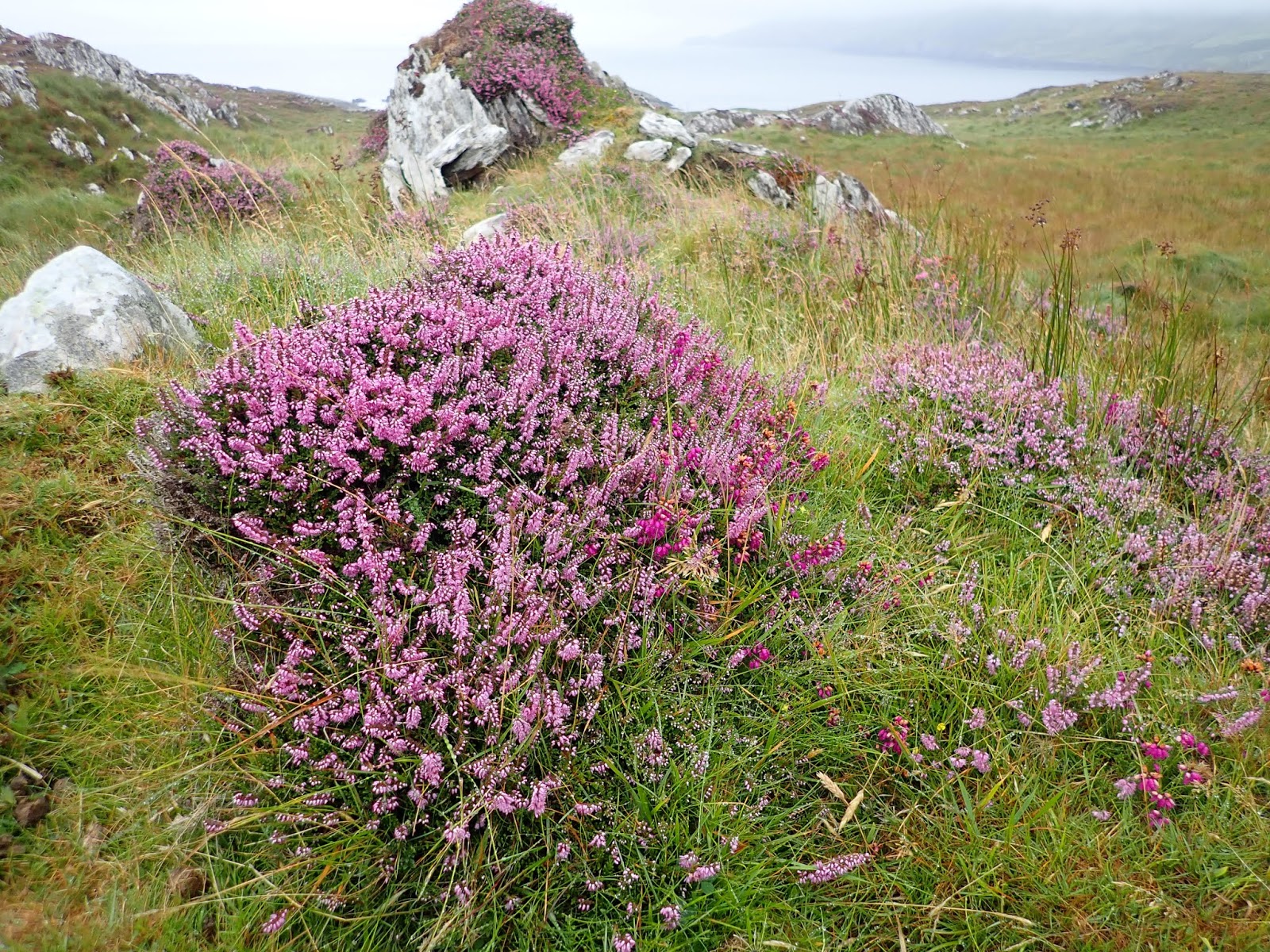
Heather, Garnish 13th Aug 2019.

Heather ( Calluna vulgaris) also called Ling have flowers that form lines up the stalk and a different leaf shape. Heather tends to flower later than Bell and Cross-leaved heather.

Heather with some Bell Heather with darker pink flowers. Garnish, 13th Aug 2019

Rock Sea Spurrey, Garnish, 4rd July 2019
Rock Sea Spurrey ( Spergularia rupicola) is a common rock plant near the sea in Garnish.   The other species of Spurrey, Greater and Lesser are rare in Beara and found on salt marsh rather than rocks. I have never found them. 

Pale Butterwort, Garnish , 6th July 2019

Pale Butterwort ( Pinguicula lusitanica ) is a tiny plant of wet flushes and bogs and is quite common in West Beara  but very easy to miss unless you go looking for it.  

Marsh St John's-wort, Cod's Head, 6th July 2019
Marsh St John's-wort ( Hypericum elodes)  is a very common plant in West Beara, found in wet areas.

Possibly Scots Pine, Hungry Hill. 16th Aug 2019

Half way up Hungry Hill on the East side is a peat bog where peat is being dug out. Several old tree stumps are present. Possibly Scots Pine showing this area was forested several thousand years ago.


Chamomile ( Chamaemelum nobile) is common on the tracks and paths around West Beara but a display like this is  the best I have seen. Dursey Sound in the background. 


To finish a view from the Atlantic of the tip of Dursey Island and the Cow Rock on the left.

Peter Leonard
Rampton
Cambridgeshire
August 2019


Friday, 9 August 2019

Geraniums and Storksbills Key Features


Notes.

Back in 2013 when I first started out taking photos of flowers, I had problems working out the identification of a Cut-leaved Cranesbill which had no petal notches, although I managed to work out what it was in the end. This was my first Geranium to be identified.
Since then I have learnt about using the hairs to separate Dovesfoot from Small-flowered and I thought I was familiar with this group.  My knowledge was really only skin deep and I would forget which species had the long hairs and had to open up Harrap's Wild Flower to check. It is hard to improve on the field guide which contains all the required information but the above is my attempt at a simple cut down reminder on how to separate Geraniums (and Storks-bills).  Different botanists have there own methods and these may be better than the ones I use, however I am puzzled that some effort goes into separating the leaf shape of Geranium molle from Geranium pusillium when the hairs on the flower and leaf stalks are an easy distinction.  I failed to find a reliable difference in leaf shape which was really reliable, so I decided to comment on the Key, 'Shape as Dovesfoot above'.   Leaves become more complex in shape in larger plants. Winter leaves can be much simpler in shape especially in Cut-leaved Cranesbill ( G. dissectum) when it becomes very similar to G. molle.
Geranium pusillum, large leaf.
Geranium molle with little petal notching. 26th June 2019, Landguard. 


Over the last six years I have learnt that flowers do not always follow the rules and as a beginner this can be very confusing. The first statement in this Key is that Geranium molle has 'Deeply notched petals' .

While searching out Sticky Storksbill at Landguard Point in Suffolk I came across a Geranium molle that showed very limited petal notching and I have seen this before, so I changed the first statement to '98% Deeply notched petals'. It is rare, but a warning that plants do not always follow key points. The petals are quite narrow and do not overlap which slightly unusual for G. Molle.

During this Summer project I have found and photographed four new species to complete the list. Wood Cranesbill was seen on a trip north to see Northern Hawk's-beard.
Musk Storksbill was found locally near Cambridge whereas Sea Storksbill required a trip to Minsmere RSPB Reserve in Suffolk. The final species, Sticky Storksbill proved the most difficult and 
is really hard to separate from Common Storksbill. A separate blog covers my problems and it highlights the variability of coastal Common Storksbill and the fact that at Landguard the key feature of how much the mericarp hairs overlap the pit is tricky to say the least.

I am not a Geranium expert so this should be seen as my attempt to learn and document what I have found. Please let me know using the comment field if you can see any mistakes in the ID Key so I can correct them.


Peter Leonard
Rampton
Cambridgeshire
Aug 2019

More detailed information can be found on these backup blogs:-
I have added a new blog covering Dovesfoot, Small-flowered and Hedgerow Cranesbill on this site. 
Another blog looks at Round-leaved, Long-stalked and Cut-leaved Cranesbill, all having long sepal tips.

New blog covering Herb Robert and Little Robin added May 2020. See under Geranium & Storksbills tag.