Saturday, 16 February 2019

Hawksbeards ( Crepis capillaris, Crepis vesicaria , Crepis biennis)


Hawksbeards.                                                                                      Yellow Composites ID article 

The Hawksbeards ( Crepis) species group are difficult to identify.
Crepis capillaris    Smooth Hawksbeard
Crepis vesicaria    Beaked Hawksbeard
Crepis biennis        Rough Hawksbeard

Separating Beaked from Rough Hawksbeard can prove a challenge.
 Fortunately they do not hybridise so we are left with just variation to contend with.  They also look similar to other yellow composites, especially the Hawkweed group.  The Crepis group ( well at least the three covered here) has two rows of involucre bracts (called phyllaries in Stace) , the outer being spread out, whereas the Hawkweeds tend to have all the bracts held tight and in more rows.


Hawkweed ( Burren, Ireland)
Hawkweed ( Royston, UK)
Crepis vesicaria ( Cambridge)
Crepis capillaris ( Cambridge)

The similar feature with Crepis and Hieracium ( Hawkweed) at least in terms of flowers heads is:-
Dark (sometimes glandular) hairs ( simple , no splits)
White hairs (sometimes glandular) ( simple no splits)
Cobwebby white hairs ( arachnoid hairs).
Differences are outer bracts spreading and white pappus hairs in Crepis. Achenes are very different.
Hawkweeds are an even more difficult group than Crepis and are only mentioned in passing as they need to be excluded first.

1)  Crepis distribution.

The three species covered here are wide spread in the UK, Smooth Hawksbeard ( Crepis capillaris) is very common throughout Britain and Ireland, Beaked Hawksbeard ( Crepis vesicaria ) is common in England and Wales but less so in the North but present in Ireland whereas Rough Hawksbeard (Crepis biennis)has a much more patchy distribution mainly in England and some in Ireland.
There are two other species with more northern distributions not covered here  Crepis paludosa, Marsh Hawksbeard and Crepis mollie, Northern Hawksbeard which are well covered in the excellent blog which also includes comparison with Hawkweed :-
cumbriabotany.co.uk.   Article on Northern Hawk's-beard (left side menu).

2)  Structure.

The basic structure is one or more major stems splitting into branches with numerous flowering heads and with leaves at the base and at branching points. Size can be highly variable especially Crepis capillaris which can have robust large plants up to one meter high or can be tiny lawn plants just a few cm high. Crepis capillaris is generally a more slender plant.
Crepis capilllaris ( Rampton)
Crepis vesicaria ( Rampton)


Crepis biennis ( Cottenham)
3)  Achenes.
The really easy way to separate these three species is to look at their achenes ( seeds) which have very different shapes.

Crepis capillaris
Crepis capillaris. (Smooth Hawksbeard)


Crepis capillaris


Crepis capillaris (9 July 16 Grantchester)
The achenes are typically short at about 2mm long plus the pappus hairs which are clean white and simple hairs ( no side secondary hairs).  The achenes are strongly ribbed ( about 10 ) with pale edges and tapper at each end. They may be straight or curved. The short length is distinctive although this does not show in these photos as the scale is hard to judge with variation in the size of the flower head.

Crepis vesicaria. ( Beaked Hawksbeard)

Crepis vesicaria ( Longstanton, Cambs)

Crepis vesicaria ( Cottenham, Cambs)
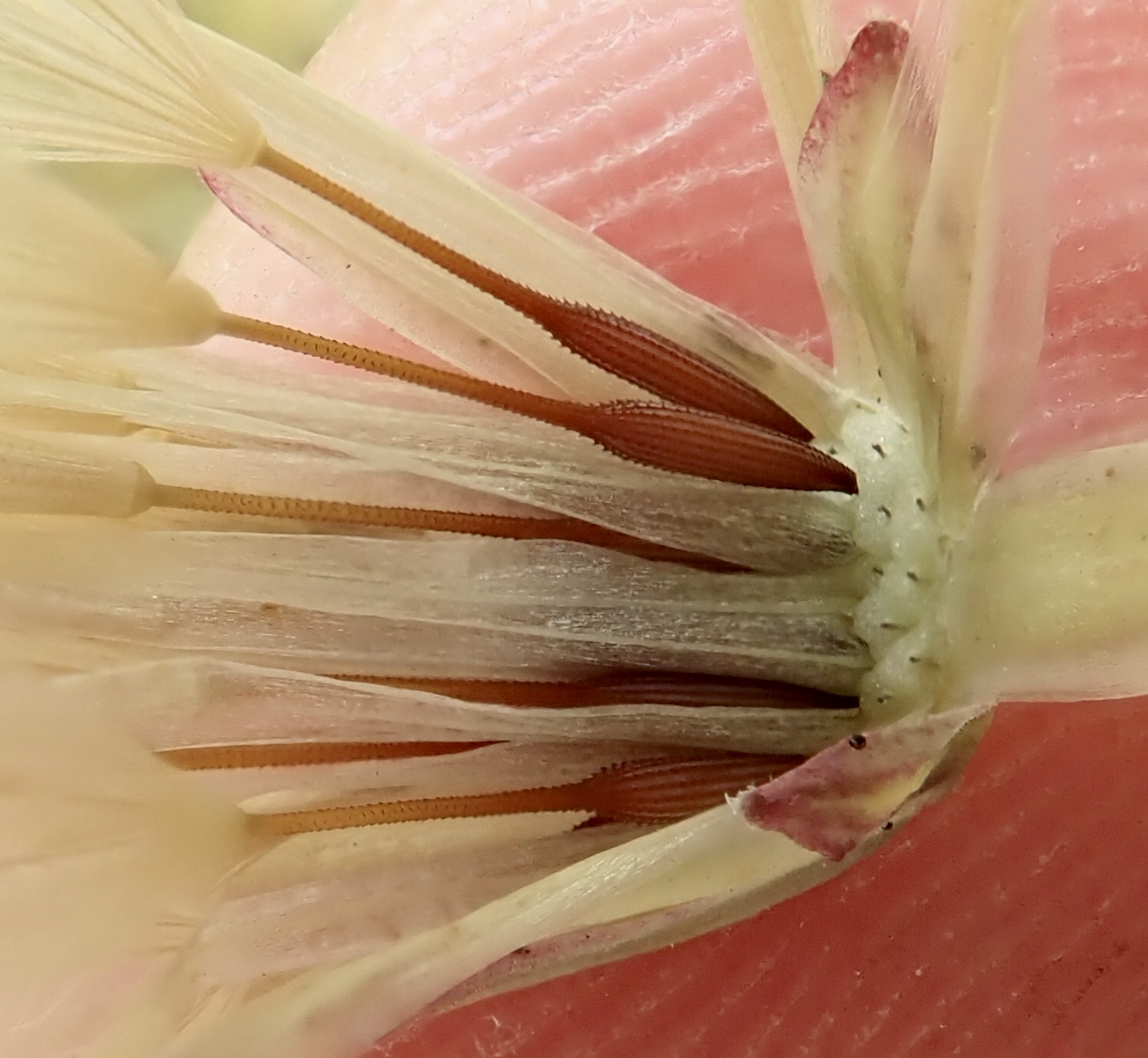
The beaked achene gives this plant its common name.  The achene is typically 7-8mm long plus the pappus hairs ( again simple bright white). They are fully beaked with the achene tapering down for about half its length. The achenes are ribbed (10) with pale edges and have tiny teeth.  The receptacle has the pits surrounded by short hairs.

Close up of receptacle and beaked achene.

Crepis biennis ( Rough Hawksbeard)


C. biennis (Rampton 18th June 17)

C. biennis (Rampton Guided Bus Way  4th Jul 17 )
The achenes are similar to those of C. capillaris but at least 4mm long, typically 6mm whereas C. capillaris are typically 2mm long ( 1.5 to 2.5) . C biennis achenes have ribs which from these photos seem much less regular with some larger than others. Typically 13 ribs but up to 18.

This is fine except that very often you find flowering plants that have not reached the stage where the achenes have developed.  One feature is to see if the shape of the achenes is apparent when the flower is developing. Time to look at the flowers.

4)  Flowers. Top View

4a) Crepis capillaris. Smooth Hawksbeard

C. capillaris  (22 Jul 18 )  Note Yellow Stigma don't stand out against the petals.

C capillaris have quite small flowers, similar to the flowers of Nipplewort, being 8-15mm across ( robust form up to 20mm)  and this is a important ID feature.  C. vesicaria can have similar sized flowers and C. biennis have much larger flowers heads and often appear more ragged compared to the neater capillaris. Outer banding can be reddish in some plants.

C. capillaris 14Jul18  
Note stigma and style are are greenish. Anther / stamen is a yellow tube around the style.


4b)  Crepis vesicaria. Beaked Hawksbeard

C. vesicaria ( 2 May 15)  Greenish Yellow style and stigma.
C. vesicaria ( 10 Jun 18,  Royston) stigma greenish.

The flowers are 15-40mm across often the outer petals having reddish ( or white) banding on outer face. Tip can show red. May have more petals than C capillaris, but generally more ragged than capillaris.

C vesicaria (13May18 Soham)
Typical array of flowering heads with bright yellow petals and some red banding, plus ragged appearance.

4c)  Crepis biennis   Rough Hawksbeard.


C. biennis ( 9Jun18)  Note Yellow style and sigma

C. biennis (9Jun18 Longstanton, Cambs)

The second flower is more mature but still shows completely yellow stigma and style.  The petals are completely yellow with no reddish banding. The two features are worth checking as they seem to be reliable. Flower across  30-45mm. much bigger than C. vesicaria.

C biennis ( 2Jun18 Great Eversden, Cambs.)

5)   Flowers Side View showing involucral bracts.

5a) C. capillaris. Smooth Hawksbeard
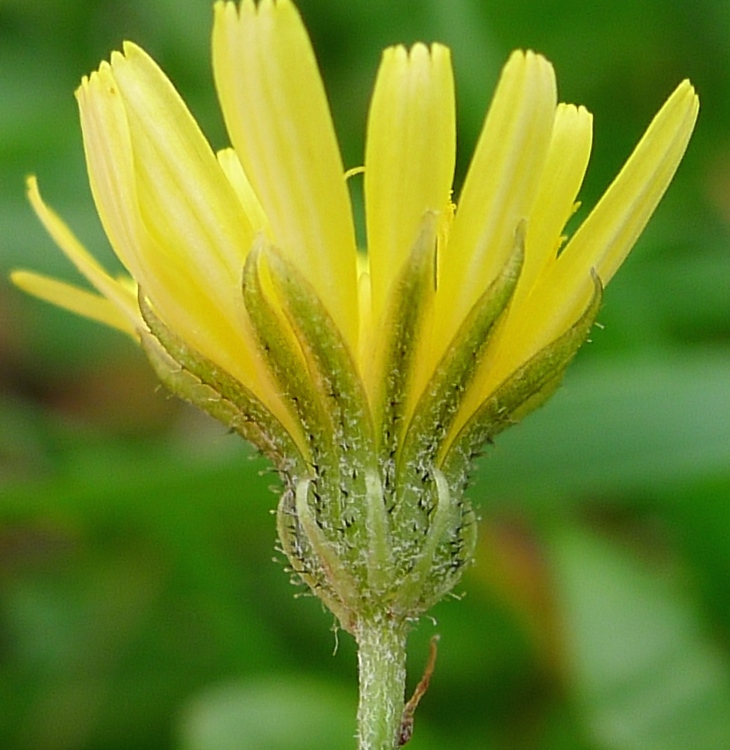

C. capillaris ( 22Oct15)

Typical flower showing the outer bracts spreading and curving back into touching the inner bracts.
Occasionally the outer bracts stay close in ( appressed), not spreading.The outer bracts are thin and are hairless except for slight a cobwebby ( arachnoid) hairs. They are about a third in length of the inner bracts which have short black hairs mainly on or close to the centre line plus the white cobwebby hairs.
Overall colour of the bracts is pale green with edges slightly paler again.

C capillaris (14Jul18)
Again a typical flower. Black hairs prominent.

C capillaris ( 30 Jun 16)

Note the best image but the only photo I have a of the robust form of C. capillaris  Structure conforms to the examples above. Note slight red banding on our petals.

5b)   C. vesicaria Beaked Hawksbeard.

C. vesicaria (10Jun18 Royston)
May have more petals than capillaris but basic structure the same with a few outer bracts curving out to form the cup and saucer which occurs in some but not all Crepis species.
Red banding on outer petals. Cobwebby ( arachnoid ) white hairs present plus the black stout hairs and some longer white hairs with glandular tips.
The outer bracts are wider and stronger looking than C capellaris but very similar to C. biennis.
A marginal difference is the outer bracts have very pale white edging which is clear in this example.

Red banding prominent ( 12 Jun16)
C. vesicaria (2Jun16)

This example is chosen as the cobwebby hairs are prominent but it almost lacks the stout black hairs which are tiny and the long white hairs which are more typical. An example of variation.

Cut flower, late stage
Cut Flower, early stage
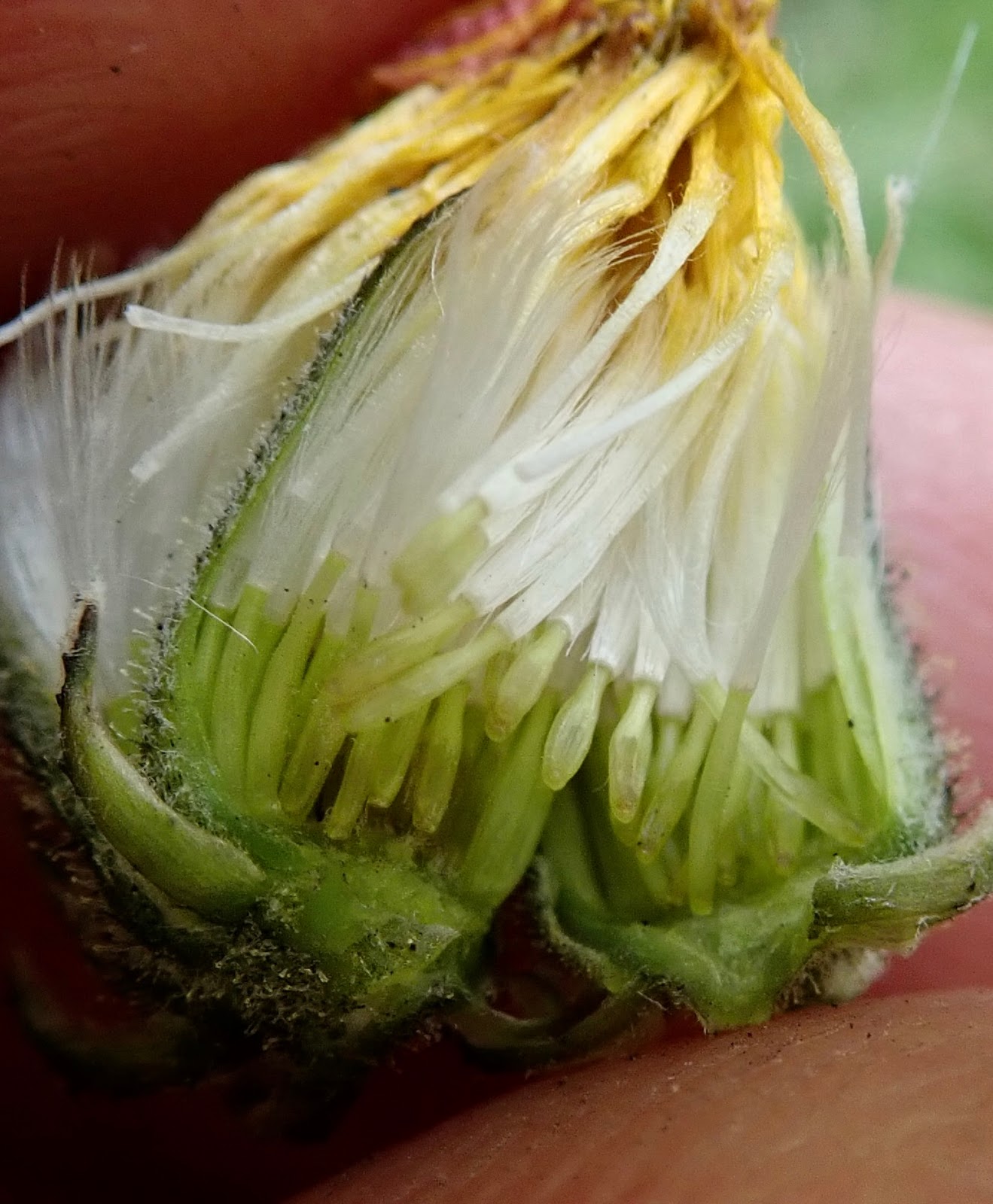
It is possible to see the shape of the achene before the flower develops in the pappus stage. The late stage photo clearly shows the beaked achenes forming but the early stage also shows the achenes thinning down just before the pappus hairs.  This is not always so clear cut as the achenes on the left are not showing this feature as well as the ones in the centre of the photo.


5c)  C. biennis Rough Hawksbeard.

C. biennis 31May14

Outer bracts are very robust and have a dark centre line in this particular plant. Cobwebby hairs as usual plus some stout black hairs.  Pale yellow petals without red banding.  The outer bracts tend to stick out rather than curve inwards and they also tend to a pale green rather than white at the margin.  
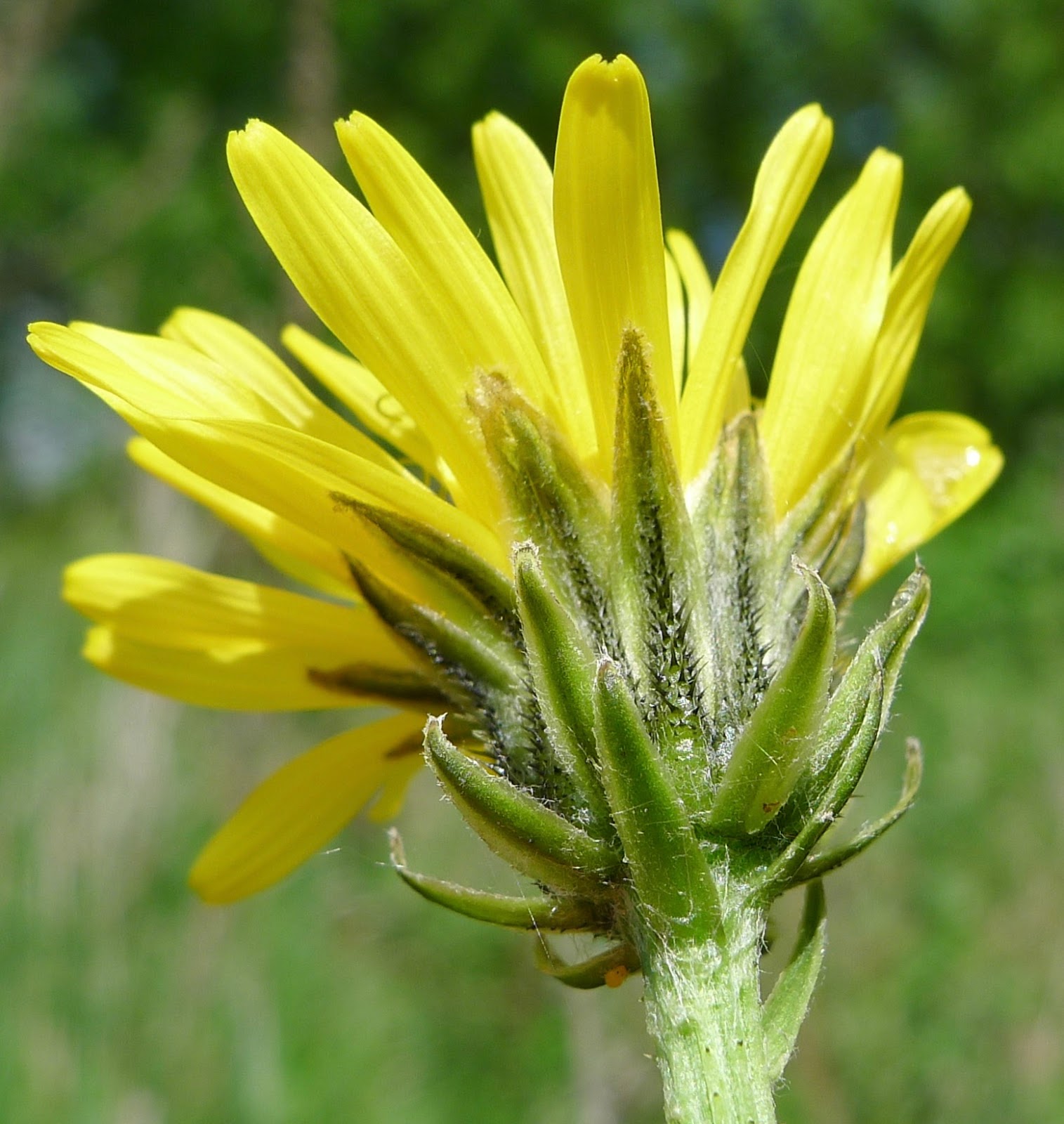
C. biennis 22May16
This example lacks the dark centre line on the outer bracts.  The outer bracts do not start at the same height on the stem. This is quite common in all three species. This plant also is showing the pale green edging to the outer bracts.  


C. biennis 9Jun18
Achene shape is well developed at the post petal stage. No sign of beaking.

C. biennis 25Jun18
Petals have faded but at this stage achene shape without beaking is apparent.  

The shape of the developing achenes are probably a more reliable feature than the appearance of the bracts or leaf shape or colour of the sap.

6) Leaf shape.

C capillaris.
C capillaris  Lower leaf shape with thin protrusions at right angles.

C. capliiaris (30Jun16) Basal leaves. Robust plant.
Basal leaf without 90Deg points

Lower leaves and basal leaves can vary in shape but often have the protrusions stick out a 90 degrees to the axis. Mid stem leaves have pointed lobes which is a distinctive feature of many C. capillaris.


C. capillaris (9 Jun18) 
A common feature in all three species is that the stem can be green or can have bright red lines running up. Some populations have about a 50/50 split with half the plants having completely green stems and the other half having the red lined stems. 

C vesicaria

C vesicaria Mid stem leaf (10Jun18)


C vesicaria 13May18 (Soham) 


Leaf shape is complex and very variable. It must be very hard to describe some of the complex shapes using words.   I am not convinced leaf shape is much help when separating C vesicaria from C biennis. The photo below shows how spiky they can be, mid stem example.
Crepis vesiciria , Bottisham 4th June 19


C biennis.
Lower leaves

C biennis Lower Leaf


Just when you might think a pattern or feature is apparent, a leaf will come up that breaks the rule. The only conclusion I have come to is Crepis biennis can have the most variable complex leaf shape
possible and that may be a feature in itself. Using leaf shape to distinguish between C vesicaria and C biennis is beyond me.


7) Sap Colour

The sap colour of Crepis vesicaria is noted as bluish-white and Crepis biennis as yellowish-white in Harrap's Wild Flowers.  

C vesicaria (3Jun18)

C biennis (21Jun16)
In practice the difference in sap colour may not be as pronounced as in the photos above but to date seems to be a reliable feature. 

8) Conclusion

The above photos give the basic difference between the three species.  This blog does not fully cover the variation and problems with plants that have been cut down and re-grown.  Achene shape is the gold standard feature even if looked for in flowers that are still in bloom.
C. biennis seems to never have red banding that is often present in C. vesicaria.    C. vesicaria often flowers about two-three weeks before C. biennis.
Stem leaves with pointed lobes at the base is a good feature for Crepis capillaris together with the lower leaf protrusions at 90degrees. As usual with difficult species as many features as possible need to be considered as plants are variable. A table follows as a trial key ID feature test. This will be used to see if these features always stack up or are not reliable in 2019. 

An example of extreme variation, the last photo below is of a flower taken in Baltimore, County Cork which is an example of C. capillaris which had been cut down and regrown. Definitely one for the expert who confirmed its identification to me, based on several photos showing the leaves with the 90 degree protrusions. A very strange plant which shows not all plants have read the Flower Guide Books. 
Crepis capillaris is the most variable of these species and is worth getting familiar with.

9May2015(Baltimore, Co Cork)
Summary. Features to be tested in the spring and summer 2019 to determine how useful they really are.
Any comments and corrections always welcome. Crepis vesicaria flower during May in Cambridgeshire, whereas Crepis biennis starts flowering at the very end of May.

Some comments that the flower size of biennis is pretty conclusive enabling ID to be made out of the car window and this is probably true. Hight is often a factor where biennis can be much taller but this is not always true. Sap colour may not be 100% as some biennis have quite white sap which may only just show the yellow tinge after about a minute.

A comparison of flower size follows. In this case capillaris is not so different to the flower of vesicaria , but biennis is about 38mm across.


Peter Leonard
Rampton, Cambridgeshire
16 Feb 2019 updated 5th June 2019


White banding on underside of petals on C. vesicaria 19th May 2019 

Spot the biennis in the sea of vesicaria, Cottenham 31st May 2019


Tuesday, 18 December 2018

Cat's-ear

Photos of Cat's-ear ( Hypochaeris radiata), Smooth Cat's-ear ( Hypochaeris glabra) and their Hybrid.


Catsear is widespread and common throughout the British Is. whereas Smooth Catsear is limited mainly to East Anglia and a few localised records in other parts of Britain.
Both fall into that group of 'Yellow Dandelions' which include Hawkbits, Hawkbeards and Sowthistles that have ray-florets only. Typical flower structure is shown below shows how these flowers are actually made up of many flowers grouped together, hence the old fashioned term 'composite'.


Introduction. Whats makes a Cat's-Ear.

Cat's Ears have a plant structure consisting of a rosette of leaves from which the flowering stem(s) rises. It can be branched to support several flowers or unbranched supporting a single flower.  The flowering stems do not normally have any leaves but have small CAT-EARS, triangular scales which are often quoted as a key ID feature. I am not sure how useful this feature is as a ID feature as other species can also have similar scales.

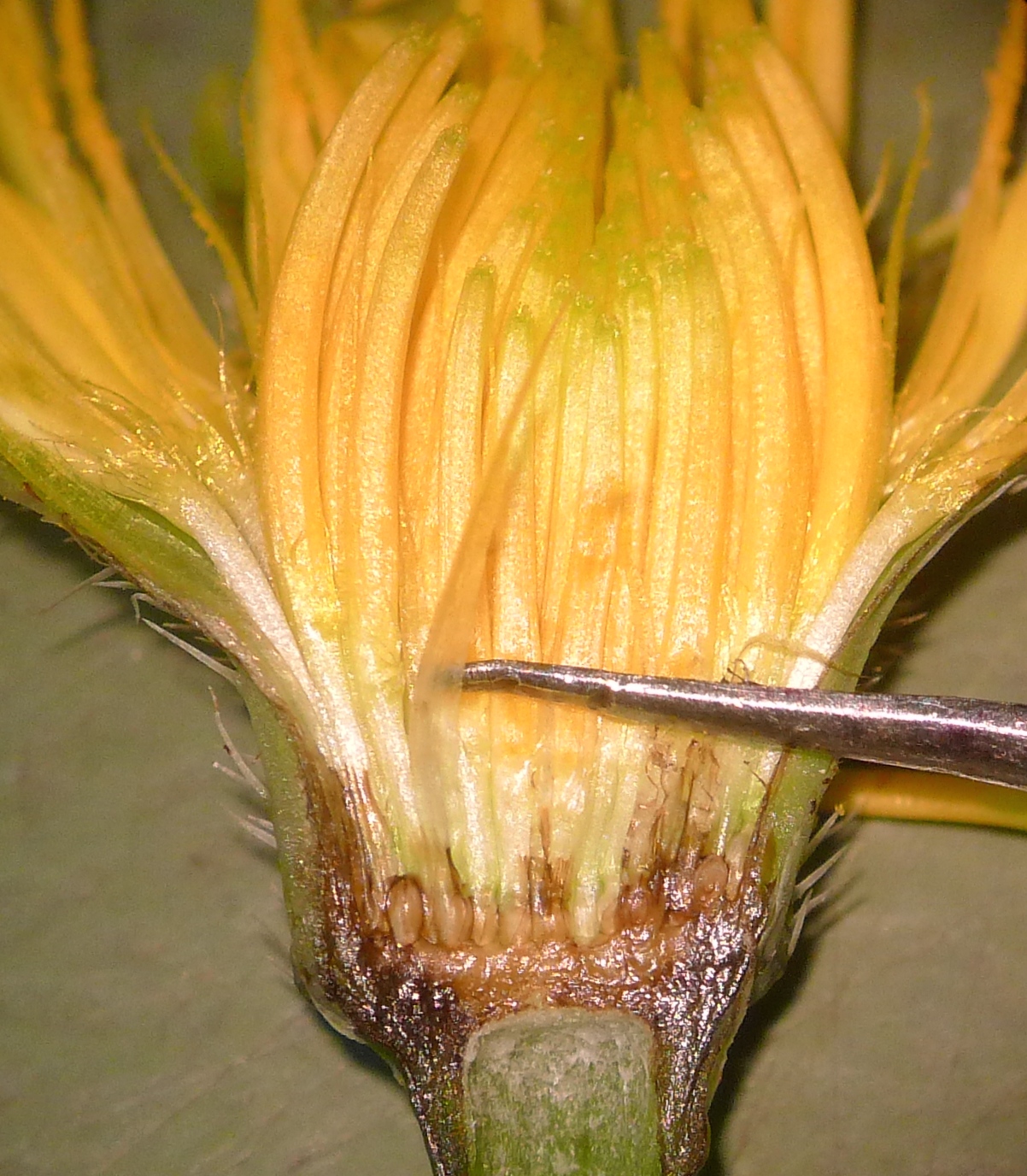
The key difference which separates all the Cats-ears from other yellow composites is a feature which is quite hard to see and is not shown on the diagram above. Cats-ears have a long almost clear scale which forms a partial tube around each achene. Because they are almost transparent they are easy to miss.
Presented with a hard atypical plant to identify, the expert botanist cuts the flower in half and looks through his magnifier to confirm his opinion that it's a Cat's-ear.

Smooth Cat's Ear showing the long scales that  partially surround the achene.
 The above photo taken 'post-flower' clearly shows the long scales. It can be harder to see them when the flower is at an earlier stage. See below where a Cat's-ear ( H. radicata)  flower has been cut in half and a spike used to separate a scale from the mass of developing florets.


A scale is highlighted by the spike used to pull it forward. Not easy to see. White sap turns brown.
Cat's -ear ( Hypochaeris radicata) .

Typical Plant
Cat's-ear is common. Upright stems typically 25cm ( but up to 60cm) long coming from a rosette of leaves up to 20cm long ( typically 10cm). Quite a robust look about it, with stem unbranched or can in extreme plants, branch many times to almost look like a 'crepis' (e.g. Beaked Hawksbeard).   The lack of leaves on the stems is a key feature but I did see one large Cat's-ear with a couple of strangely shaped leaves half way up a branching stem, but this is most unusual.
Simple plant with one branched stem and showing possible variation in leaf shape.
Leaf shape is variable, wavy edged to deeply lobed but always very hairy with simple hairs ( no splits or hooks).  Leaves are green and do not have the tendency to turn red as they can do in Smooth Cat's-ear.

The Flower Head.

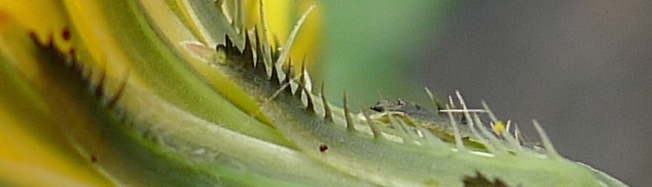
The involucre bracts hold several features of interest.  The stem has no hairs and becomes wider just before the head but there is always a step. The bracts form a shape that is compact, wide and short unlike Smooth Cat's-ear bracts which have a much more elongated shape.  A unique feature is the 'Cockscomb' of curved hairs which is normally present on the longer inner bracts but may also be present on other bracts to a lesser extent. In addition to the 'Cockscomb' there are white hairs that run down the centre line of the bracts. A feature not normally noted in the field guides is that most Cat's-ears have a prominent pale line down the middle of the bracts. This is very prominent in the photo above but occasionally may not be present. It is however a very quick and easy ID feature which I find useful.

As always plants show variation on the amount of hairs and extreme examples can have no 'Cockscomb' so the combination of features should be looked for.


An example of variation is this example which has prominent Cockscomb but lacks the white hairs. It does have the pale centre line. A close up of a Cockscomb follows.The hairs are strong, often slightly curved and normally dark ( from green to black)


Cockscomb of Cat's-Ear ( H. radicata)

H.radicata extreme without hairs but with red tipped bracts.

More variation. A example with no hairs, no Cockscomb or white hairs. The pale centre line is nicely present plus another very common feature not shown in the previous photos, the bracts often have red tips.


Inner bracts can be long and turn yellow at the tips.
I had never noticed in the field, that the tips some of the bracts can turn yellow.
  Not all flowers of H. radicata show this feature but it may be a feature worth looking for. It may only develop through growth as the flower matures? The design of the bracts vs the petals is very different but the fact the tips turn to the same shade of yellow indicates some connection between them.  Why not stay green to the tip?.

 The red tips are very common and can be very dark on some flowers. This photo shows the outer banding of grey on the petals which is also quite common. Banding colour can vary (silver white through to dark grey) and is a feature shared with many other yellow composites.

Lesser Hawkbit                                 Cat's-ear                             Autumn Hawkbit
Comparison with other Yellow Composites , shows while the basic structure is similar, the details are different in each case.


Smooth Cat's-Ear ( Hypochaeris glabra)


Basic structure of a rosette of leaves and normally unbranched flower stems that are not always as upright as Cat's-ear.  Whole plant is not as robust looking as Cat's-ear.  Note also the sandy soil which is the preferred ground. Having said that some plants do have upright branched stems.

Upright and branched stem, Spain.

Leaf rosette of Smooth Cat's-ear.

 Leaf shape is variable but usually not a deeply lobed as the average Cat's-ear. The main difference is the leaves are not as hairy, in fact some books suggest there are no hairs but this is not true as typical leaves have side pointing hairs from the margins as seen in the photo above. Some other hairs may also be present but not to the density of a Cat's-ear. Leaves are often a paler green but Smooth Cat's-ear can have leaves that turn an amazing red colour.

Red leaf of Smooth Cat's-ear with no hairs ( usually has side hairs at a minimum)

Example of a red leaf  with more hairs that usual and was a hybrid.

One final comment on structure. Although some plants can grow quite large with stem up to 40cm most are smaller and some can be tiny. The smallest I have seen had just two leaves 3mm long by 1mm wide and yet this tiny plant had put up a flowering stem with a tiny head of about 1mm diameter.  Why it did not grow larger before attempting to flower I do not know.

The major difference between Cat's-ear and Smooth Cat's-ear is the shape of the flower head being long and narrow. The stem has the Cat's-ears and these are red at the edges, like the bracts.

Long and narrow with bracts edged with red is typical of Smooth Cat's-ear.
The flower head has no hairs, no Cockscomb or white hairs. It is completely smooth. It can show the pale centre line on the bracts but it also nearly always has very red edges.

The example that does not have the red edges seen in Spain.

Another flower with slightly more red, same group of flowers in Spain.
Despite the variation in colour the basic narrow shape remains a key feature. What does a open flower look like?

Short yellow petals are pale yellow.

No hairs, pale center line, Red edges, Short Petals.

First problem is finding a flower that is open as flowers remain closed most of the time and only open for a hour or two in late morning when in full sun. Petals are pale yellow, almost white on the underside.

Red limited to tip of bracts with pale edging.

Final feature is the achenes, which can have some beaked and outer ones un-beaked which is a very distinct feature of Smooth Cat's-ear.

Outer achene not beaked ( 7 o'clock)  unlike the beaked majority.


Un-beaked achene of Smooth Cat's-Ear
Beaked achene of Smooth Cat's-ear
Occasionally some examples have no un-beaked achenes.


Hybrid (Hypochaeris radicata   X  H. glabra)  = Hypochaeris X intermedia

I was fortunate that Alan Leslie found a site near Fordham in Cambridgeshire where both Cat's-ear (H. radicata)  and Smooth Cat's-ear (H.glabra ) were growing together and he had found several hybrid plants.  He invited me along to take a few pictures.

Hybrid Cat's-ear which petals slightly longer than Smooth cat's-ear.

The first thing to say is Alan had perfectly timed our visit for late morning and the flowers were open.
The main key ID feature is often stated as the petal length being intermediate between the very short petal extension beyond the bracts in Smooth Cat's-ear and the much longer petals of Cat's-ear.
With both species present and with open flowers, this was easy way to find a Hybrid.
The problem comes when the flowers are not open which is most of the time. Based on the photos taken I think even with closed flowers the bracts can give away the features of a Hybrid.
The above photo does not have the very narrow shape of a Smooth Cat's-ear. The red on the bracts is more like Smooth Cat's-ear in its extent. Both species have the pale centre line.  The 'cockscomb' is present although limited. Smooth Cat's-ear does not have this.  This example is about half way between in terms of the involucre bracts.

Hybrid Cat's-ear

Another open flower with petals too long for Smooth Cat's-ear but too short for Cat's-ear. It has the most tiny 'cockscomb' present on some of the lowest inner bracts. The petal banding is pale greyish whereas Smooth Cat's-ear tends to have almost white banding however how reliable this feature is , is not certain.  The involucre bracts  form a shape which is not a thin as in Smooth Cat's-ear and it may be a Smooth Cat's-ear bud that is in the left of the photo from a different plant for comparison.
The red tips on the bracts are not limited to the tip as in Cat's-ear but extend down the edges.

Hybrid Cat's-ear more towards the Smooth Cat's-ear end of the spectrum.

This flower shows the intermediate petal length well, but in may ways has features of Smooth Cat's-ear with no 'cockscomb' , red edging to the bracts and that thin shape. If this flower was closed it would be easy to miss being a Hybrid and might be seen as a Smooth Cat's-ear.


Example of a flower past its best and closed.  The narrow shape is good for Smooth cat's-ear but there is Cockscomb present and the bract tips are just like Cats'-ear being dark and limited to the tip. The shape is the feature that suggests this is a hybrid.


Hybrid Cat's-ear

The final photos shows a hybrid flower which shows the petal length just a little longer than might be expected with a Smooth Cat's-ear and the shape is not quite as narrow as one might expect. The bracts have no 'cockscomb ' and have the red edging more like a Smooth cat's-ear but it's a close call.
One of the longest inner bracts has turned yellow as seen in previous photos of Cat's-ear.

Conclusion.

With open flowers the hybrids are not too difficult to spot mainly based on the length of the petals but as these photos show there is some variation in whether they lie in the middle of the two species or are more like one of the parents.
When the flowers are not open, it becomes much more difficult but shape, extent of the red edging and the presence of the Cockscomb are factors which help in making an identification. It would appear from this brief encounter that hybrids that lie half way between these species are fairly straight forward but because some hybrids are fertile and backcross a whole range of hybrids can occur, some being very close to either parent. These would probably be very difficult to spot.

One factor that was not checked out was how hairy the leaves are on the hybrids, maybe next year.


Many thanks to Alan Leslie for showing me the site.


Peter Leonard
21st December 2018