Showing posts with label Geraniums &Storksbills. Show all posts

Wednesday, 13 May 2020

Herb Robert (Geranium robertianum) and Little Robin (Geranium purpureum)

Herb Robert (Geranium robertianum) and Little Robin (Geranium purpureum)

My Geranium ID Key Blog of last August highlighted the main differences between these two similar species; i.e. the smaller flowers of Little Robin and its yellow anthers. The blog did lack detail on the hairs that Little Robin displays. Here are a few additional photos to show Little Robin against the much more common Herb Robert.
Herb Robert left and Little Robin right, showing the size difference in the flower. 11th May 2020, Cambridge.
White petal lines more prominent in Herb Robert.

Little Robin showing the yellow anthers, Cambridge
Herb Robert showing orange anthers 28th June 2019 Cork

Herb Robert with dark purple anthers 17 June 2019
Herb Robert normally has dark purple anthers but can have orange anthers.
The pollen of both species is yellow so when comparing the anther colour pick a flower that has anthers which have not opened to avoid confusion.


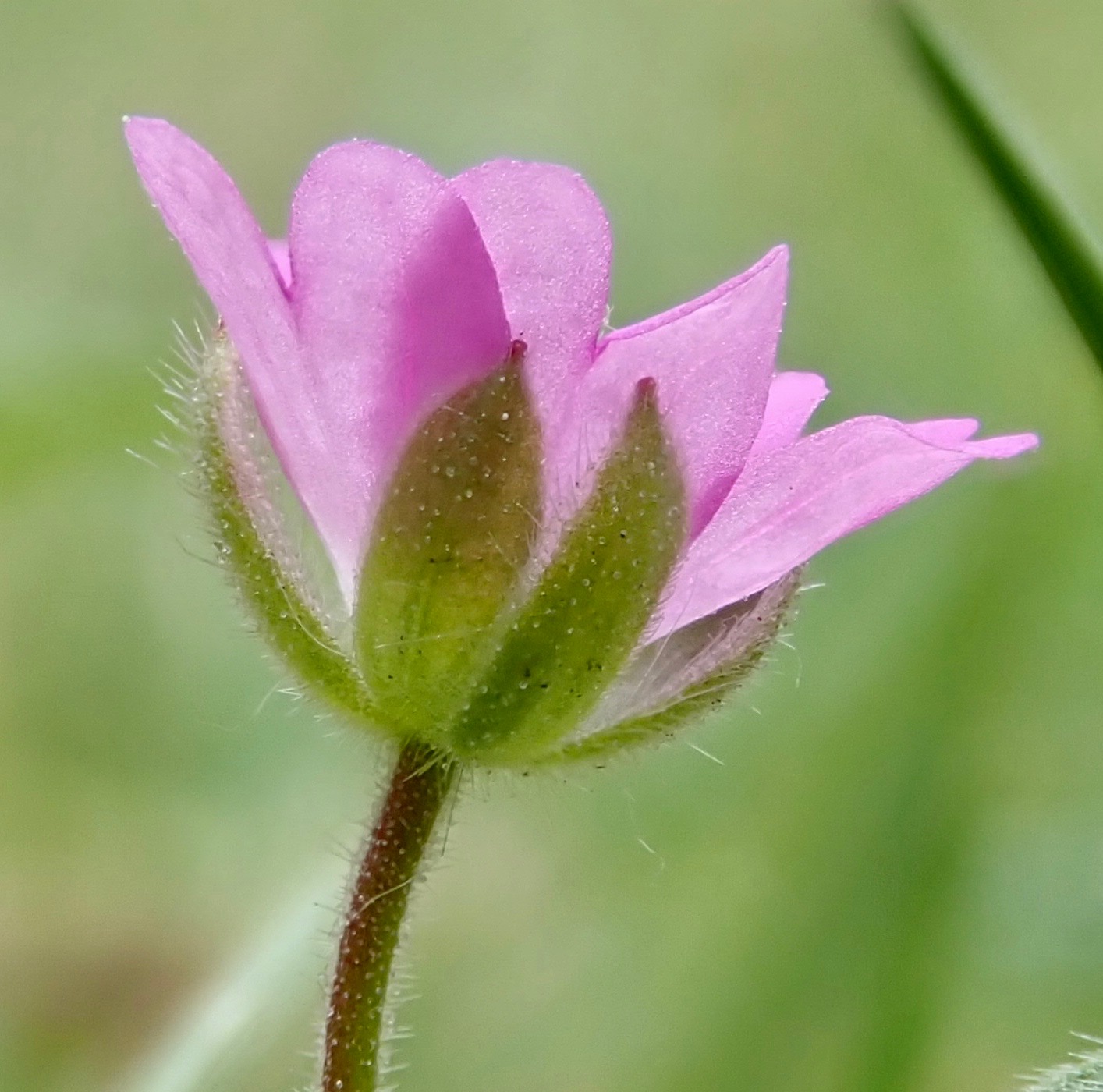
Little Robin, sepal hairs 11th May 2020. Cambridge
Neglecting the stray hairs picked up from a nearby composite, the Little Robin has sepal hairs which are different lengths and have red glandular tips. These are similar to the hairs on the upper flower stem.

Herb Robert 28th June 2019, Cork showing the very long sepal hairs.
Herb Robert sepal hairs, 11th May 2020, Rampton
Herb Robert also has tiny red glandular tips to the sepal and flower stem hairs. The length is much longer for many of the hairs compared with Little Robin. The sepal hairs are longer than the flower stem hairs but the flower stem hairs also have some long hairs. Some non glandular hairs are also present on the flower stems and the main stems have curved simple hairs pointing downwards.

Little Robin, flower stem hairs similar to sepals but less dense. Ignore the stray composite hairs.

In summary Little Robin has sepal hairs that look quite normal whereas Herb Robert seem excessive.
This is a generalisation and sepal and flower stem hairs will vary depending on the population. The amount of hairs is a variable feature, however this is an interesting difference.

Leaves.

Little Robin has pale green leaves that look smooth and hairless to the naked eye. A close look shows they do have some hairs. Herb Robert can have slightly darker green leaves and again it is easy to miss the sparse hairs. Leaf shape is similar between these species. Stems are often red in both species. It is usually regarded as impossible to identify these two species apart, using vegetative features.

Pale green leaf of Little Robin, with some sparse hairs just visible. 11th May 2020 Cambridge
Some leaves have a thiner shape.

Little Robin leaf, 11th may 2020 Cambridge.

Stem Hairs

Stem hairs are mainly short downward curved hairs without glandular tips. G. purpureum
Stem hairs are mainly the short curved hairs but occasional simple long hairs are present or some stems may be hairless.


Hybrids between these two species have been found and the situation in Europe is apparently more difficult due to variation.  Herb Robert has chromosome count 2n=64, Little Robin 2n=32.
Some suggest that Little Robin is a parent of Herb Robert. Cross fertilisation experiments have been done but the situation in the wild is not clear. It is suggested that some hybrids have no flowers but I can't see how you would prove that this is a hybrid. Some plants have been found with intermediate features. It is not known if any recent research has been done on these two species to confirm their relationship.

Little Robin records from Cambridgeshire have been from sites associated with the railways. Recent expansion of Little Robin may be related to winters with less hard frosts.

Peter Leonard
Rampton, Cambridgeshire.
11th May 2020


All comments welcome.


Monday, 30 March 2020

Geranium in early spring.

Following on from my ID Key on Geraniums and Stork's-bills which was aimed at flowering plants, I have found identification in winter/early spring, introduces the extra complication of winter leaf shape in Cut-leaved Crane's-bill ( G. dissectum) which looks much like G. molle, G. pusillum and G. pyrenaicum. These four species are covered in the following photos.
G. dissectum   5th Feb 2020


Despite the leaf shape changing on certain species like G. dissectum, the petiole (leaf stalk) hairs still provide a reliable method of separating the geraniums. A slight complication is that winter leaf stalks can have fewer hairs. I did find a G. pusillium petiole which had no hairs but fortunately later leaves on the same plant had the normal hairs.


1) G. molle  ( Dove's-foot Crane's-bill)  vs G. pyrenaicum ( Hedgerow Crane's-bill)

These two species share the three types of  leaf stalk hairs, short glandular hairs , short simple hairs and long hairs.  The difference is that the G. molle long hairs are wispy and are even longer than G. pyrenacium.


G. molle showing wispy long hairs. Rampton 24th March 2020


G. molle showing the short glandular hairs , the simple hairs and the long wispy hairs.


G. pyrenaicum showing three types of hair, short glandular, short simple hairs and long hairs.
The long hairs which tend to be angled down on G. pyrenaicum are not wispy but stronger and less bendy.


G. pyrenaicum showing detail of the three types of hairs. Landbeach 24th March 2020
Some of the hairs are angled up to 45 degrees . 
Hedgerow Cranesbill when in flower have flower stems without the long hairs.
G. pyrenaicum flower stalk with no long hairs.
Variation and similarity of the three basic hair types makes this quite difficult. The density of long hairs can vary with some G. molle having a dense layer of these wispy long hairs while other plants may have much fewer.  The Landbeach photo above is slightly odd in that the long hairs are very dense and downward pointing which gets close to the appearance of G. dissectum ( Cut-leaved Crane's-bill). The following photo which shows the same leaf and stem which gives a less detailed view showing that overall the hairs are not as downward pointing as you might expect in G. dissectum. This plus the leaf shape confirmed identity as G. pyrenaicum ( Hedgerow Crane's-bill). Hedgerow Crane's-bill is often a much more robust plant that G. Molle with bigger leaves.


G. pyrenaicum. Landbeach
G. pyrenaicum leaf
2) G. dissectum Cut-leaved Crane's-bill.

G. dissectum winter leaf, Rampton 24th March
First problem is that the winter leaves are not the thin cut versions of summer but rather like the G. molle/G. pusillum/G. pyrenaicum cut to 2/3rds type. Later leaves tend towards the thinner cut leaves as spring passes.


G. dissectum   5th Feb 2020


G. dissectum  leaf showing trend towards summer leaves.
G.dissectum Leaf showing more deeply cut sections. Rampton 24th March 2020
I will let others think about what the advantage of changing the leaf shape from winter to summer is.
Whether the more compact leaf shape is more frost resistant comes to mind.


Petiole (Leaf Stem) hairs.
Not easy to separate from G. pyrenaicum because dissectum can vary from sparse to dense hairs. G. dissectum can sometimes have very few glandular hairs but these are often quite dense just below the leaf. 


G. dissectum  hairs showing short glandular hairs and angled straight hairs.


G. dissectum, less hairy stem. Angled hairs.

Key feature is the straight eglandular hairs are angled downwards at up to 45 degrees. The short glandular hairs are just visible in the top photo. The extremely long hairs that G. molle/G. pyrenaicum show are not present.

3) G. pusillum ( Small-flowered Crane's-bill)

G. pusillum leaf hairs, short glandular hairs plus short glandular hairs. No long hairs.

G. pusillum Devils Ditch, 25th March 2020

Some winter/early spring petioles (leaf stems) have almost no hairs. Normally they have a few short glandular hairs and lots of simple hairs that can be straight or curved. Because the short hairs tend to be all the same length and quite dense they make up a consistent layer.

Conclusion.
Whereas leaf shape is variable, the hairs on the petiole ( leaf stem) do seem to give a consistent method of identification provided you have not found a garden escape which would make the situation much more complicated.

Peter G. Leonard
Rampton
Cambridgeshire.
30th March 2020


Thursday, 14 November 2019

Cranesbills with long tips to sepals


Geranium rotundifolium  Round-leaved Cranesbill   
Geranium columbium       Long-stalked Cranesbill    
Geranium dissectum         Cut-leaved Cranesbill       

These are small flowered cranesbills which have a long tip to the sepals, unlike Dovesfoot Cranesbill  (G. molle ) and Small-flowered Cranesbill (G. pusillum) which were covered in a previous blog.

These are additional photos and notes as backup to the ID Key Features blog of August 2019.


1)  Geranium rotundifolium  Round-leaved Cranesbill

14Jun2019 Cambridge North Station
The above photo shows several key features, the pink petals have a pale white base which gives the flower a pale centre. The petals can occasionally have slight notches. The pale centre is the standout feature as otherwise it is easy to walk past thinking its just another Dovesfoot Cranesbill, which is much more common.

The leaf lobes are cut up to a half way and the shape gives the plant its common name 'Round-leaved'.
The leaves are variable in shape having from  5-9 lobes ( three at the apex). The apex leaves at the top of the plant can sometimes look very different to the rounded shape shown in the ID Key. The 'cut up to a half ' is a consistent feature.
Lower leaf as used on ID Key Feature Blog with 5/6 lobes.

The photo of the flower below shows the sepals have quite a thick point extension and it is just possible to make out the red-tipped glandular hairs.  The sepal extension is a variable feature, occasionally some plants only have a tiny extension.


The most important secondary feature is shown above and is the red-tipped glandular hairs which stick out from the sepals, flower stem, leaf stem and leaf edges.  There are in addition non glandular hairs. No other small flowered geranium has these red-tipped glandular hairs except Herb Robert but that has white lines on the petals and a completely different leaf shape.  The sepal has a darker green centre line and edge lines giving it a striped appearance. This is quite common in many Geraniums and Storks-bills.

Main stems also have red-tipped glandular hairs plus non glandular hairs mixed in.


The petals have three pale veins and the anthers are purple. Hard to see the stigma in this photo but just possible to make out it is pale pink. The anther colour can be variable from purple through to almost white.  The mixture of long non-glandular and red-tipped glandular hairs can be seen on the sepals.

6th June 2019 Cambridge North Station

The cranesbill as it springs its seeds out, with two of the five mericarps sprung. Sepals have turned slightly red at this stage showing the three stripes. The stems are often red.


2) Geranium columbium      Long-stalked Cranesbill

3 Jun 2019 

The flowers are held on long thin stalks.  The flowers are also slightly bell shaped and this and the long stalks is normally what makes them stand out from the Dovesfoot Cranesbill that is the most common species. The plants are often taller and climb through other vegetation.  Long-stalked Cranesbill is quite rare in Cambridgeshire, so it is always nice to find.

3 June 2019 Pink petals normally slightly notched.
A key secondary feature is all the hairs on Long-stalked Cranesbill are pressed flat as shown above. These flattened hairs also cover the leaf stems and the leaves.

3 Jun 2019 Leaf with flattened white hairs.

Leaf shape is quite complex but a key feature shared with Cut-leaved Cranesbill is that the cuts often go to the base and the lobes have thin sections . The lobes tend to be slightly thicker than with Cut-leaved Cranesbill.

11th June 2019 Devils Ditch, Cambridgeshire
Close up of flower and leaf showing reddish stigma and pale anthers with blue line.

Long-stalked Cranesbill Flower.


3) Geranium dissectum        Cut-leaved Cranesbill

19May2019 Needingworth, Cambridgeshire

The standout feature, apart from the deep pink colour of the petals, is the very long sepal tip. The flower is similar to the Dovesfoot Cranesbill in that it has notched pink petals but the sepal tips are  much longer than the petals and I have not seen any plants that have any variation in this key feature.
Flowers have short stems. Occasionally the petals lack the notch.

Next example is a pale flower variation which is quite rare.

19 May 2019 Needingworth, Cambridgeshire.

In common with other cranesbills and storksbills, the pale versions of these flowers also have paler stigma and anther colour. In this case the stigma is off white and the anthers are pale pink. The normal deep pink flower has a dark pink stigma. Note this photo shows the five petal veins well, as it is easy to miss the two outer ones.

19 May 2019 Flower stem hairs
This photo shows the mainly glandular hairs with clear glands on the flower stem and the sepals mixed in with some non-glandular hairs. Note the aphid which has to battle against all this sticky stuff.


The flowers are on short stalks and the leaves are deeply cut and individual lobes are thin. Plants are often quite large but the flowers are tiny.

Leaf stem showing simple hairs downward pointing at about 45 degrees


G. dissectum winter leaf is very like G. molle

Winter leaves can be very different in shape looking like G. molle. Leaf hairs are angled downwards away from leaf at angle up to 45 degrees.
G. dissectum downward pointing simple hairs on leaf stalk in winter.


Conclusion.

These three species are fairly straight forward to identify.  The leaf shape of the Round-leaved Cranesbill and pale versions being the possible variations.   Careful examination of the hairs will offer a clear ID feature in each case.


Peter Leonard
Rampton, Cambridgeshire
14th November 2019

Tuesday, 24 September 2019

Dovesfoot Cranesbill vs Small-flowered


Additional notes and photos on flowering Geraniums to support the ID Key features Blog.
Hedgerow Cranesbill

The ID Key features blog, August 2019 is a reduced set of features to distinguish between all the wild Geraniums found in the UK when in flower.
Additional features and photos are included here to give a more complete picture of the differences.

Three species are covered in this blog which share a common feature in that they do not have extension tips to the sepals.
The leaves are cut to 2/3rd towards base and are of a similar shape.
Dovesfoot Cranesbill ( Geranium molle)
Small-flowered Cranesbill ( Geranium pusillum)
Hedgerow Cranesbill ( Geranium pyrenaicum )


1) Dovesfoot Cranesbill ( Geranium molle)

Petal colour is often the first clue in separating G. Molle from G. pusillum, normally being a deep pink, however white forms are common with intermediate colours also common, including some with a pale purple tinge.
Small-flowered, (G pusillum) often have a blue tinge in the petals which are also often narrow with a gap between them.

Small-flowered G. pusillum in all the photos I have taken, have had a pale off-white stigma whereas G. molle have had a pink or reddish purple stigma, only once has a plant been found with a pale stigma.
White form but still with re/purple stigma. 


Stigma colour is not mentioned in the literature as a method of identification which is surprising but  some Dovesfoot Cranesbill rarely may have a pale stigma.  An example follows but they are infrequent.
G. mollie with pale stigma. 15th May 2020. Cambridge

Occasionally the petals may not have the notch, see the comments and photo at the end of the ID Key August blog.

The style splits into 5 curved stigma arms at the centre of the flower, with the stamen filaments holding the anthers arranged round the stigma in two rows. G. Molle has ten anthers whereas G. pusillum has only five of its ten stamen filaments having anthers. Anthers do fall off (after splitting to reveal pollen) so this feature may not be a clear cut in some flowers.


A pale pink version that is quite unusual. 24th June 2019, Cambridge.

Normal deep pink colour, Ten blue anthers present.

Each petal has five pale green veins from the green base.  Only five of the ten anthers showing probably because the first five have already fallen off having split. This can occur quite quickly and possibly most flowers are self-pollinating in these smaller geraniums.
Ten anthers present , 5 have split and have revealed their pollen and the other 5 are held lower into the flower and line up with the petal centre lines.   22nd Sept 2019 Rampton.
Note the overlapping petals have 5 veins which can be paler or darker than the pink of the petal and this may be dependent on the angle of the light. Some veins do split but not as much as the veins in the larger flowered Hedgerow Cranesbill ( G. pyrenaicum)  which shares quite a few features with G. Molle.  A significant difference is that the sepals on G. molle have long hairs whereas G. pyrenaicum has only short hairs ( many glandular ) .
Hedgerow Cranesbill (G. pyrenaicum) has flowers twice the size of  Dovesfoot Cranesbill (G.molle) and the sepals are shorter relative to the length of the petals. Size is always a dangerous parameter in plants as growing conditions can change some features more than others. Often flower size is largely maintained even when produced from tiny malnourished plants.

Hedgerow Cranesbill (G. pyrenaicum ) with short hairs on sepals. 

Side view showing tips of the sepals just short of the petal notches, approx 2/3rd of the lengths of the petals.
Side view, note long hairs plus short glandular hairs on sepals, a feature shared with G. pusillum.


Flower and leaf stems have 3 hair types, short glandular hairs, short simple hairs and very long hairs.
Mericarp at base of beak showing wrinkled groves and the impossibly small hairs which the photo does not show.
The seeds are held inside the mericarp case.  G. Molle.
Comparison of mericarp at same stage showing the lack of groves and abundant hairs for Geranium pusillum.
The both cases a sepals has been pulled back to show the mericarp.


2) Small-flowered Cranesbill ( Geranium pusillum)

Small flowers and no long hairs on flower and leaf stalks, separate pusillum from molle.  Leaf shape has been used in non flowering plants, as a identification feature but I found this too difficult. Much easier to use hair length.
 The leaves are split to 2/3rds towards base and are very similar to G. molle.   The flowers are small and the three veined petals have either no or very limited overlap. G Molle petals often overlap but there is variation with some having no overlap.  The sepals have long hairs plus short glandular hairs much like G. molle. 


G. pusillum, white 5 pointed stigma with 5 anthers only as the other 5 stamen lack anthers. Hard to see in this photo.
Side view showing sepals nearly as long as petals. Long hairs on sepals.
G. Pusillum showing pale stigma and five anthers. 13th June 2019, Rampton


G. pusillum, leaf stalks which have no long hairs, just short hairs (glandular and non-glandular).


Section of flower stem and sepal at base of flower showing hairs.

Flower stem hairs, a dense combination of straight simple hairs and glandular hairs , all short.


Typical leaf from a small plant growing in a gravel drive.
More complex leaf of G. pusillum growing in good soil.
Leaf shape is variable but certain features hold, like the 2/3rd cut towards base.

Hairy mericarps attached to the beak. G. pusillum, Rampton 24th Sept 2019


3) Hedgerow Cranesbill ( Geranium pyrenacum)

In practice this is not a difficult species to identify. It is much larger than G. molle and the flower colour is more normally purple/pink  than red/pink.  It does share quite a few features with G molle  hence its inclusion here.

G. pyrenaicum showing similar shape to G. mollie but much larger and with more prominent veins.


Geranium pyrenacum pale form
Side view of pale form of G. pyrenaicum 


Normal pink flower showing the inner 5  anthers having split and the outer 5 still intact.
Note the stigma has not opened. 

The photo above shows the Hedgerow Cranesbill follows other larger cranesbills in that the stigma is not open to receive the pollen from the split anthers at least at first, suggesting pollination is dependent on insects rather than self-pollination that may occur in the smaller species like G. molle.


First 5 anthers have fallen off and the second set of 5 have split open. Stigma has also opened with its 5 pale pink arms. The Hedgerow Cranesbill seems to have a more complex timing arrangement of pollen and stigma availability,  but from a identification view only, the stigma is pale pink and has thinner longer arms than G. molle.


Short hairs, mainly glandular on flower stalks.


Leaf stalk has 3 types of hairs, with short glandular and non-glandular plus long simple hairs which are slightly
stronger and less wispy than those of G. molle.


G. pyrenaicum .  Leaf split into in this case 7 sections by cuts up to 2/3rds. 

Leaves can be split into from 5 to 9 lobes/sections depending on how deep the cuts go and this is open to different points of view, as you can't use the vein structure to give a clear result.


Seeds just before they get thrown from the mericaps.
4) Conclusion.
As usual, I use the excellent 'Harrap's Wild Flowers' as my constant companion in the field.
Additional information on Geraniums was also found in 'Hardy Geraniums' by Peter F. Yeo which has detailed introductory chapters on the family. It covers both wild and cultivated types.
I am fortunate that both G. Molle and G. pusillum both grow in my gravel drive here in Rampton.
I suppose the good news is that to date, none of these three species has hybridised so identification should be straight forward. It is just a matter of remembering the key features which is why I made up the ID Key blog in the first place. Please comment if you see any incorrect assumptions.

Peter Leonard
Rampton, Cambridge
24th September 2019


Hedgerow Cranesbill from Picos Mountains of Northern Spain show pale centre.

1st July 2018. Picos Mountains.