Monday, 14 August 2023

Identification of Roses, Leaf stipules.

Identification of Wild Roses, Leaf stipules. Based on new research by Tony O'Mahony.

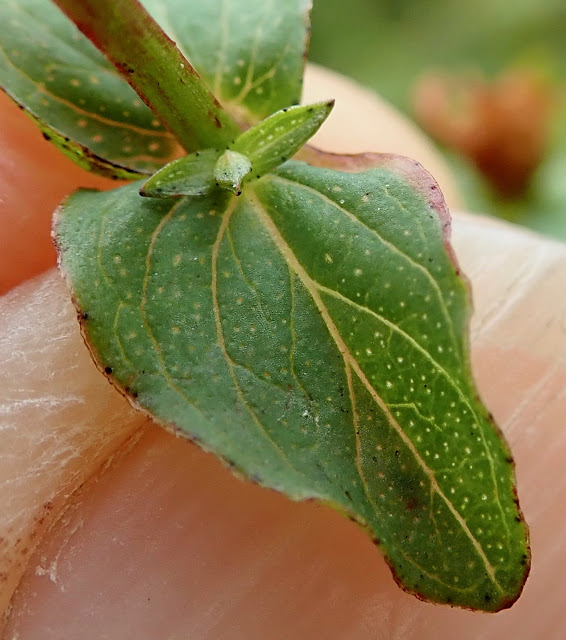
Leaf of Rosa agrestis showing stipule.

In a recent major article by Tony O'Mahony in the Irish BSBI bulletin (ref 1), he found that Dog Roses in the subsection Caninae ( Canina, caesia, squarrosa, corymbifera and stylosa.), leaf stipules have a different gland type to that of other groups ( Rubiginosa and Vestitae.). R. tomentella is regarded as having its own sub-section although being close to the caninae section.

  His article covers many other new features but here, I thought I would illustrate the stipule gland feature, as it has been found to work well in Cambridgshire.

Warning. Dog Roses are a difficult group with features that not easy to separate into what are now regarded as 'species'. Recently British and European Dog Rose species have been aligned ( ref. 2) resulting in R. canina being split into three species, R. canina, R. corymbifera and R. squarrosa. Also the Northern Dog Rose R. caesia has been split into R. caesia and R. dumalis/vosagiaca. Unfortunately an updated BSBI Handbook has not appeared yet although I hear one is being written, so the BSBI Handbook No7 by Graham and Primavesi (ref. 3)is still the best source of information. Good though it is, it is now showing its age. New features that Tony O'Mahony has found are not covered.

The Species Problem.  Roses as a group do not fit into neat species. What now have been decided to be  'species' are hybrids that arose in the distant past from unknown parents and became stable and spread as ice ages came and went. Although 'stable' the evolutional splits and regroupings never reached the stage where different 'species' could not freely hybridise. In more recent times, although these old established 'species' are widespread, any local groupings of different 'species' will hybridise and sometimes produce viable offspring. The problem is particularly bad with the Group Caninae (Dog Roses) with their strange unbalanced combining of the parents genes (canina-type meiosis) plus frequent hybridisation. Reticulate lineages in evolution cause problems as most genetic analysis  assumes a branching tree of life to generate the relationships between species (Phenograms).  

As an amateur botanist without any formal training, I try and look at as many features of a rose as I can cope with and see if they all fit the somewhat basic descriptions in the handbook. Some plants fit well but many have aberrant features, which indicate they are not quite right for a perfect example of that species. The additional feature of stipule glands can help to confirm a good fit but can also show a Dog rose which was thought to be a straight forward R. canina but is in fact hiding some genes from, say a Sweet Briar. The stipule glands are however a useful identification tool to add to the range of feature that should be considered.

The New Feature.

Tony O'Mahony spotted that Dog Roses ( Subgroup Caninae) have stipule glands that are not round but elongated and also are feebly attached and therefore quickly detach leaving older leaves to have none left on the margin. Often these glands are well spaced on the margin and forward pointing.

Subsections Vestige ( R. mollis, sherardii, tomentosa, villosa) and Rubiginosa ( R. agrestis, micrantha, rubiginosa) have have stipule margin glands on stout stipes ( stalks) , the stipes are patent and permanently attached. Each gland is round in shape and when fresh, full of volatile oils, often red in colour. Strangely they often have a larger one, then a smaller, then a larger one along the margin and can be quite dense.

A) Dog Roses.

Rosa canina, close up of elongated glands on stipule margin near the tip.


Rosa canina. Rampton 31Jul23. Elongated glands and also missing ones which have got detached.
Note that the elongated glands on the stipule margin are different from the petiole glands (leaf stalk) which are stalked and round tipped.


R. corymbifera. Even when dried out the glandular tips of this Dog rose are clearly elongated and in this example, on forward pointing tips. 27th July 23. Cambridgeshire.

Dog Rose. R. canina . 7Jun23 Devils Ditch, Cambridgeshire


The photo above shows elongated glands which are mainly forward pointing and also sections of the stipule margin that have lost their glands even at this time in June. 


R. canina with possibly some caesia in it. Allendale, 21Jul23 

Above photo included to give a bit more geographic range ( Northumberland) to these photos. A dog rose that had mixed features of canina and caesia and therefore regarded as a hybrid.   It does show forward pointing glands, which even though dried are elongated, although the smaller ones do appear to be more rounded. It is possible that this particular rose has a more complex history and is not 100% a dog rose. It would seem that the Dog Roses can also have the big, small, big gland pattern but what that means is unclear.
Another canina/caesia hybrid, Fen Drayton, Cambridgeshire, 

Clearly elongated glands but not as forward pointing as one might expect. Interestingly the larger elongated glands are interspersed with smaller sessile glands. This does seem to occur in some examples of Dog Rose.

R. stylosa. slightly dried but still elongated and forward pointing.
25 Jul23 Comberton , Cambridgeshire.

It is interesting that although R. stylosa is held within the Subsection Caninae it is often regarded as not being a 'Dog Rose' yet it still displays the elongated forward pointing glands. It does show some variation in size with the big, small, big pattern, seen in the non 'Dog rose' groups but also in some 'Dog Roses'. 


B) Non Dog Roses.

R. rubiginosa. Fresh round glands on short stalks, patent not pointing forward.
25th July 23 Comberton, Cambridgeshire.

This example shows the big, small, big alternate sized glands, the smaller being sessile.


R. sherardii, 23 Jul 23. A11 junction near Duxford.

 A non Dog Rose in that rounded glands, not forward pointing, dense along margin and displaying the big, small, big pattern. 

R. micrantha,  Buff Wood, Cambridgeshire.

Again the round glandular tips to the stipule margin. Also large and small and evenly spaced.


Rosa mollis,  Grosmont, North Yorkshire, 16 Jul 2025


Conclusion.
It would appear that there is a difference between Dog roses Sub-section Caninae and non Dog roses when it comes to stipule gland shape. The forward pointing and big, small, big features seem more random. What works in County Cork seems to work well here in Cambridgeshire. 
There are problems in that the Dog roses have often lost all their  glands but usually it is possible to find a new leaf on a late non flowering shoot which may have glands left. The gland shape can be seen with a X10 or X15 magnifier.  The paper by Tony O'Mahony is linked below and he has to be congratulated on highlighting this new feature.  

Ref 1,  Irish BSBI News No 33 Page 5  by Tony O'Mahony

https://bsbi.org/wp-content/uploads/dlm_uploads/2023/05/IBN-2023-V2.pdf

Ref 2, 

Dog-roses (Rosa sect. Caninae): towards a consensus taxonomy, Piet Bakker, Bert Maes, Roger Maskew, Clive Stace.

https://britishandirishbotany.org/index.php/bib/article/view/10

Ref 3, Roses of Great Britain and Ireland by G.G. Graham and A.L. Primavesi BSBI Handbook No 7 1993


Peter Leonard

Rampton, Cambridgeshire

10 Aug 2023

Update 29th August 2023.

Roses are never going to be easy and today in Hayley Wood we found a rose that would appear to be a Dog Rose, with no glands on the pedicle and might fit the group Dumales/ R. squarrosa, but had round glands on the leaf stipule. This and another similar plant nearby seems to break the rule and can only wonder what this means in terms of its parents. This combination of Dog Rose features and round glands on the leaf stipule is not common, as several hundred roses up to this point had conformed to the suggestions by Tony O'Mahony. I can only assume this is down to a more complex history with some hybridisation to a non-caninia type rose. When looked at these plants did have a some slight differences to the other canina type roses in the wood. A few photos follow.

Dog Rose, R. squarrosa Hayley Wood. 29th Aug 23

A rule breaking example of a Dog Rose showing round stipule glands.

Dog Rose , Hayley Wood , with round stipule glands. The hip is more rounded than typical Dog Roses found in Hayley Wood which might indicate a more complex history. 


Dog Rose at Hayley Wood, with round stipules glands. The orifice is narrow as expected and the disc almost flat to slightly convex. Many of the Dog roses in Hayley Wood have a much more convex conical disc.

It would be good practice to go back and have another look at these plants when in flower, as the more features you look at the better.

Wednesday, 28 September 2022

Toadflax-leaved St. John's-wort. Hypericum linariifolium.

Toadflax-leaved St. John's-wort.  Hypericum linariifolium. 

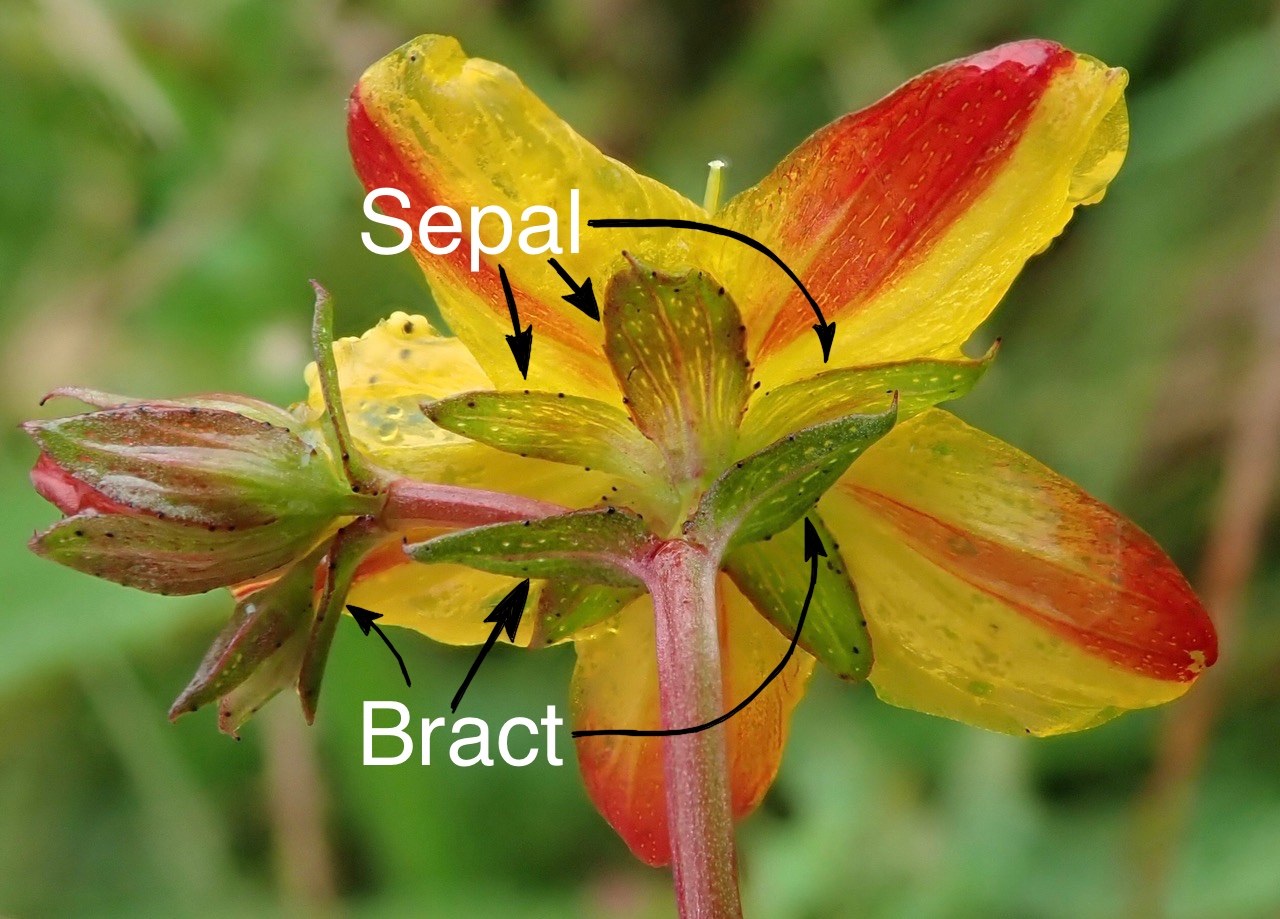
Toadflax-leaved SJW underside of flower showing sepals.

This rare St. John's-wort might be called narrow-leaved St John's-wort since this is its main feature difference, compared with other species of SJW.

 In my previous blog on SJW ID features I had to use photos from Northern Portugal since I had not seen this species in the UK.  This is not ideal as some features might be slightly different, so I decided to visit the Teign Valley in Devon to update my photos.

I had a tip off that a site close to Fingle Bridge on the upper path to Castle Drogo had a good population but this was back in 2017. In fact the BSBI database had no records in the Teign Valley since 2017.

The site was visited on the 19th July 2022. The valley side is mainly wooded but the grid reference aligned with a clear area. No plants were found but the area was very dry.

The next day I went to Dunsford Wood which has the most records on the BSBI database. This site is slightly downstream of the Fingle Bridge site but is similar in being a wooded steep valley with occasional rocky outcrops which are free of tree cover.  Several sites were checked but no plants were found. A final area just upstream of Dunsford Wood was checked and I climbed up a steep wooded slope to a clear area.

Again this site was very dry, even the heather was struggling to flower.

Rocky outcrop being suitable habitat.

This site was my lucky break. Three plants were found and one was in full flower.

Toadflax-leaved St. John's-wort. 20July2022

The above photo shows the main feature of the narrow leaves. The main stem is upright but other stems were prostrate. One plant was looking very dry and had no open flowers.

The narrow leaves were about 1-1.5cm long and had a prominent pale central vein.


Close up views of a backlit leaf shows prominent central vein and thiner secondary veins which run up the leaf. The leaves have black glands (dots) mainly on the margin but also some on the inner parts. No perforations were seen but according the the literature some can occasionally occur. The stem can be seen as round in section.The leaves are sessile and have no petiole.

The only other St. John's-wort with narrow leaves is the Irish SJW but this has no black dots anywhere.

Underside of flower. Teign Valley, Devon. 20July2022
The length of the sepals were about half the petal length, much longer than the plants I had seen in Portugal. The sepals in both countries have very long stalks tipped with the black glands. The length of these stalks seems to vary from long to extremely long as shown in above photo. Based on a limited sample of plants this would appear to be a distinctive feature. The sepals also have black lines (glands), present in both countries and the petals have lots of black glands on the margin.

This flower also has two sepal like bracts just below the sepals, a feature which seems to be common in many SJW's. The above flower is not showing any red lines on the petals which may have faded out as in bud, the petals can look red. You can just see two-three yellow anthers poking out from behind the petals.

Toadflax-leaved SJW Northern Portugal. 2017

Toadflax-leaved SJW, 20Jul 2022. Teign Valley, Devon

Final shot showing top view of flowers.

Conclusion.

I was very lucky to find any plants this year. The preferred habitat of the rocky outcrops was very dry. Maybe in a wetter year more plants would have been showing, however with no BSBI Database records from the Teign Valley since 2017, it is possible than this species is becoming less frequent. It should be well adapted to dry conditions since its range is more southerly in Europe (France and Iberian Peninsula) and Britain is at its northern limit. 

Dr Robson in his article 'British and Irish St. John's-worts' published in ' A Guide To Some Difficult Plants' by the Wild Flower Society suggests that plants on mainland Britain, seem to be pure without any signs of hybridisation with Trailing SJW (Hypericum humifusum).  Plants on the Channel Islands and a previous population on Cape Cornwall (now extinct), had either been thought to be a form called var. approximatum or possible the result of hybridisation. More recent informatiom from the 'Hybrid Flora of the British Isles', 2015 by Stace, Preston and Pearman show hybrids have been recorded from Pembrokeshire and the Lleyn peninsula, Caernarfonshire. 


Peter G. Leonard

July 2022


Thursday, 23 June 2022

St. John's-wort identification

St. John's-wort identification. Beginners Guide.

Britain and Ireland have 12 non-shrubby species of St. John's-worts plus a few shrubby species like Tutsan. All have attractive yellow flowers and many are widespread.  


Separation of these 12 species is fairly straightforward in Britain and Ireland. Species that are usually easy to identify as seperate species in Britain may not be so easy in Europe. The best comprehensive and expert guide to 'British and Irish St. John's-worts'  was written by Dr N. K. B. Robson and published by the Wild Flower Society in it's  'A Guide to some difficult plants' reprinted by Summerfield Books in 2006. The strength of this paper is that it gives a European wide perspective, written by the leading expert. 

Following, is my non-expert attempt to produce a set of identification features to separate these 12 species, based on photos I have taken.  The idea is to use it as an addition to your field guide which will include other information like flowering time and distribution maps. It attempts to give more detail than normally possible in a field guide. 

The weasel word 'fairly' appears above because this group of species has pairs that can hybridise. This is especially true of the most common Perforate SJW and the Imperforate SJW and their hybrid know as 'Des Etangs' Hypericum x desetangsii.   David J. Barden wrote an excellent paper on this hybrid, Hypericum maculatum-Hypericum perforatum complex in Cambridgeshire ( V.C. 29) published in Nature in Cambridgeshire Volume 52 2010 and available on their website.

 The key finding for me in this paper, was the range of intermediate plants that David Barden separated into five groups.  It showed me that some plants I had photographed and labelled as pure H. perforatum, were in fact not pure. It is however possible to find populations of Perforate SJW which appear pure and have no aberrant features, the 'perfect perforate'.  

As always, plant ID should be based on a range of features, as no single feature is always 100% reliable.

This Key covers leaves (perforations and black dots), petals and sepals with attention to black glands and stem profile which should be looked at mid-stem, not just at the top. Use of X10 or X15 eyepiece will be expected unless you have very good eyesight. 

Where the ID Key species boxes touch, this indicates that hybridisation can occur.

Finally the exact definition of a gland, is that it has a zone of secretion and this is clearly the case for the stalked glands on the sepals. The black dots on the leaves are also glands but I prefer to call them 'dots' because they just look like dark dots. Perforations which can be dots or lines are a feature of St John's-wort and are also glands. Glands contain hypericin and other chemicals which are an attempt to repel insects. These chemicals have been of medical interest and tend to dominate any web searches for any information regarding St. John's-wort's. 

Peter G. Leonard   May 2022 (Updated September 2022 with changes to Wavy and Toadflax-leaved SJW following visits to Devon and Pembrokeshire) 

To print each page, click to highlight and save to downloads, then print from downloads. One correction needed is the difference in perforations between tetrapterum and undulatum which looking at more plants, does not really hold. See photo below Key. A more important point would be the flowers of tetrapterum are normally very crowded (except in shaded positions) and undulatum are not. The sepal shape and the number of black glands does really seem to work.


Left is Wavy (undulatum), right is Square-stalked (tetragonum).

No difference in perforations that I can see.  The example of Wavy SJW is from a plant grown from seeds given to me at a BSBI Conference but it is possible that these were hybrid plants and the size difference seen on the real undulatum photographed in Wales, is a possibly a useful feature.

Monday, 11 April 2022

Wavy St. John's-wort. Hypericum undulatum

Wavy St. John's-wort.   Hypericum undulatum 

Wavy St. John's-wort was a species I had never seen. It has a distribution in Cornwall and Devon with some in Pembrokeshire and a very few near the coast in Mid-Wales. A trip to Ireland via Fishguard provided a chance see it, although mid-September was getting rather late in the season, some records seemed to suggest this species could still flower through September.

We failed to find any at the first site near Newgale, where we were staying. It was late by the time we arrived and started raining, so it was not a intensive search. The next day we headed off to a site near Carnhedryn;  a large area of rough wet pasture with just a few cattle.

 This provided a suitable habitat and previous records suggested it might be a good place. We only found three plants despite an intensive search but that might have been due to it being late in the season. Later that day a search on the coastal path near Tresinwen also failed to locate any plants. The site looked rather overgrown.

H. undulatum shares some features with H. tetrapterum ( Square-stalked SJW) both having a square stem with wings and these two species can have intermediate forms in the western Mediterranean. This is according to the best article on St. John's-worts, British and Irish St. John's-worts by Dr N. K. B. Robson, published by the Wild Flower Society in 'A Guide to some difficult plants'.

 In the UK hybrids have been found although they are very rare.

Wavy SJW hiding in long grass. 13Sept21 

Wavy SJW- top view of flower showing the usual yellow and black anthers.

The good news was that the odd flower was still showing petals so I could see the main characteristic of this species, the red undersides of the yellow petals. See photo below.

Note the sepal like bracts (with a thick main vein) just below the flower where the second stalk breaks off the to the left. This is also present on the bud on the left and made photographing the sepals difficult.

Although several species of St. John's-worts can have red on the underside of the petals, which give the unopened buds a red look, none have the extent of red which Wavy SJW exhibits, as shown below. This and the square stem are good features to identify this species. The petals are showing none or maybe just one black dot near the margin suggesting that black dots are few. 

Wavy SJW 13th Sept 2021


Sepals are both pointed with a distinct tip and oval in shape, with the widest point in the middle. They are also quite wide. Compare with Square-stalked SJW below.


Square-stalked SJW sepals. Narrower and very pointed with a more tapering shape. Same pale perforation lines and veins just visible and just a few black glands.  A maximum of three glands is suggested in the literature for Square-stalked SJW , whereas Wavy SJW has three plus.

Wavy SJW different plant showing wide sepals.

A different example shows sepals with more black glands on the surface. Note the oval shape, where the widest point is about half way on the sepal on the middle bud. Some tips have been lost on the sepals on the open flower. 

 Wavy SJW showing sepals and bracts. 13 Sept 21

Here again there is a sepal like bract getting in the way and hiding one of the sepals on the open flower. 

The shape of these sepals is still wide and oval and they do not just taper down from a wide base as in Square-stalked SJW. 

Stem.

Wavy SJW square stem.

Stem shape  at mid level shows a square stem with wings. Sometimes these wings have black edges.

This is similar to Square-stalked SJW which can have slightly larger wings apparently.

Wavy SJW Leaf.

Leaf showing wavy edge, a feature that was not as easy to see on these late season plants, partly due to the lack of lower leaves at this late date. The leaf is sessile but not clasping. It has many quite prominent perforations and some net veins can be seen between the major veins. It also has black dots mainly along the edge.

Wavy SJW leaf showing net veins.

Some comparison shots of Square-stalked SJW.

Flowers

Square-stalked SJW flowers. 

Flowers are crowded at the top of plant. Petals are pale yellow with no or very limited red.

Sepals are tapering and pointed and can have a few black glands, if any. 

Square-stalked SJW. 

Stem is square and winged.  The leaf is sessile but not clasping. It has many quite prominent perforations and some net veins can be seen between the major veins. It also has black dots mainly along the edge. All similar to Wavy SJW except the perforations are smaller and denser but this difference is tiny and may be too subject to variation.

Detail of leaf of Square-stalked SJW showing density of perforations.

Detail of leaf section of Wavy SJW showing lower density and slightly larger size perforations .

 Conclusion.

The combination of lots of red on the petals, less crowded flowers and a wavy edge to some of the leaves, especially lower down, separate Wavy St. John's-Wort from Square-stalked SJW. The size of the leaf perforations and density are also a feature, with Square-stalked having smaller and denser perforations but as the photos show above, this is a subtle difference and may not be reliable.

The literature suggests that the winged square stems have more prominent wings in Square-stalked but this is hard to judge and there may be some overlap in this feature. On the sample of only three plants,  it is hard to judge the sepal shape but it does appear that the sepals are more oval in shape than most Square-stalked SJW .

Separation of these two closely related species is therefore fairly straightforward however, finding a hybrid between them would be quite difficult and would require very close inspection. We are fortunate that flowers in Britain have the prominent red flushing because plants in for example Portugal, have just yellow petals. 

The literature suggests that the flower diameter is 12-20mm for Wavy SJW and 9-13mm for Square-stalked SJW. A featureI did not check on my visit.

Peter Leonard

Rampton , Cambridgeshire.

15 March 2022

Square-stalked SJW leaf showing small and dense perforations.

Wavy SJW leaf showing slightly less dense perforations.

Note the wavy edge to these leaves especially near the base of the leaf. Not easy to see. 


Wednesday, 23 February 2022

Rosa agrestis. Small-leaved Rose in Cambridgeshire.

 Rosa agrestis Small-leaved Rose in Cambridgeshire.

In June 2020 Joe Sharman (of Monksilver Nursery at Cottenham)  brought Alan Leslie ( author of Flora of Cambridgeshire) a specimen of an unusual rose he had collected  from near Knapwell Wood. Alan recognised it as a probable R. agrestis and this was confirmed by a visit to the site and subsequent confirmation by the BSBI rose expert Roger Maskew. This was the first record for Cambridgeshire. I had been attempting to take photos of all the wild roses found in Cambridgeshire, so this proved an added bonus as this was not a species I had considered as a remote possibility. There is only one other dot on the BSBI map in East Anglia and that is near Norwich.

R. agrestis is a very rare rose with just a scattering of records in Southern Britain and slightly more in the centre of Ireland.

This blog contains some photographs of the excellent find by Joe and Alan.

R. agrestis belongs in the Section Caninae because it has the peculiar canina meiosis where four fifths of the inheritable characteristics come from the seed parent. All roses in the section caninae are all unbalanced polyploids. R. agrestis is in sub-section Rubigineae with R. micrantha and R. rubiginosa.   

R. agrestis Knapwell Wood, 15th June 2020
At first sight the flower could be passed over as just another Dog Rose.

R. agrestis.

The stigma cluster is quite large nearly covering the disc and with few hairs if any. The disc is slightly convex. Again this could be within the variation of a Dog Rose R.canina.

R. agrestis, 15th June 2020 Sepals and pedicel.
The pedicel (stalk just below the flower and hypanthium) has no glandular hairs being clean, again just like a Dog Rose R. canina. The sepals have an upper surface covered in cobwebby hairs which is a feature shared with many other roses. The sepals are long and pinnate with edges showing the red tips of the glandular hairs. Sepals are reflexed at flowering stage. Again there is nothing here to separate it from a Dog Rose R. canina although the number of red tipped glandular very stalked hairs on the sepals is a bit unusual for a R. canina.

R. agrestis Underside of leaf. 15th June 2020

Leaflet shape has narrow base (cuneate) which is not normal in Dog Rose and the stem between the leaflets ( petiole and rachis) are covered in stalked glandular hairs and no simple hairs. Hard to see in this photo but the leaflets have scattered clear glands all over the lower surface. Time to take a more detailed look as these glands are not consistent with a Dog Rose.

R. agrestis Underside of leaflet. 15thJune2020

The underside of the leaflet is covered with clear stalked glandular hairs and although there is some variation in the size of these glandular tips they are in the range 0.1-0.12 mm diameter for the larger, which is similar to those seen on R. rubiginosa and R. micrantha.

R. agrestis 22nd Aug 2020, Leaf upper-side somewhat shiny. The lower leaflets are often smaller and reflexed.

R. agrestis Leaf upper side, new growth May 2021

R. agrestis Leaflet edge showing glandular edge. 22th Aug 2020

A close view of the leaflet edge shows a uniserrate edge with glandular hairs on both sides of the teeth which give it a multi-serrate look. The teeth tips have red hydathodes which are different to the glandular hairs in that they are solid and hard and pointed, not rounded. The glandular hairs are not really forming on distinct secondary-tips. Exact shape of leaflet edge does change depending on what part of the leaflet you look at and sometimes the glandular hairs do sit on secondary tips, as shown below on a new leaflet taken in May 2021.

New growth, May 2021. Multiserrate edge.


R. agrestis Stipule at base of leaf. 15th Jun 2020

Stipule is quite narrow with stalked glandular hairs on the edge and also some on lower surface. The glandular hairs on the leaf stem (petiole) are often on a short stalk and the rachis and petiole lack any white simple hairs. 

R. agrestis 15th Jun 2020. Stipule and young prickles.

R agrestis. 15th Jun 2020 Base of terminal leaflet.
Not all leaflets will be as extreme as this example but the narrow cuneate base is a key feature of R. agrestis. Note also the stalked glandular hairs on the rachis with no simple white hairs.

A new word to learn....

R. agrestis. 15th Jun 2020. Leaflet veins highlighted to show semi-craspedodromus pattern.

One of the important features in separating roses in the fossil record is the semi-craspedodromus pattern shown in some roses species. This is not a term I had come across before, so had to look it up. 
Although quite subtle and not present in every part of the leaflets, overall these leaflets show this semi-craspedodromus pattern with the loops before the veins make it to the leaflet edges. In a craspedodromus leaf the veins all end up going directly to the leaf margin. Some may split on the way. The semi-craspedodromus venation is present in all the section caninae roses and many others, so it is not a useful ID feature but it would be an interesting find if you found a rose that did not have his feature. An example would be Rosa stellata which has leaves like a gooseberry, but it is not hardy in the UK coming from the deserts of Texas to Arizona. 

Craspedodromus leaf venation      Semi-craspedodromus leaf venation


R.agrestis 15th Jun 2020. Stem prickle.

The BSBI Rose handbook No7 shows the prickles having a very stout base whereas the prickles photographed were a more ordinary shape. However the shape of prickles is quite variable depending on what part of the stem you look at. These prickles are not very hooked.  

R. agrestis 15th Jun 2020 Near Knapwell Wood, Cambridgeshire.

Finally a photo of the largest, possibly the original, plant in this group of about ten plants.

All these section Caninae roses are species derived from hybrids from their past evolution which continue to hybridise now. To identify a rare rose like R. agrestis, I am very grateful that Alan Leslie took a sample and sent it to BSBI rose expert Roger Maskew to be confirmed. 

Peter Leonard

Rampton, Cambridgeshire.

6th May 2021

Ref:- 

 G. G. Graham and A.L. Primavesi.(1993) Roses of Great Britain and Ireland, BSBI handbook No 7 . 

 Leslie, A.C. (2019). Flora of Cambridgeshire. RHS, London.

Postscript. Additional sites seen in 2021.

The nearest agrestis site to Cambridge is at Wymondley near Hitchin. This population was found on the banks of the Wymondley Grid Station back in 1986 and was confirmed by A.L. Primavesi  in 1994.  Alan and I visited this site on 12th July 2021 and a large number of bushes was found. They showed the same key features as the Knapwell plants but had a more greyish leaf colour.  


Wymondley Grid Station  Hertfordshire. 12th July 2021
Note the rose in the picture was not identified as it was inside a perimeter fence.


R. agrestis Wymondley Grid Station 12th July 2021

Leaflet shape showing pointed apex and well spaced leaflets. Petiole and rachis showing lots of glandular hairs.


R. agrestis Wymondley Grid Station 12th July 2021

The above photo shows the slightly greyish leaflet colour of all the plants at this site.

New Norfolk site.

On 27th July 2021, I visited Snettisham RSPB  reserve in Norfolk to see the Western Sandpiper and having obtained distant views, walked south on the footpath to find two bushes which fitted Rosa agrestis.  A sample was taken and this was later confirmed by Mr Maskew as R. agrestis. First record for West Norfolk.

R. agrestis Snettisham RSPB. 27th July 2021

R. agrestis. 27th July 21. Photo showing smooth pedicel, hypanthium and sepals.

R. agrestis. 27th July 2021. Rachis showing glandular hairs plus some simple hairs.

The observations from these two addition sites is that the Wymondley plants had a greyish look unlike the Knapwell plants; the Snettishham plants had additional simple hairs on the petiole/rachis which the Wymondley and Knapwell plants did not have. One has to conclude that within, what is regarded as a species, there is some variation of quite important features. 


Essex Botany No 13 Autumn 2021 reported six bushes of Rosa agrestis had been found on scrubbing saline pastures on Oozedam Farm at Stanford-le-Hope VC18 growing on mud-flat deposits. 

'It's possible that there is sufficient marine shell material in the mud to provide the calcareous substrate which is supposed to need.'

This is the first record for Essex. It might be worth searching for more coastal sites in East Anglia?

Peter Leonard

23rd Feb 2022


Final update 2023. The Knapwell Wood records, following a search of the area by Alan Leslie has been found to have spread from a planted original plant nearby. It would appear that somewhere is a nursery that is carefully propagating wild roses species for sale and this will contaminate the distribution mapping.