Wednesday, 23 February 2022

Rosa agrestis. Small-leaved Rose in Cambridgeshire.

 Rosa agrestis Small-leaved Rose in Cambridgeshire.

In June 2020 Joe Sharman (of Monksilver Nursery at Cottenham)  brought Alan Leslie ( author of Flora of Cambridgeshire) a specimen of an unusual rose he had collected  from near Knapwell Wood. Alan recognised it as a probable R. agrestis and this was confirmed by a visit to the site and subsequent confirmation by the BSBI rose expert Roger Maskew. This was the first record for Cambridgeshire. I had been attempting to take photos of all the wild roses found in Cambridgeshire, so this proved an added bonus as this was not a species I had considered as a remote possibility. There is only one other dot on the BSBI map in East Anglia and that is near Norwich.

R. agrestis is a very rare rose with just a scattering of records in Southern Britain and slightly more in the centre of Ireland.

This blog contains some photographs of the excellent find by Joe and Alan.

R. agrestis belongs in the Section Caninae because it has the peculiar canina meiosis where four fifths of the inheritable characteristics come from the seed parent. All roses in the section caninae are all unbalanced polyploids. R. agrestis is in sub-section Rubigineae with R. micrantha and R. rubiginosa.   

R. agrestis Knapwell Wood, 15th June 2020
At first sight the flower could be passed over as just another Dog Rose.

R. agrestis.

The stigma cluster is quite large nearly covering the disc and with few hairs if any. The disc is slightly convex. Again this could be within the variation of a Dog Rose R.canina.

R. agrestis, 15th June 2020 Sepals and pedicel.
The pedicel (stalk just below the flower and hypanthium) has no glandular hairs being clean, again just like a Dog Rose R. canina. The sepals have an upper surface covered in cobwebby hairs which is a feature shared with many other roses. The sepals are long and pinnate with edges showing the red tips of the glandular hairs. Sepals are reflexed at flowering stage. Again there is nothing here to separate it from a Dog Rose R. canina although the number of red tipped glandular very stalked hairs on the sepals is a bit unusual for a R. canina.

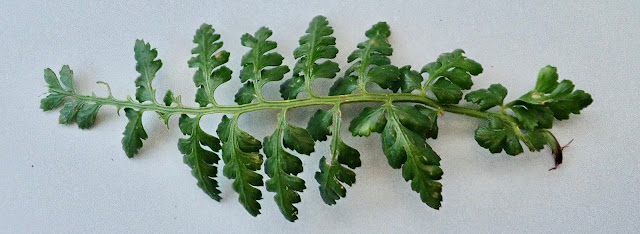
R. agrestis Underside of leaf. 15th June 2020

Leaflet shape has narrow base (cuneate) which is not normal in Dog Rose and the stem between the leaflets ( petiole and rachis) are covered in stalked glandular hairs and no simple hairs. Hard to see in this photo but the leaflets have scattered clear glands all over the lower surface. Time to take a more detailed look as these glands are not consistent with a Dog Rose.

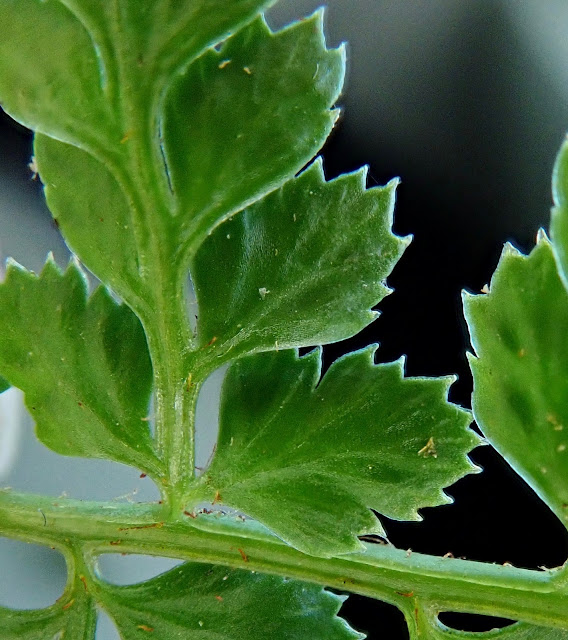
R. agrestis Underside of leaflet. 15thJune2020

The underside of the leaflet is covered with clear stalked glandular hairs and although there is some variation in the size of these glandular tips they are in the range 0.1-0.12 mm diameter for the larger, which is similar to those seen on R. rubiginosa and R. micrantha.

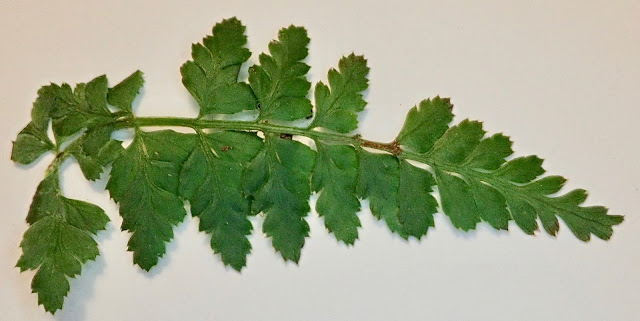
R. agrestis 22nd Aug 2020, Leaf upper-side somewhat shiny. The lower leaflets are often smaller and reflexed.

R. agrestis Leaf upper side, new growth May 2021

R. agrestis Leaflet edge showing glandular edge. 22th Aug 2020

A close view of the leaflet edge shows a uniserrate edge with glandular hairs on both sides of the teeth which give it a multi-serrate look. The teeth tips have red hydathodes which are different to the glandular hairs in that they are solid and hard and pointed, not rounded. The glandular hairs are not really forming on distinct secondary-tips. Exact shape of leaflet edge does change depending on what part of the leaflet you look at and sometimes the glandular hairs do sit on secondary tips, as shown below on a new leaflet taken in May 2021.

New growth, May 2021. Multiserrate edge.


R. agrestis Stipule at base of leaf. 15th Jun 2020

Stipule is quite narrow with stalked glandular hairs on the edge and also some on lower surface. The glandular hairs on the leaf stem (petiole) are often on a short stalk and the rachis and petiole lack any white simple hairs. 

R. agrestis 15th Jun 2020. Stipule and young prickles.

R agrestis. 15th Jun 2020 Base of terminal leaflet.
Not all leaflets will be as extreme as this example but the narrow cuneate base is a key feature of R. agrestis. Note also the stalked glandular hairs on the rachis with no simple white hairs.

A new word to learn....

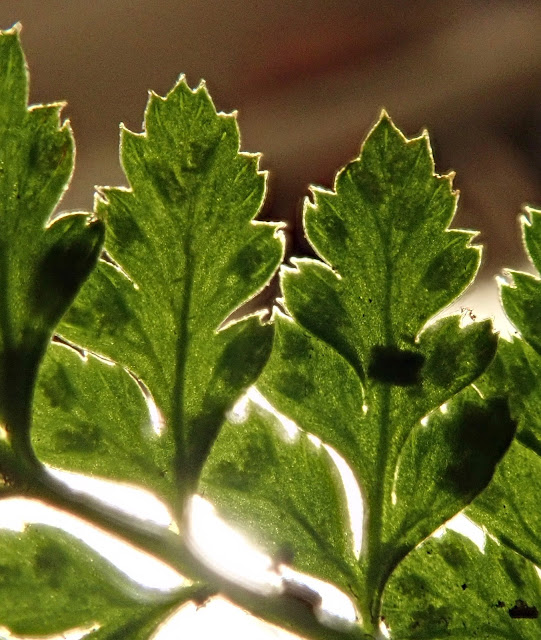
R. agrestis. 15th Jun 2020. Leaflet veins highlighted to show semi-craspedodromus pattern.

One of the important features in separating roses in the fossil record is the semi-craspedodromus pattern shown in some roses species. This is not a term I had come across before, so had to look it up. 
Although quite subtle and not present in every part of the leaflets, overall these leaflets show this semi-craspedodromus pattern with the loops before the veins make it to the leaflet edges. In a craspedodromus leaf the veins all end up going directly to the leaf margin. Some may split on the way. The semi-craspedodromus venation is present in all the section caninae roses and many others, so it is not a useful ID feature but it would be an interesting find if you found a rose that did not have his feature. An example would be Rosa stellata which has leaves like a gooseberry, but it is not hardy in the UK coming from the deserts of Texas to Arizona. 

Craspedodromus leaf venation      Semi-craspedodromus leaf venation


R.agrestis 15th Jun 2020. Stem prickle.

The BSBI Rose handbook No7 shows the prickles having a very stout base whereas the prickles photographed were a more ordinary shape. However the shape of prickles is quite variable depending on what part of the stem you look at. These prickles are not very hooked.  

R. agrestis 15th Jun 2020 Near Knapwell Wood, Cambridgeshire.

Finally a photo of the largest, possibly the original, plant in this group of about ten plants.

All these section Caninae roses are species derived from hybrids from their past evolution which continue to hybridise now. To identify a rare rose like R. agrestis, I am very grateful that Alan Leslie took a sample and sent it to BSBI rose expert Roger Maskew to be confirmed. 

Peter Leonard

Rampton, Cambridgeshire.

6th May 2021

Ref:- 

 G. G. Graham and A.L. Primavesi.(1993) Roses of Great Britain and Ireland, BSBI handbook No 7 . 

 Leslie, A.C. (2019). Flora of Cambridgeshire. RHS, London.

Postscript. Additional sites seen in 2021.

The nearest agrestis site to Cambridge is at Wymondley near Hitchin. This population was found on the banks of the Wymondley Grid Station back in 1986 and was confirmed by A.L. Primavesi  in 1994.  Alan and I visited this site on 12th July 2021 and a large number of bushes was found. They showed the same key features as the Knapwell plants but had a more greyish leaf colour.  


Wymondley Grid Station  Hertfordshire. 12th July 2021
Note the rose in the picture was not identified as it was inside a perimeter fence.


R. agrestis Wymondley Grid Station 12th July 2021

Leaflet shape showing pointed apex and well spaced leaflets. Petiole and rachis showing lots of glandular hairs.


R. agrestis Wymondley Grid Station 12th July 2021

The above photo shows the slightly greyish leaflet colour of all the plants at this site.

New Norfolk site.

On 27th July 2021, I visited Snettisham RSPB  reserve in Norfolk to see the Western Sandpiper and having obtained distant views, walked south on the footpath to find two bushes which fitted Rosa agrestis.  A sample was taken and this was later confirmed by Mr Maskew as R. agrestis. First record for West Norfolk.

R. agrestis Snettisham RSPB. 27th July 2021

R. agrestis. 27th July 21. Photo showing smooth pedicel, hypanthium and sepals.

R. agrestis. 27th July 2021. Rachis showing glandular hairs plus some simple hairs.

The observations from these two addition sites is that the Wymondley plants had a greyish look unlike the Knapwell plants; the Snettishham plants had additional simple hairs on the petiole/rachis which the Wymondley and Knapwell plants did not have. One has to conclude that within, what is regarded as a species, there is some variation of quite important features. 


Essex Botany No 13 Autumn 2021 reported six bushes of Rosa agrestis had been found on scrubbing saline pastures on Oozedam Farm at Stanford-le-Hope VC18 growing on mud-flat deposits. 

'It's possible that there is sufficient marine shell material in the mud to provide the calcareous substrate which is supposed to need.'

This is the first record for Essex. It might be worth searching for more coastal sites in East Anglia?

Peter Leonard

23rd Feb 2022


Final update 2023. The Knapwell Wood records, following a search of the area by Alan Leslie has been found to have spread from a planted original plant nearby. It would appear that somewhere is a nursery that is carefully propagating wild roses species for sale and this will contaminate the distribution mapping. 


Thursday, 13 January 2022

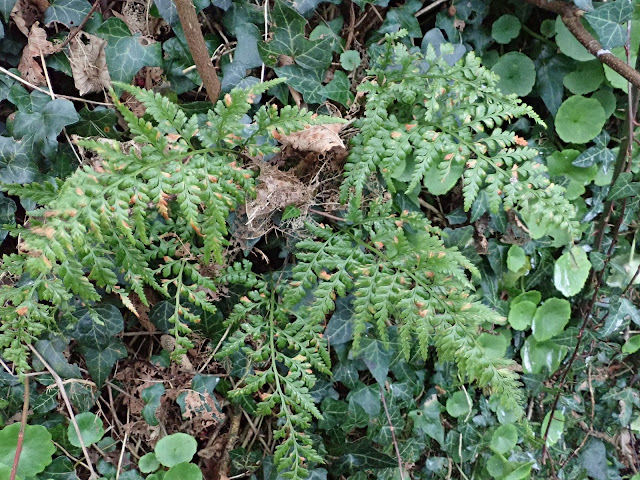
Lanceolate Spleenwort in West Cork

Lanceolate Spleenwort in West Cork.

A search for new ferns while on a winter break in West Cork, December 2021.

 Two possible targets were Irish Spleenwort (Asplenium onopteris) and Lanceolate Spleenwort (Asplenum obovatum).  Both are rarely recorded, especially Irish Spleenwort which has no recent records in County Cork.

Both species hybridise with the variable Black Spleenwort (Asplenium adiantum-nigrum) so some care would be needed in identification, especially as I have no previous experience. A site near Bandon, Keye's Bridge, was checked for Irish Spleenwort, where it had been seen in the past but only Black Spleenwort was found. About ten quite large plants were seen. One possibly might have been showing some intermediate characterises of Irish Spleenwort but more likely was just variation. 

 The new book on ferns, 'Britain's Ferns' by James Merryweather, uses photos taken in Corfu which shows plants of Irish Spleenwort which are more similar to Black Spleenwort than those seen in Ireland. The Irish plants are more extreme in their fine dissection. 

The Keye's Bridge visit did allow me to get more familiar with Black Spleenwort. These were large plants that had fronds with pinna over 20cm of rachis.

Black Spleenwort at Keye's Bridge.  19Dec2021


Black Spleenwort, large frond. 19Dec2021

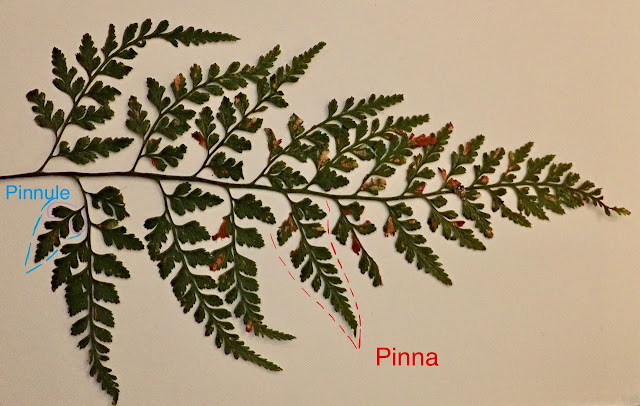
The two lowest pinna have pinnules that are divided into pinnulets so this large frond is tripinnate.
Smaller fronds are only just bipinnate but all are triangular in outline.

A bit of detail.

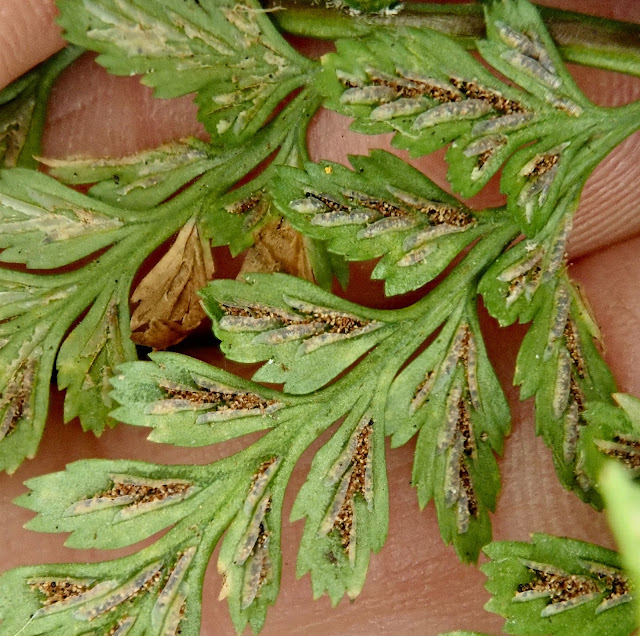
Black Spleenwort. Keye's Bridge.  Linear sori are long. 19Dec2021
The sori are covered by a hinged indusia which is at least four time as long as wide, on the longer ones. They are also starting towards the inner side of the pinnulet. 

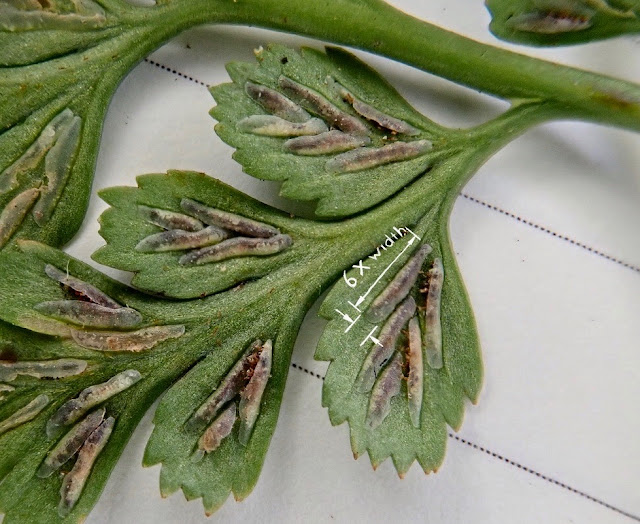
Black Spleenwort indusia is long and thin and they start near the base of the pinnule/pinnulet.
The one highlighted is measured as six times as long as wide although the ones further out are much shorter. The indusia are hinged along one long edge and cover the sori. 


Black Spleenwort. 27th Dec2021

Notice the stem , called the stipe below the lowest pinna, is dark brown. This dark shinny brown colour goes all the way round the stipe until just below the lowest pinna then fades out to green on the upper side but continues on the back of the frond as a tapering brown line that eventually thins out at least half way up the rachis. See photo below.
Black Spleenwort 27Dec2021. Brown strip tapers out on underside of rachis. 

Why are these features important?  The new target species, Lanceolate Spleenwort, has short indusia.
The shinny red-brown stem ascends the stipe/rachis higher in Irish Spleenwort according to some literature but I have yet to see that feature or the species, to see if it holds true. 

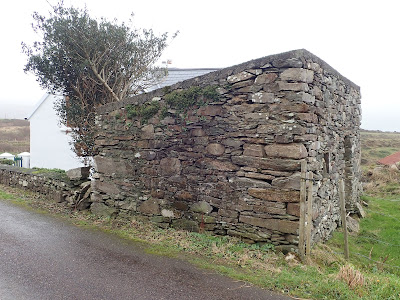
The search for Lanceolate Spleenwort started with research into the British Pteridological Society Bulletin ( Vol 7, 2010 No3 page 198-204), where I found a society visit to West Cork back in 2009. They had found an 'easy to access' colony of Lanceolate Spleenwort on the Kilcatherine area of the Beara Peninsula, not far form where we were staying. There was even a photo showing members taking pictures of Asplenium obvatum subsp. lanceolatum on the wall of a small outbuilding beside the road.
A bit more research using street view on google maps located the outbuilding was still present and that ferns could still be seen growing on it.  It seemed likely that this would be a good place to check out.

On the 31st December I drove to Kilcatherine and found the stone outbuilding. 


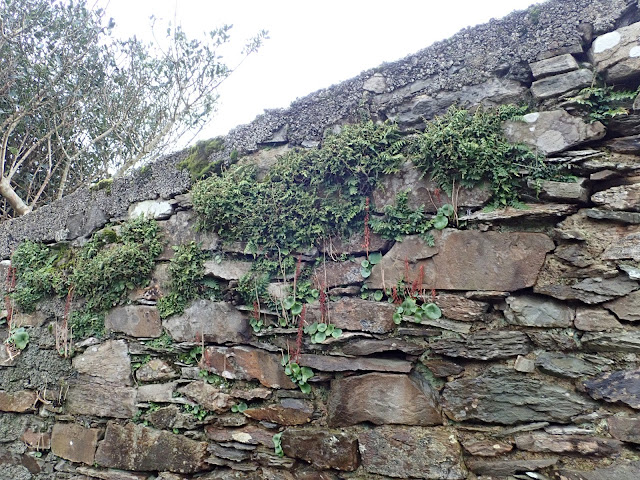
It looks as if nothing has changed since 2009. The ferns were still growing on about ten clumps high on the wall. The house has been done up but that's about it. I took photos.

The first thing to say is that these clumps of ferns looked similar to Black Spleenwort but were somewhat different. Late December is probably not the best time of year and they were a bit bashed up but the fronds which stayed close to the wall were still in good condition and even at a distance looked different. Something about the way the terminal pinnae stick out with a clear gap between them and form a ladder each side of the rachis was unlike the Black Spleenwort I had seen earlier that day. Out on the end of the Beara, all these plants are small and the fronds are typically not more than 7cm long compared with the 20cm of the more inland Black Spleenwort (Keye's Bridge, Bandon).  

Lanceolate Spleenwort, 31Dec2021, 

Lanceolate Spleenwort. Detail of frond showing ladder of pinna on each side of the rachis.

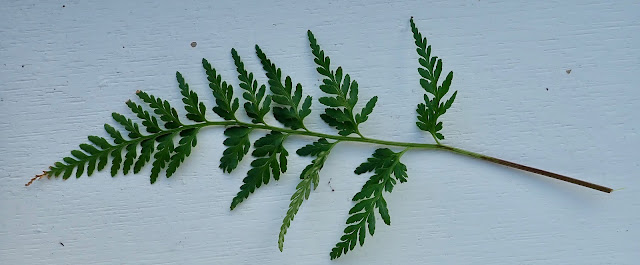
Another characteristic which the above photo shows, is that the pinnules on the lower pinna are cut back to the pinna stem making this a bipinnate frond. This is not a useful distinction as the small Black Spleenwort are also often bipinnate ( pinnate to bipinnate to tripinnate). What is slightly more interesting is that the pinnules are rounded (obovate) and have points, like little hands with tiny short fingers.

Shape:


 The most important difference as stated on page 36 of 'Britain's Ferns' is

                                       Lanceolate  Spleenwort                                 Black Spleenwort
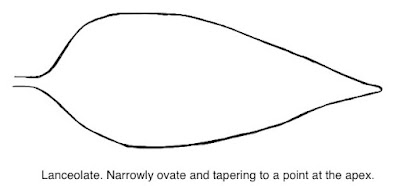
Fronds-                          Ovate-lanceolate in outline narrowing             Triangular in outline. broadest
                                       at the base. Basal pinna weakly inflexed.         at the base. 

Pinna -                           lanceolate shape                                               triangular shape
Pinnules-                       obovate shape                                                   lanceolate shape

(Note Obovate , egg-shaped with the broadest part near the apex.)

My photos did not support the pinna shapes as stated above. Maybe this is due to small plant size.

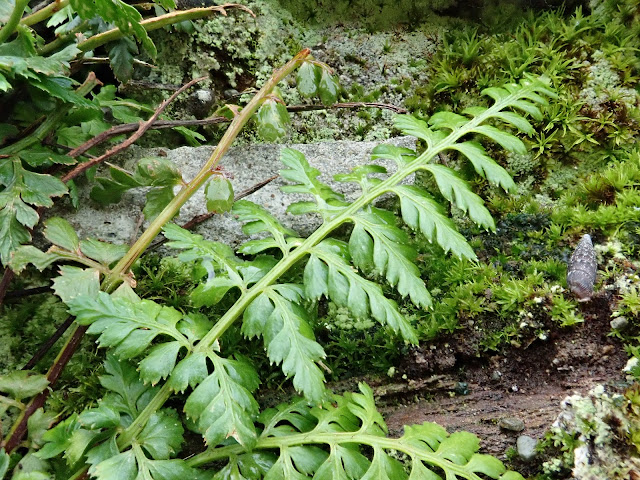
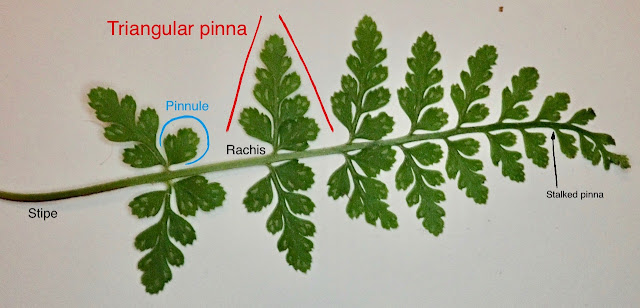
I could see that the Lanceolate Spleenwort has fronds that are not triangular. The pinnae were often triangular in the sense that the pinnules get larger towards the base on the pinna, not lanceolate. These pinnules were rounded/obovate. 

Frond of Lanceolate Spleenwort, Asplenium obvatum subsp. lanceolatum   Kilcatherine, Beara.

The main point is that the frond is not triangular with the lowest pinnae being slightly smaller than the next pair up. I would consider the pinnae to be triangular rather than lanceolate. Maybe larger plants show a lanceolate shape as stated in 'Britain's Ferns'. The lower pinnae are clearly supporting separate (stalked) pinnules (example highlighted in blue), which are quite rounded in shape.  The terminal pinnae are stalked.

The pinnae start off being opposite and become more and more alternate as you go up the rachis. Some fronds had opposite pinnae all the way up but others were alternate for most of the way up. Lots of variation on this feature and it is probably not that useful.  I have yet to see a Black Spleenwort with opposite pinnae going all the way up the rachis. 

Lanceolate Spleenwort. Kilcatherine, Beara.

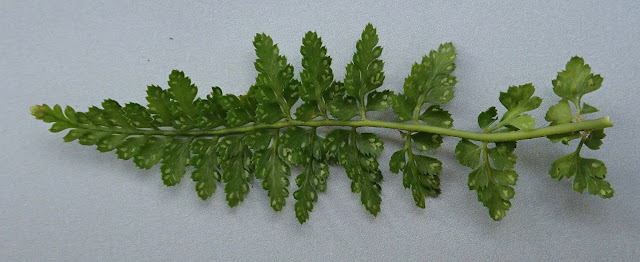
Another frond which again is lanceolate in outline - certainly not triangular. Pinnae shape not as open on this frond but pinnules are still rounded. Ultimate segments near the apex are stalked.

Lanceolate Spleenwort, Kilcatherine, Beara.

Although the tip of the frond is rather damaged this frond displays the ladder effect of the pinnae sticking out at right angles in a line. Black Spleenwort tends to have more upswept pinnae but this is a marginal feature.


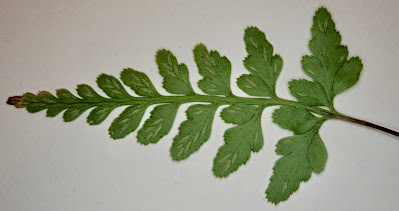
Lanceolate Spleenwort. Detail of pinnule showing the serrated outer margin with sharp tips.

Black Spleenwort. Detail showing similar sharp tips which is not always present on some plants. 

Black Spleenwort showing triangular frond outline despite some damage.
Note the terminal segments are wide based rather than stalked at least on smaller fronds, whereas on Lanceolate Spleenwort these terminal segments are more stalked. There is variation as some Black Spleenwort also can have stalked terminal segments.

Black Spleenwort , typical small frond from West Beara. 

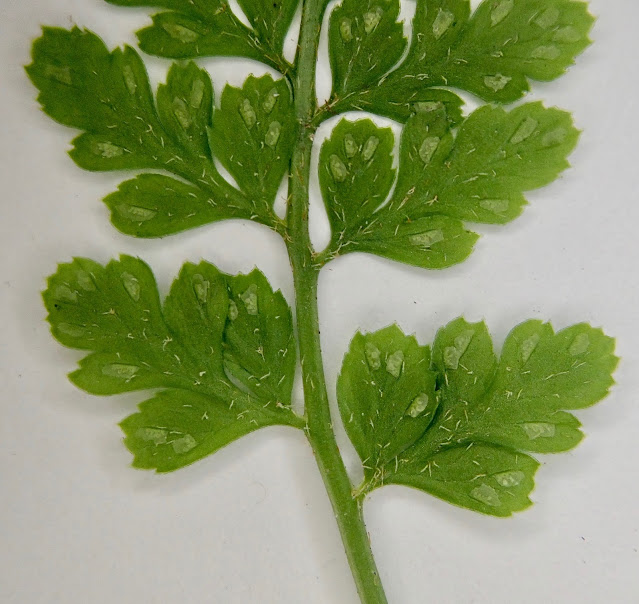
Lanceolate Spleenwort. 

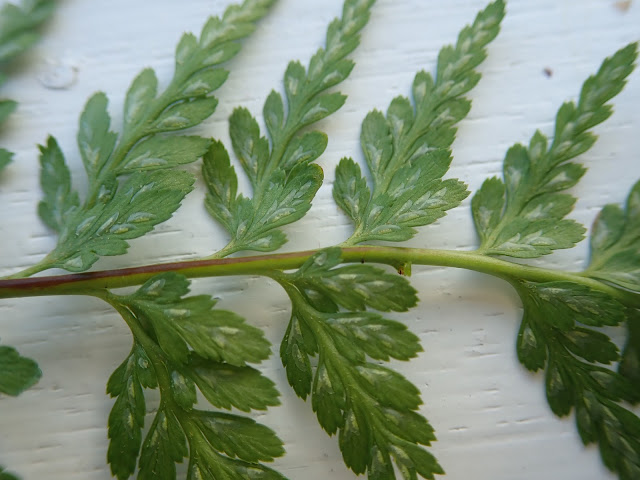
The above photo shows the short indusia which are at most, three times as long as wide in Lanceolate Spleenwort.  They also start towards the margin rather than at the base. The tiny hair like scales that are present on the rachis and underside of the pinnules, a feature that Black Spleenwort can also have.

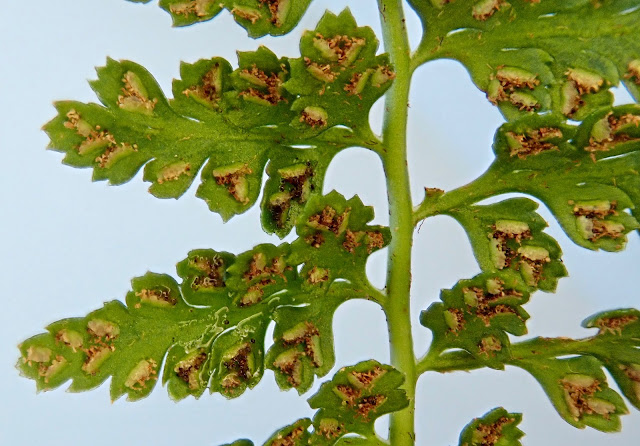
Lanceolate Spleenwort. A more mature frond showing indusia and sori.

The shape and position of the of the indusia are useful in separation of Lanceolate and Black Spleenwort. The above photo shows very short indusia at most three times as long as wide, plus the starting point is further out from the base in comparison to Black Spleenwort.

I made a second trip back to Kilcatherine to double check I really had found Lanceolate Spleenwort and to exclude the possibility that some were hybrids. Black Spleenwort is quite a common plant in the area. More photos were taken and in the end I was happy.

 Something in the shape of the fronds is different even before you look at the outline shape, but is hard to put into words that do not fall foul of the variation between fronds. Size of fronds makes a big difference and all the Black Spleenwort I found this far west, are small. Getting very familiar with Black Spleenwort would seem important before looking for the rare species and I am only starting on this journey.

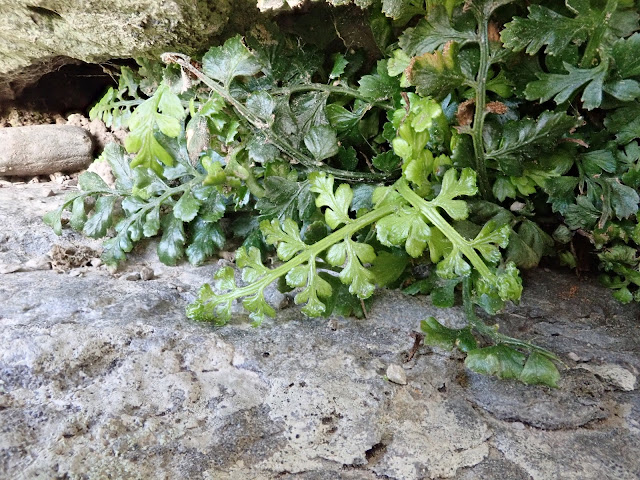
The good news was that on the 4th Jan on a walk out the road on Dursey Island, I was looking at the Black Spleenwort in the roadside bank when I spotted something different, a Lanceolate Spleenwort growing in a crack between stones in the bank.  A new record for Dursey Island.

Lanceolate Spleenwort, 4th Jan 2022. Dursey Island.

Lanceolate Spleenwort is called Aspenium billotii in  C.N. Page, The Ferns of Britain and Ireland but the scientific name has been updated to A. obovatum.  Two sub-species are known, subspecies obovatum is found in SW Europe and Mediteranean but has not been recorded in the British Isles. It is a diploid whereas A. obovatum subsp. lanceolatum is a autotetraploid. ( ref Plant Crib 1998, BSBI) The Plant Crib has an interesting table to separate Black and Lanceolate Spleenwort including  a comment on habit. 

Black Spleenwort is a plant rarely with a well-formed rosette , with few leaves whereas Lanceolate usually forming a compact rosette of many (15+) leaves amongst old persistent leaves and petioles. I did not count the number of fronds but I think my photos did show these features. Indusia length is noted as 1-3mm in Black Spleenwort and 1-2mm in Lanceolate which does not sound much of a difference but together with the position actually quite a useful ID feature. 

Resources

Page, C. N. (1982) The Ferns of Britain and Ireland.   Cambridge University Press.

Merryweather, J (2020) Britain's Ferns. Princeton University Press.


Peter Leonard

Rampton, Cambridgeshire. 13th January 2022


Friday, 26 November 2021

A start into Ferns. Bipinnate or Tripinnate.

A start into Ferns. Bipinnate and tripinnate ?

I started looking at ferns in the autumn of 2020 in West Cork as my normal summer trip had been delayed due to COVID and flowering plants were over their best.

As a complete beginner I made some progress helped by the arrival of the new fern book, 'Britain's Ferns' by James Merryweather which arrived towards the end of my holiday. This new book contains a lot of information and many photographs and is well worth the price of £16.  It does lack some of the detail found in 'The Ferns of Britain and Ireland' by Chris Page which was published in 1982 and has more on hybrids etc. No photos though.

This blog looks at Buckler ferns, as I made basic mistakes in 2020 and missed identifying Broad Buckler- fern ( Dryopteris dilitata).  This was corrected in 2021.

The first reason for going wrong was not understanding the distinction between bi-pinnate and tri-pinnate, which is used a a basic key differentiator in 'Britain's Ferns'. Second reason was not fully appreciating the difference in the size of the pinnule teeth of the Shield ferns vs. the Buckler ferns. 

As a complete beginner, the sheer density of information in 'Britain's Ferns' key was a problem.  Not fully understanding the definition of bipinnate and tripinnate definitely puts you at a disadvantage, along with the fact that this is not a clear distinction in practice.


The above diagram is based on the textbook definition of bi and tri pinnate (Ref.  The Kew Plant Glossary) and is not to scale.  Nor does the shape in the textbook diagram come close to a real fern but it does show the principle.

 If each division were stalked as shown, by the blue Pinnule and purple Pinnulets, it would be fairly straight forward but in real life ferns have a much more complex shape.  In a real fern, the divisions might start off being stalked but become merged, so the distinction between bi and tri has to be based on looking at the lowest pinna rather than the tips. This applies to the pinna division as well as the further pinnule and pinnulet divisions.  An example of these problems is shown in the green highlighted pinnules which show that the pinnules are clearly stalked at the base of the pinna but become merged at the tip. Also the pinnule are segmented into pinnulets at the base of the pinnule but become merged towards the tip.

 The amount of segmentation that forms the pinnulets can cause problems which will be illustrated later using photos.

One suggestion might be that it pays to be methodical. Start with the main frond stem (stipe) and moving up from the base, determine what is a pinna, the first division.  Then move up that pinna and check if the pinnule nearest the stipe is divided into pinnulets, i.e.  separated into distinct sections. This is where it can difficult, as this third division is not always clear cut and this gets worse as you travel up and out on the frond. Also as I will demonstrate later, not all plants conform to the segmentation being complete, even at the base.

Buckler Ferns.

Buckler ferns are tripinnate in 'Britain's Ferns' initial Key. The pinnulets have pointed tips but not as strong as those shown on the bipinnate Shield Ferns. Broad Buckler-fern has the classic shuttlecock form. Separation of the different species of Buckler-fern is difficult but the Broad Buckler-fern normally  has stipe scales that have a dark line through the middle. Separating Buckler ferns species is not the goal of this blog, but it was these dark strips that first alerted me to the correct identification. I had been seeing a Buckler-fern not a Shield-fern. As a beginner with no experience, you can make this type of mistake.

Broad Buckler-fern stipe near the base showing dark centre line.  23Sept21

  Back to the frond detail.

Detailed photo of the pinnule of a Broad Buckler-fern. 23Sept21

I might be breaking my rule to look at the lowest pinna but in this example even the mid pinna show a pinnule (shown outlined in red) has at the base pinnulets, which are segmented right down to the stem of the pinnule (outlined in white). Although the pinnulet base is quite wide and gets wider as you go up the pinnule the segmentation remains 100% until you get close to the tip. This is clearly a tripinnate frond. 


Broad Buckler-fern. Part of pinna near top of frond.

The above photo from the same frond but further up, shows that the pinnule is segmented but only to about 60%.  If you only looked at this part of the frond, the plant might be regarded as bipinnate.  

My first error using the Key was thinking Broad Buckler-fern was bi-pinnate because I was looking too high up the frond.

I wondered if I had found a Shield-fern, never having seen a Shield-fern?


Photo showing pinnulet tips follows.

Broad Buckler-fern showing tips to pinnulets.


Where it starts to get difficult, is that on some plants only the very lowest pinna and the closest pinnule to the stipe has anything like a full segmentation, all the other pinnules have partial segmentation.
There seems to be a lot of variation in this feature. Some fronds are clearly tripinnate for at least the lowest four pinnae and only above that become bipinnate.


Narrow Buckler-fern ( Dryopteris carthusiana) showing lowest pinnule lacking segmentation into pinnulets. 

The photo above shows the lowest pinna base coming off the stipe. The pinnule is segmented but only the very lowest pinnule next to the stipe is fully segmented right down to near the stem of the pinnule.


Photo of the lowest pinna base with the pinnule closest to the stipe. It shows the first pinnulet
is segmented back almost to the stem, the second segmented to about 90% and the third only to about 80%.  I have highlighted the pinnulet margin in black to show this. The next potential pinnulet out is far less segmented. I do not care if the pinnulet is attached on a broad base only its division from the next.

 I think the implication of this is that Broad Buckler-fern and probably all the Buckler ferns are variably bipinnate to tripinnate. 
Buckler-fern frond with tripinnate pinnulets highlighted in yellow, all the rest is bipinnate.

Conclusion. It is good to understand the principles behind the terms bipinnate and tripinnate but also be aware that in real life, ferns require a more complex description. It is interesting that Poland and Clements in their 'Vegetative Key to the British Flora' do not use the term bipinnate and tripinnate but use terms like 'Group BH - Lvs 2-3(4)-pinnate for all the Buckler-ferns, Shield ferns and even Bracken.  
I take from this that the Buckler-ferns can be bipinnate through to tripinnate and is therefore not a good fundamental separator to use in a key, as used in 'Britain's Ferns'. This applies if you are a complete beginner.  The experts know all this anyway.

To finish-  a few shots of Soft Shield Fern to show the different frond structure and the stiff terminal spines to the tips of the pinnules.

Soft Shield-fern, taken West Cork, 25Sept21

Soft Shield-fern. Base of pinna with pinnules with a thumb. 


Soft Shield-fern. Stalked pinnule with thumb and stiff terminal spines.

The first comment on Soft Shield-fern is that the pinnule is only slightly segmented so this is a bipinnate  frond. The shape is very different to that of a Buckler-fern with a much less symmetrical pinnule, unbalanced by the thumb which has a margin that runs very close to the stem.  The tips have terminal spines which are longer than those on the Buckler-ferns, but this is a variable feature.   I saw my first Shield-fern after returning from Cork in 2020, in late November in a ditch in Cambridge.


References:-
Beentje, H. 2020 The Kew Plant Glossary. (2nd Edn.) Kew Publishing.
Merryweather, J. 2020   Britain's Ferns. Wild Guides
Page, C.N. 1982 The Ferns of Britain and Ireland. Cambridge University Press.
Poland. J & Clements. E.J. 2020 The Vegetative Key to the British Flora.(2nd Edn.) John Poland.
 
Peter Leonard
Rampton
November 2021


Other terms not used in this blog:-

 The segmentation of the pinnules is partial and this is called pinnatifid where the depth is not specified, pinnatipartite where segmented to about half way and pinnatisect where divided to almost the midrib.


Narrow Buckler-fern  D. carthusiana.
 Yellow areas are tripinnate pinnulets which are separated to more than 90% of pinnulet length. Rest of frond is bipinnate.
Broad Buckler-fern D. dilatata 

Yellow areas are tripinnate pinnulets which are separated to more than 90% of pinnulet length. Rest of frond is bipinnate. There is a lot of variation about the extent of the frond being tripinnate.

These two fronds were collected in the Kings Forrest in February 22.