Friday, 9 July 2021

Rosa virginiana. Virginian Rose in Cambridgeshire.

Rosa virginiana.  Virginian Rose in Cambridgeshire.

On the 15th June 2021 the Cambridgeshire Flora Group were walking westwards along the Guided Bus Way from Oakington towards Over.  Just before the Northstowe/Longstanton station Alan Leslie spotted a rose with deep pink flowers and green leaves growing in the planted hedge on the north side of the path. Alan identified this rose as Rosa virginiana and is the first record for Cambridgeshire. The hedge has been planted as part of the Guided Bus Project from a 'hedge pack' which mainly contains hawthorn but has at regular intervals rose species, mainly Dog Rose R. canina plus less frequently Sweet Briar R. rubiginosa.

Somehow either by design or mistake the rather unusual American rose has been included in the 'hedge pack' and is now growing free in our countryside.  The Virginian Rose has escaped before in several counties and is included in the BSBI handbook No. 7 by G.G. Graham and A.L. Primavesi.

The following are a few photos to show the features of this American Rose and I include some links to papers on rose evolution.

R. virginiana. Deep pink flowers and green leaves.

R. virginiana. Bright green leaves.

The deep pink might suggest these plants have come from a cultivated form as the handbook suggest the flower colour can be pink to white. It also suggests that the cultivated forms sucker freely, whereas in more natural stock, suckers are few (according to the handbook). The five plants in the Busway hedge were all suckering freely.

R. virginiana. Stigmas in a low dome shape that covers the disc.


One of the first observations that made this rose stand out as odd, was the stigma dome which was very hairy (villous). In fresh flowers it was yellow but soon turns pink.


The stigma dome almost completely covers the disc.

Sepals narrow, more or less simple, with long fine tips, densely glandular beneath. The pedicle and hypanthium with long glandular hairs which were much longer than shown in the handbook illustration. The US literature says these glandular hairs are very variable and some plants can lack them completely.

This photo above shows that some sepals did have thin lobes, so some were not entire/simple.

Bracts on pedicle

Although not a important detail, the bracts are shown in the above photo. The centre pedicle has no bracts but the two side pedicles have a bract at the base plus two smaller bracts ranged oppositely about half way up the pedicle. These bracts did not hide the glandular hairs on the pedicles.  These bracts had sparse glandular tips along the margin.

R. virginiana. 

Pedicles were up to 4cm rather than the 0.8-1.5cm as stated in the handbook but the length of pedicles is always variable and the handbook uses average values. Not sure what he average length would be but certainly more than 2cm.

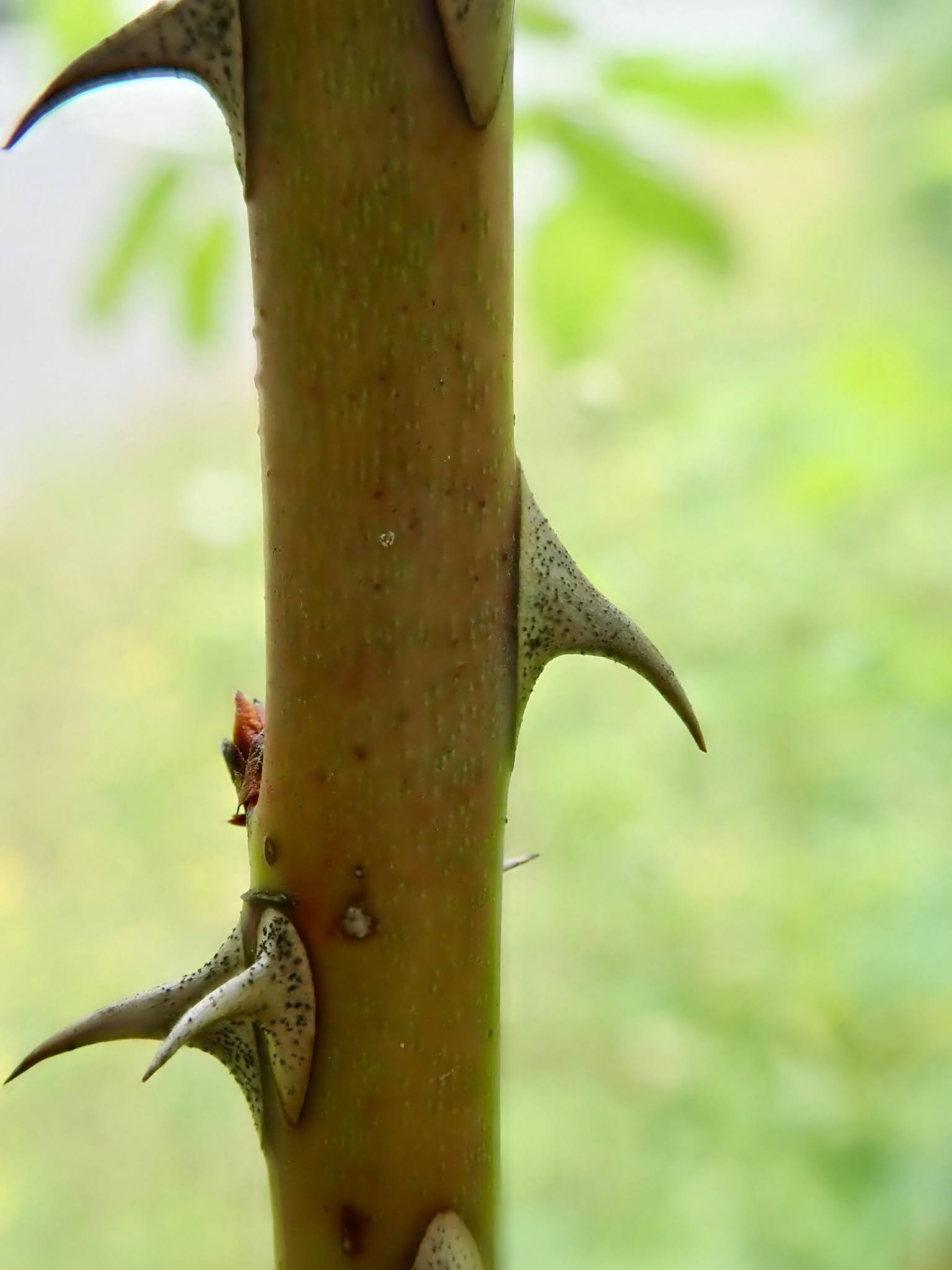
Young prickles,  slender, straight or curved.


Leaflet. Uni-serrate, glabrous.

 An interesting feature of this leaflet is that the teeth do not start at the leaflet base, so you have an entire margin to the first quarter without teeth. This is shown in the handbook illustration by Margaret Gold but is not commented on. This particular leaflet has 12 teeth on a side, which is a low count as a more typical count would be 18. This shows that teeth count is variable.  The average count should be 14 according to Bean, but my experience on these planted roses, is that teeth count is quite variable and some leaves are in some parts bi-serrate. Do you count the secondary tips?

Leaflet margin showing uni-serrate teeth and hydathodes on each tip. No glandular hairs.

In many ways this rose is quite familiar to our British roses. For example, the leaflet margin teeth having the temple dome shape, (convex then concave), as seen in R. arvensis and many R. canina.  A paper on the evolution of roses suggests the American roses have been long separated at 4.1 million years at least :-

'This means that among the extant species of American roses, only the species of R. subgen. Hesperhodos results from this ancestral widespread distribution while the other American species result from a later (at 13·4 Ma) re-colonization from Asia. Exchanges between western North America and eastern North America seem to persist even today. Exchanges between eastern North America and Asia were interrupted at 5·3 Ma but exchanges between western North America and Asia lasted longer and were finally interrupted at 4·1 Ma. '

https://www.ncbi.nlm.nih.gov/pmc/articles/PMC4551085/

R. virginiana. Leaflet stipule is large and wide and toothed.

Another stipule, sometimes edges can roll inwards to make it look thinner than it really is.


This feature of a wide stipule (especially at the leaf end) is one of the identification points that separate R. virginiana from the similar R. carolina which has only a narrow stipule.

  R. carolina also tends to have only 1-2 flowers per stem rather than the 3 or more in R. viginiana. The following site has details on how to tell these species apart.

ref :-     https://gobotany.nativeplanttrust.org/species/rosa/virginiana/

Native distribution from a paper on evolution of American roses which suggests separation of these species is not easy and the Americans face the same problems as European rose taxonomists.

Native distribution of R. virginiana by Simon Jolly

https://www.researchgate.net/publication/51196380_Polyploid_and_Hybrid_Evolution_in_Roses_East_of_the_Rocky_Mountains

Summary.

Although there are some discrepancies in the handbook description, compared to the roses shown here, like the stipules being narrow, (shown wide in the illustration by Margret Gold), I am happy that the plants found on the Guided Bus Way are Virginian Rose, which was a new species I was not expecting.  This species is available for sale in the UK. There is some suggestion that plants from a horticultural source have been improved with larger flowers than found in native US populations.

Rose Site on Guided Bus Way

Plants at TL40696 67779,  TL40444 67879, TL4039494 67896, TL40375 67913 and TL40348 67922.

Peter Leonard

Rampton, Cambridgeshire.

30June 2021 

Ref:- G.G. Graham and A.L. Primavesi  Roses of Great Britain and Ireland. BSBI Handbook No. 7

Hip taken on 7th November 2021

Saturday, 12 June 2021

Early Forget-me-not, Myosotis ramosissima

Early Forget-me-not, Myosotis ramosissima 

A follow-on blog from my general blog on dry habitat 'Forget-me-nots July 2020' Myosotis ramosissima with attention to the sub-species ramosissima and globularis, using knowledge gained in Spring 2021. Both sub-species would appear to be present in Cambridgeshire but as sub-species some plants do not always divide nicely into either camp.  A comparison with M. arvensis is also included. 

Summary and terminology.


M. ramosissima ssp. globularis. 19May2021, Cambridge, Norman Way.

Sub-species globularis has several differences from the sub-species ramosissima.

Stace gives the sub-species name lebelii to the intermediates. 

Sub-species globularis

1) Flowers present almost to the base of stem.

2) Calyx is up to 2.5mm rather than up to 4mm in ssp. ramosissima.

3) Calyx lobes broadly triangular rather than narrowly triangular.

4) Corolla distinctly exceeding the calyx rather than scarcely exceeding the calyx.

Ref. Sell and Murrell, Flora of Great Britain and Ireland. Vol 3 Page 374.

In this particular plant as shown above, the stem leaves were limited to either one or two, with the highest being only 1 cm from the base. The inflorescence then continues 7cm beyond the top stem leaf. The stem leaves were at stem junctions.  

The length of the calyx was measured at 2-2.5mm and the calyx lobes are cut to slightly more than half way and are quite blunt tipped. The tips of the calyx fall short of the petals so you can see the corolla tube before it splits into the petals. The petals are held in a cone rather than being flat.

M. ramosissima ssp. globularis    Scale in mm

The above photo shows the calyx is just over 2mm in length and tends to have the calyx teeth slightly open in fruit. The corolla tube is easy to see with a gap between the calyx teeth tips and the petals. The  flower has a diameter of just under 2mm.

M. ramosissima ssp. ramosissima,  Gun Hill Dunes, North Norfolk. 3Jun2021

The tips of the calyces are touching the petals so there is no gap to show the corolla tube. The calyces are slightly more pointed than shown in ssp. globularis.  The length of the calyces were over 3mm.  This plant was found in the short turf of the dunes just west of Holkham Pines, Norfolk. 

M. arvensis. Fen Drayton, Cambs. 30May2021

Field Forget-me-not M. arvensis can look similar to M. ramosissima ssp. ramosissima  with no corolla gap but the pedicels are longer than the length of the calyx and so far, this has always been a clear difference once the pedicel has grown/matured.

M. ramosissima ssp. ramosissima. Newmarket. 18May2021

M. ramosissima ssp. ramosissima. Newmarket. 18May2021

The lack of corolla gap on the open flower is not quite as much as some, short pedicles supporting longer calyces.
Note the fading flower is starting to show the corolla tube so the presence of the gap should be taken from fully open flowers.


M. ramosissima ssp. globularis, Fen Drayton. 15May2021

Flowers present almost to base of stem although this may be a difficult feature to determine on some plants due to variation in growing structure. Corolla gap is clear. Note short pedicels.


Top plant is a M. ramosissima ssp. ramosissima from Cambridge North Station sidings and the lower plant is a M. arvensis. The stem leaves do go up the stem in both but the M. arvensis tends to have many more leaves and has a thicker stem. The pedicels are much longer in the M. arvensis. 15May2020.

Summary. Sometimes very small plants of Field Forget-me-not M. arvensis are hard to tell apart from Early Forget-me-nots M. ramosissima. Some knowledge of the two sub-species helps in distinguishing Early ramosissima from  Field M.arvensis. I thought at first that the corolla gap would be a good feature to distinguish them.  This hit a problem fairy quickly in that some ramosissima lacked the corolla gap and hence triggered an investigation of the literature.

 The two sub-species both have chromosomes 2n=48 and some plants will be intermediate. So far, on a limited sample, these two sub-species do seem to be consistently different, based on the four differences noted by Sell and Murell. 

Stace gives the sub-species name lebelii to the intermediates. The difference in the shape of the calyces' lobes is very subtle and the structure of the plant can be be variable but the corolla gap and length of the calyces seem to hold up well. With a larger sample I would expect some intermediate plants to be found and it would be interesting to take samples from many sites and plot the corolla gap and length of calyx to get distributions. The pedicle length could be added as another parameter.

 What also seems to hold up very well, is the length of the pedicels in relation to the length of the calyces; being short in both sub-species. Often M. arvensis has clearly longer pedicles especially lower down the stem being equal or longer than the length of the calyx. 

 There is truth in the words in Sell that 'M. arvensis , ramosissima and sylvatica run into one another and are difficult to distinguish on precise characters but can usually be recognised in the field when all taxa involved have become familiar'.

Hopefully these photos will help in the identification of both versions of Early Forget-me-not. Some populations seem to have many plants that are intermediates but others do seem to fall into one camp or the other.


Peter Leonard

Rampton, Cambridgeshire.

11June 2021

M. arvensis showing pedicle length equal or longer than calyx length.


Monday, 29 March 2021

Rosa stylosa. Short-styled Field Rose in Cambridgeshire.

Rosa stylosa   Short-styled Field Rose in Cambridgeshire.

In my quest to photograph all the wild roses in Cambridgeshire (during the summer of 2020), R. stylosa was not an easy species to find.  The recent Flora of Cambridgeshire by Alan Leslie,  points out that it is often recorded as a hybrid with R. canina in scattered sites across the south of the county. Since this is my first season looking at roses,  I was attempting to avoid hybrids and concentrate on learning the basic species first.  The first record for Cambridgeshire from C.C. Babington was redetermined by A.L. Primavesi as R. arvensis x canina so that was another warning that this species might not be straightforward.

As ever, my reference book for this task was the excellent Roses of Great Britain and Ireland , BSBI Handbook no 7 by G.G. Graham and A.L. Primavesi published in 1993, plus a lot of help from Alan Leslie.

R. stylosa, 15Jun2020. Fen Drayton, Cambridgeshire.

Context.

The field guides tend to group the two 'Field Roses' together, R. arvensis and R. stylosa although R. arvensis is one of very few roses in the UK that is not in the section Caninae (unbalanced polyploids). R. arvensis is in section Synstylae whereas  R. stylosa is in the section Caninae and the sub-section Caninae with Dog Roses R. canina and R. caesia. Various papers on the evolutionary history of all these stable species show they shared parents in the past (through hybridisation) and never separated enough to stop hybridisation occurring currently. 

R. stylosa 15Jun2020. Species gets its name from the fused short style.

R. stylosa.

Upper arrow points to the stamen and anthers which are a similar height to the fused style whereas the fused style in R. arvensis is taller being longer than the stamen.

R. arvensis.

Upper arrow points to the fused style of R. arvensis raising the stigma above the level of the stamen and anthers ( second arrow).  The lowest arrows show the conical disc in R. stylosa and the flat disc in R. arvensis although I now think the conical disc is under drawn. The styles in R. stylosa are slightly different lengths so that the stigma cluster is taller in shape than the more domed shape in R. arvensis.

R. stylosa 11Aug2020. Conical disc and fused style starting to come apart.


R. stylosa, 18Oct2020

A late season photo shows the conical disc and the fused style of R. stylosa.

R. arvensis. 20Oct2020

A late season photo shows the flat disc and long fused style of R. arvensis. The hip is typically more soccer than rugby in shape and the pedicle longer. The glandular hairs on the pedicle are almost gone at this stage.

Rosa arvensis is a distinctive species in that it has weak thin stems (often green or purple) that climb through hedges or trees at the edges of woods, often in shady places. R. stylosa is a more typical structure with strong arching stems much like other Dog roses.

R. stylosa. 15Jun2020 

A key feature of both R. arvensis and R. stylosa is that the pedicle has glandular stalked hairs. These hairs are typically shorter than those found in the Downy roses and quite sparse in R. stylosa.  
R. stylosa. 15Jun2020, Bract, pedicle and sepal.

Above photo showing the pedicle below the hypanium with glandular tipped hairs. The sepal is pinnate,  the lobes typically simple without additional side protrusions, although some glandular tipped side protrusions may occur as seen in the photo below on the lower two protrusions.

R.stylosa 11Aug2020, Sepal , very few glandular hairs on margin and long 1.5-2cm.

R. tomentella ( was obtusifolia) Bi-pinnate sepals for comparison. Protrusions on protrusions.


Leaves.

R. stylosa 15Jun2020 Leaf with widely spaced leaflets with lowest often reflexed, tapering to an acute apex. Leaflets are 2-2.5 X as long as wide.
R. stylosa 11Aug2020 

R. stylosa 18Aug2020. Reflexed lower leaflets.


R. stylosa 11Aug2020, Leaf stem , petiole and rachis have stalked glandular hairs and pricklets.


R. stylosa 15Jun2020. Leaflet edge is uni-serrate with red tipped hydathodes


R . arvensis leaf edge with temple dome shape.

The leaflet edge is uni-serrate (occasionally bi-serrate) and has the temple domed shape ( convex to concave) to each tip but less pronounced than in R. arvensis with almost straight tip edges on many in the photo of R. stylosa. This shape is seen in some R. canina Dog Rose.  No glandular hairs on the margin in these photo although it can occur in R. stylosa. 
R. stylosa Leaflet lower surface with white hairs on midrib and secondary veins.


R. stylosa, 15Jun2020 

Deltate prickles on mature stems, a wide base with a triangular shape with either a straight or curved tip.

R. stylosa hybrid 28Jun2020 Orwell.

R. stylosa hybrid 28Jun2020 Orwell.

Although I am avoiding hybrids in an attempt to learn the basic species first, it is easy to get caught out when looking at roses.  The above photo shows the fused stigma and conical disc that made me think this was a R. stylosa. The important message is that you cannot rely on a single feature and the leaves on this plant showed a problem. Other features also did not quite tie up with R. stylosa either.

Hybrid leaflet. 28Jun2020 Orwell.

This leaflet is not correct for a R. stylosa with red tipped glandular hairs on the underside of the leaflet and red-tipped stalked glandular hairs on the leaflet margin.  The edge is multi-serrate and this hybrid is not the common Canina x stylosa (or Stylosa x canina)  and would need expert evaluation. 

R. stylosa 20Oct2020 Hip cut in half to show narrow orifice and thick conical disc.

Conclusion. 

These photos do not show every feature of Short-styled Field Rose ( R. stylosa) but hopefully show some of the important details of this species. The short stalked glandular hairs on the pedicle and the shape of the fused stigma being about the same or below the height of the stamens and the uni-serrate leaf margin are the key features. This is backed up by the sharply pointed dark green leaflets which are well spaced on a petiole and rachis that have stalked glandular hairs. The lowest leaflet pair are often reflexed but not all my photos show this feature well, as it does vary plant to plant. Some versions of the Dog Rose (R. canina) can have the conical disc and similar shape to the style and hybrids are often recorded.

 In some ways R.stylosa fits somewhere between R. arvensis and R. canina but in my first season looking at roses, I think I have achieved some progress in all the species in Cambridgeshire, except R. canina. 

Dog Rose (R. canina) and its hybrids with R. caesia form a very difficult group which I have failed to untangle. The term R.canina agg. might come in useful.


Peter Leonard

28th March 2021

Rampton , Cambridgeshire.


Wednesday, 10 March 2021

Rosa sherardii. Sherard's Downy Rose in Cambridgeshire

Rosa sherardii. Sherard's Downy Rose in Cambridgeshire.

This blog shows a few photographs taken in my quest to learn about roses to be found in Cambridegeshire during the summer of 2020. 

According to the 'Flora of Cambridgeshire',  Alan Leslie 2019, there is only one current place where this species is found-  by the A11 at Four Went Ways. There were other records in the past in other locations but some were later considered to actually be Rosa tomentosa (Harsh Downy Rose), which suggests that telling these two species apart is not easy. 

Both these downy roses are in the section Caninae which mean they have the unbalanced breeding system in which the female parent contributes four sets of chromosomes to the progeny, whereas only one set comes from the pollen (male) which fertilises it. All these roses hybridise now and it is thought that all the current stabilised species today, were derived by hybridisation in the distant past.  The Downy roses are in sub-section Vestitae  which also includes R. mollis (Soft Downy Rose) which is a more northern species as far as the UK goes. R. mollis is not found in Cambridgeshire, nearest place being the Peak District. 


R. sherardii, 12 June2020, Four Went Ways.

First comment on this flower is the deep pink colour. The only other rose that gets close to this deep pink in Cambridgeshire would be R. rubiginosa (Sweet Briar). 

R. rubiginosa 10Jun2020 Devils Ditch. Reach.

R. tormentosa has a much paler pink flower.

R. tomentosa, 9Jun2020, 

Flower colour is not the most important feature that separates the Downy roses, which is the hairy leaflets. Flower colour in R sherardii according to the 'Roses of Great Britain and Ireland' BSBI Handbook No 7 by Graham and Primavesi (which is the standard reference) can be white in Scotland.  

R. sherardii, 12Jun2020, underside of leaflet.
The underside of the leaflets is densely hairy, a feature sherardii shares with tomentosa. It also has lots of glandular hairs which in the case of the sherardii at Four Went Ways are easy to see. In some tomentosa it is even more densely covered in hairs so that it is difficult to see the tiny glandular hairs. The density of these glandular hairs can be variable according to the literature.

R. tomentosa 19Jun2020. 

R. tomentosa 19Jun2020. Just a very few glandular hairs only just visible amongst the hairs.

R. rubiginosa has lots of glandular hairs but the glands are much larger and the density of the simple white hairs is less. The diameter of the largest glands is 0.1-0.12mm whereas the Downy roses have glands 0.05mm diameter and can also have a stalk. This is according to the handbook and was confirmed using a calibrated magnifier.
R rubiginosa showing stalked glandular hairs on underside of leaf. 15Aug2020 Swavesey.

R. rubiginosa Underside of leaflet showing glandular hairs and simple hairs.

Leaves.
R. sherardii,  note simple hairs on upper surface and glandular margin.


R. sherardii, 12Jun2020 Upper side of leaf.

R. sherardii, Underside of leaf.

R. sherardii, 12Jun2020. Stipule at base of leaf.

The particular group of Sherard's Downy Roses at Four Went Ways has an abundance of red glandular hairs. This is not always the case as I discovered when I visited Cork, Ireland in September. The stipule above has the normal glands along the margin but also all over the lower surface, whereas in Cork the glandular hairs just ran along the margin like many other species of rose.

 The leaflet stem ( petiole and rachis) have glandular hairs plus white simple hairs.

R.sherardii, 12Jun2020. Leaf edge.
The leaflet margin can be described as Multi-serrate with stalked glandular hairs having tips of their own in some cases. According to the handbook, R. sherardii can show quite a lot of regional variation, so sometimes the the underside of the leaflet can almost lack the soft white hairs and the glands.

R sherardii, 12Jun2020, Four Went Ways

The photo above shows the top of the flower stem (pedicle) and hypanthium (hip) with with long glandular tipped hairs. In this population the ball like tips are a deep red colour. To the right of the pedicle is a bract which also has lots of red tipped short glandular hairs on the margin and across much of its surface.

R. tomentosa. 22Jun2020 

Comparison shot of R. tomentosa showing the pedicle and hypanium have the same long glandular hairs.
The stipule has red tipped short glandular hairs along the margin like many species of rose.

R. tomentosa 24Jun2020 Post flowering photo showing pedicle, hypanium and sepals.

R. sherardii 12Jun2020  Post flowering photo showing pedicle, hypanium and pinnate sepals.

Not a lot to choose between these photos of the pedicle, hypanium and glandular hairs, as many of the features are similar. The stalk ( pedicle) for R. sherardii is supposed to be shorter 1-1.5cm compared to R. tomentosa at (1.5)2-3.5cm but I am not sure how reliable pedicle length is, as in my limited experience pedicle length can vary a lot even on a single stem.  

R sherardii, 12Jun2020 stigma cluster.

The stigma cluster is large, almost covering the disc - to 2/3rds- and domed with a few hairs. The disc is almost flat.

R. tomentosa 19Jun2020 Stigma cluster.

The stigma cluster is smaller so you can see more of the disc. It is taller and less domed in shape but also has the odd hair (many to none).  Disc is almost flat. This is a subtle feature and it would be interesting to take more photos of each species at more sites, to see if there is a consistent difference.

R. sherardii, 1Sep2020, Rounded hips have very deep red colour. 

R. canina Dog Rose, 1Sep2020 comparison shot.


Note the sepals remain on the R. sherardii whereas they have fallen on the Dog Rose at this stage. The R. sherardii are an amazing deep red which is not really shown to its full extent by the photos. Below is R. tomentosa which, according to the Handbook, should have lost its sepals by this stage of the hip turning red. It has previously been noted by Chris Preston in his review of The genus Rosa in Cambridgeshire (v.c. 29) an interim account, that some local bushes of R. tomentosa have persistent sepals. 
R. tomentosa. 14Oct2020


R. sherardii, 15Sep2020 Castletownbere, West Cork , Ireland

Final photo shows the shiny round red hips as the season comes to an end. They are not always so round in shape. By this stage the glandular hairs have lost their red tips which have turned grey and dried up. 

Conclusion. 
In my first season of looking at roses I think I can identify the two downy roses, R sherardii and tomentosa but need to be careful of hybrids. It is easy to miss the slightly aberrant features of hybrids, which require expertise beyond one season's learning.  Also I have little experience of regional variation which is a feature of R. sherardii, so more to learn plus I have not seen R. mollis yet. Hope to travel north to find R. mollis when lockdown is over in June.


Peter Leonard
Rampton, Cambridgeshire.
10th March 2021


R. tomentosa stigma cluster slightly taller than wide. Devils Ditch

R. tomentosa, Ditton Park Wood. 24Jun21

R. tomentosa 22Jun21. Devils Ditch


R. sherardii , flat disc, hairy stigma covering about half the disc at this stage.
Note pinnate side lobes, with two on the left sepal side in view.

R. sherardii, domed stigma cluster not as tall as R. tomentosa, Cambridge, Four Went Ways

R, sherardii Stigma cluster about as wide as tall.

Variation in prickles.


R. sherardii, almost straight.

R. sherardii, a more curved example. Shape slightly concerning but it is good to check several stems and see how much variation is present. This plant had mainly straighter prickles.


R. sherardii. Younger prickles.


R. sherardii, younger prickles.
The handbook suggests that although normally the prickles have weak bases some populations have stronger more curved prickles. The above prickle photos were all taken at Four Went Ways.
The variation in prickles from being thin and straight ad patent through to curved with slightly thicker bases is important as R. mollis has all prickles thin, straight and patent. It is worth checking several stems to see how much variation occurs.

For R. mollis see new blog under Rose label.