The fullest and most useful account of Erophila is given in the BSBI Plant Crib ( T.C.G. Rich and A.C. Jermy) by S.A. Filfilan and T.T. Elkington, available on the BSBI website. The second source is the 'Crucifers of Great Britain and Ireland' by Tim Rich BSBI Handbook no 6.

In summary, it would appear to be, that within the UK Erophila is split into three 'species' by chromosome number.
E. majuscula ( Hairy Whitlowgrass) Chromosomes 2n=14 (Diploid)
E. verna ( Common Whitlowgrass) Chromosomes 2n=30-44
E. glabrescens ( Glabrous Whitlowgrass) Chromosomes 2n=52-64
(One cytotype with 2n=24 was only recorded in Germany.)
Key features are:-
E. verna Variably hairy, petals split more than halfway, leaves tapering to broad stalk, 0.5-1 times as long as leaf blade. (Deep petal groove.)
E.glabrescens nearly hairless, with longer leaf stalks and less deeply cleft petals.
E. majuscula leaves densely greyish-hairy, with shorter leaf stalks and less deeply cleft petals.
(Taken from Harrap's Wild Flowers.)
Now if you had the skill and knowledge to do a root tip chromosome count, it would be possible to identify the plants we see but I don't and worse that that, the key features listed in the field guides do not take into account the variation in E. verna. It is not difficult to find plants with a deep petal groove that go from having almost no hairs to very hairy. The deep petal groove suggests these plants are all E. verna ( Common Whitlowgrass).
The chromosome counts indicate that E. majuscula is the original type of Erophila and that evolution has caused more than just a doubling/ tripling/quadrupling of the base number of chromosomes.
Quite what this range of chromosome counts mean is well beyond my own very limited knowledge. Normally plants go 14, 28, 56 but for example E. verna has been found with 30, 32, 34,36, 40, 42, and 44 chromosomes. This abnormal variation in the number of chromosomes within one species is called Aneuploidy. Aneuploidy can even occur in the diploid form of some plants ( e.g. Claytonia virginica) but in humans is bad news causing for example, Down's Syndrome.
It is interesting that the polyploid E. verna is by far the most successful type of the three species.
The plant crib article tends to suggest the E. verna leaf is 'lamina scattered to moderate pubescence of mainly branched hairs'. I think this understates the variation of hair density on E. verna. an example photo follows:-
 |
| E. verna from Sutton Gault, Cambs. 14th Feb 2020 Very hairy leaves. |
 |
| E. verna, same plant as above showing petal cleft/notch. |
The extent of hairiness appears consistent where plants seem to be clones ( from self pollination) but a few aberrant plants can occur. The petal cleft is clearly deep but even this feature is not completely reliable. Just occasionally clearly E. verna type plants can have a shortened notch ( this is also noted by Tim Rich in a paper looking at herbarium specimens.)
One might think the grey hairy leaves would make this a E.majuscula but the petioles are too long and the deep petal grooves do not fit the requirements.
 |
| Typical E.verna 14th Feb 2020 Sutton Gault. |
 |
| E. verna showing few hairs 14th Feb 2020 Sutton Gault |
Sub-conclusion. The term 'variably hairy' should not be underestimated. E. verna can vary from very very hairy to almost no hairs. Hairs seem to reduce with age so only new leaves should be considered. This can be seen in the last photo where the lowest leaf has lost most of its hairs.
Note also the highly variable shape of the petiole and leaves.
Leaves.
What is left to tell these species apart? Next up is the shape of the leaf stem compared to the leaf. Immediate problem which can be seen in the above photo is where does the leaf start and the petiole finish, as this is not clear to me. It would seem hard to assess and plants are highly variable. Some leaves can have a tooth ( or teeth) but this is another variable feature like the hairs being simple or forked.
 |
| E verna This plant has attempted to 'self mark' the extent of leaf vs petiole but failed to do it correctly!. Nice try. |
Before moving on what does a petal cleft/notch look like.
Petals.
E. verna has cleft from 1/2 to 3/4 of their length
E. majuscula and E. glabrescens , petals bifid to not more than 1/2 their length.
 |
| E. verna 14th Feb 2020 Sutton Gault. Normal deep notch in each of the four petals. |
 |
| E. verna deep petal notch visible. 14th Feb 2020 Sutton Gault |
 |
| Petal notch not quite half length, 18th March 2020. |
 |
| Petal notch short, 18th March 2020 |
 |
| Petal notch short 27th March 2020 |
Once familiar with the petals of E. verna the shorter petal notches of glabrescens/majuscula stand out quite easily. It helps if the flowers are fully open but even if not, the difference is usually clear. In Erophila some plants are not so clear cut and E. verna occasionally has short notches . In Europe, work by Jordan/Rosen back in the nineteenth century, spilt E. verna into 53 species, some based on petals that were enlarged or had very had narrow petals, so in the UK we are seeing only part of the possible variation.
Stems
The Handbook No 6 shows another feature.
E. majuscula Flowering stems densely hairy and with at least scattered hairs beyond the first pedicel ( stalk of a flower).
E. verna Scattered hairs on flowering stems on lower part, upper parts and pedicels no hairs.
E. glabrecens Flowering stems with hairs on lower part only or no hairs.
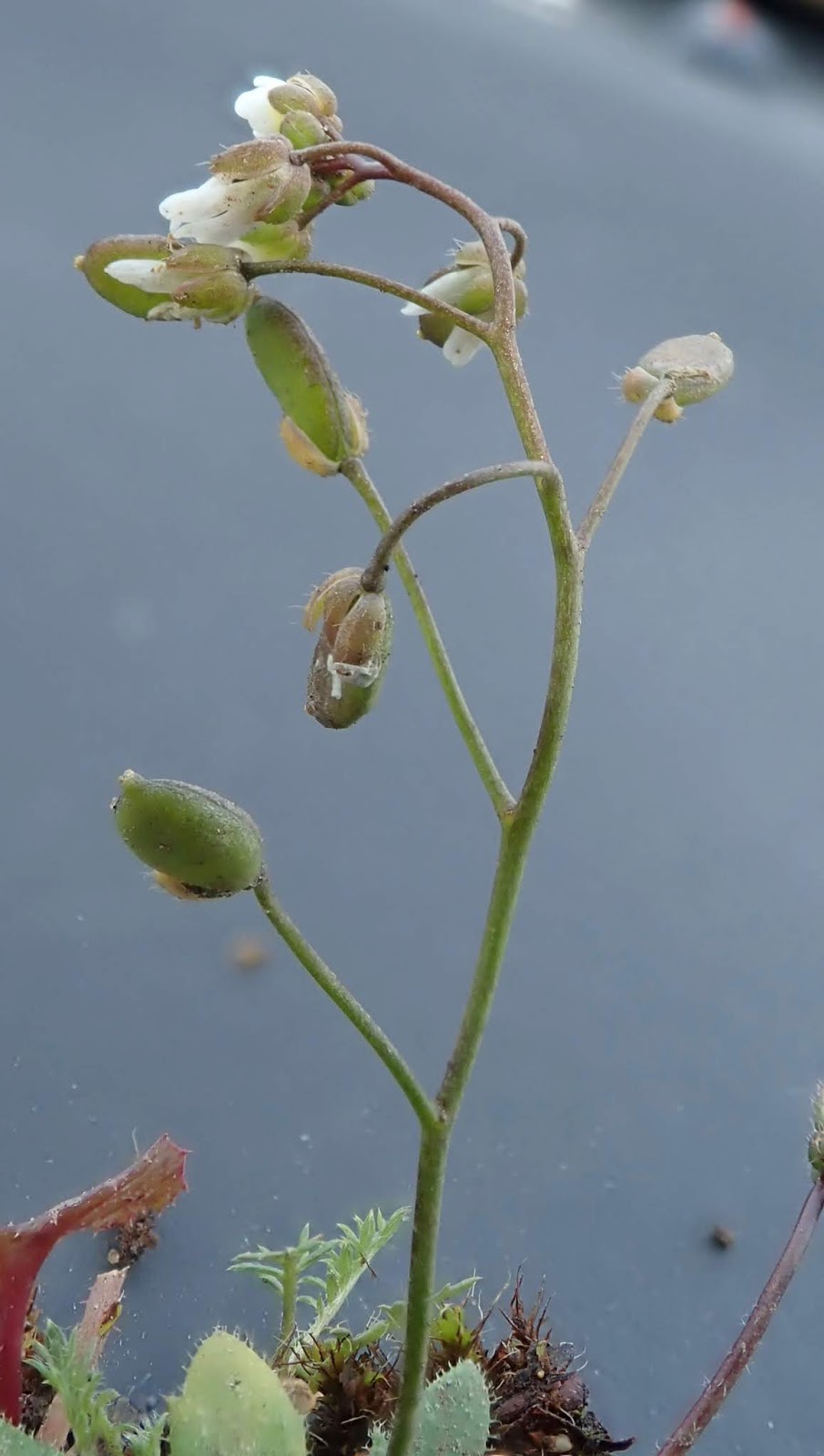 |
| Typical E. verna with no stem hairs on upper parts and pedicels but many hairs will have fallen off at this fruiting stage. |
 |
| E. verna with new stem showing many hairs but the older stem with only a few at the lower end. |
Plants with extreme features that might suggest they are not E.verna.
A) Potential candidate for E. glabrescens
 |
| Leaves have almost no hairs. 17th March 2020 Girton, Cambridge. |
The plant above was in a group of E. verna but just a few plants had no hairs.
a) The leaves were green with just a few hairs along the margin even when new.
b) The stem had no hairs, even near the base on pre-fruiting stems.
c‚ The petiole ( leaf stem) looks quite long compared to the leaf blade however this seems a very variable feature. I am not sure this can be used to distinguish from E. verna.
e) The sepals surrounding the petals have no hairs. E. verna can have sepal hairs or no sepal hairs. E. majuscula seems always to have hairy sepals.
d) The petals have a notch less than half way.
The combination of the listed features would suggest this is a E. glabrescens. The seed size is the same as E.verna so there was little point waiting until the plant fruited (fresh seeds 0.5-0.8 mm). The number of seeds in each fruit can be 20-60 for E. glabrescens and 15-50 for E. verna. The combination of features is the critical factor as any individual feature is not totally reliable. This is very probably E. glabrescens but it is hard to be certain without backing the identification with a chromosomes count.
B) Potential candidate for E. majuscula
 |
| Short petiole gives tight rosette of leaves. 18th March 2020. Isleham Plantation |
 |
| Enlargement to show new leaves. Note also sepals have hairs. |
The compact rosette due to the short petioles is quite different to the normal E. verna growing at the same site. This feature suggests the plant is a E. majuscula but it has leaves that are not hairy!. This would surely be a problem but the new leaves as shown in the enlargement of the rosette, do show early leaves have dense hairs. The leaves are green and shiny but I have seen huge variation in E. verna, so I am not surprised potential E. majuscula could have these features. In fact the Plant crib says majuscula leaves often appear grey , so therefore some do not. The key feature is the very compact form of the rosette caused by the short petioles.
Next step was to check petals notch. Some flowers had a short notch but others were more marginal.
 |
| Petal notch less that half way. |
 |
| Stem is very hairy and although this photo does not show it well, hairs went beyond the first pedicel. |
 |
| Stem hairs go up beyond 1st and 2nd junction even when fruiting has started on top right flower. |
A small percentage ( est. 5-10%) of plants at this sandy site showed consistent features of very short petioles giving the rosette a compact shape, petals with short notches and hairs that went beyond the first (and second) pedicle. These plants could be E. majuscula.
As the population of these compact rosette examples was quite large, well in excess of twenty plants, two samples were taken and potted up, so that seed length could be measured when fruits matured.
E. majuscula is supposed to have smaller seeds at 0.3 to 0.5mm whereas E. verna/glabrescens has seeds 0.5 to 0.8mm.
When two plants were measured the first one had seeds in range 0.47 to 0.57mm and the second from 0.4 to 0.59mm, with mean length of 0.54 and 0.5mm. (E. verna seeds ranged from 0.5 to 0.75mm in my sample). This suggests that in practice there is some overlap in seed length but on average the seed size is less than E. verna. In Pot 2, some fruit contained seeds that were all below 0.5mm but not all fruit conformed to the expected limit of 0.5mm. All seeds measured were fresh, not long dried herbarium samples.

1st Plant from Isleham Plantation in Pot 1.
 |
| 2nd March 2020. Potted up potential E. majuscula, note hairs on stem even at fruiting stage go above first junction. |
 |
| Plant 1 still in flower on 22nd April 2020. |
 |
| Enlarged version of above photo showing a few forked hairs on stem above third junction. You will not see these hairs without a lot of magnification but a few are left even at fruiting stage, in this case at least. |
2nd plant from Isleham Plantation in Pot 2
 |
| Potential E. majuscula |
 |
| Seeds from 1st plant |
The Erophila aggregate group have had a long and troubled history with several attempts to describe species from Mr Jordan back in 1864 to the chromosome count method used today. The basic problem is relating the chromosome count to features that can be easily observed. The common E. verna shows a lot of variation and the field guides do not describe the complexity.
The reproduction system forming populations of clones and the aneuploidy are surely a warning that separating these three species is not going to be easy.
Hopefully my photos show this group with enough attention to the detail so that some plants can be at least considered as candidates for E. majuscula and possible the even more difficult E glabrescens. Identification has to be based on a full range of features. If only I could count the chromosomes....
The Isleham site for the E. majuscula was found by Alan Leslie. Interestingly a plant taken by Alan Leslie from the Isleham site had all seeds measuring below 0.5mm showing sample size is a important factor in the determination of limits. Alan's sample has been confirmed as E. majuscula by the BSBI referee Dr T Elkington.
Comments welcome. The season is now over, so we will have to wait until next February to start again to improve our knowledge of these charming plants. The Girton site for the E. glabrescens was found by Jonathan Shanklin. The Isleham site for the E. majuscula was found by Alan Leslie. At least this year with help from Alan Leslie regarding E. majuscula, some progress has been made.
Peter Leonard
Rampton
Cambridgeshire
2nd May 2020
 |
| The stigma is held very close to the pollen bearing anthers in the open flower on the right and then elongates past the anthers on the left flower. |
From O Winge, 1940 showing just how much work was done on E verna in the past. A small extract follows:-
The present investigation confirms the view that the Erophiln-
microspecies biologically really behave as a series of Linnean species.
They are constant and have different chromosome numbers. Their
hybrids are more or less sterile, owing to abnormalities during the
meiosis. They are able to give constant amphidiploid hybrids. When
nevertheless the collective species Erophila verna is commonly regarded
as a good Linnean species by taxonomists this is the outcome of our
defective classification of the phenomena in Nature.
1940 article at A CASE OF AMPHIDIPLOIDY WITHIN THE COLLECTIVE ...onlinelibrary.wiley.com › j.1601-5223.1933.tb02609.x
Reference of Watsonia paper by Tim Rich and J Lewis 1999 containing in particular comment on how difficult it is to separate verna from glabrescens in Results section
http://archive.bsbi.org.uk/Wats22p377.pdf
End
Reference of Watsonia paper by Tim Rich and J Lewis 1999 containing in particular comment on how difficult it is to separate verna from glabrescens in Results section
http://archive.bsbi.org.uk/Wats22p377.pdf
End


