Monday, 2 April 2018

Sweet Violet ( Viola ordorata ) and variants


Sweet Violet  ( Viola odorata )

Sweet and Hairy Violets form a pair of species that are distinct from the Dog Violets in having very blunt ended sepals.


The sepals are attached so a smaller part points backwards towards the stem called the Sepal Appendage and the majority points forward to protect the petals. The petal end is blunt and rounded in both Sweet and Hairy Violets.

The various species of Dog Violets have pointed sepals. The length of the sepal appendage can be important in separation of Dog Violets.


Violets can be tricky to identify as species are prone to considerable variation and hybridisation but the sepal shape is consistent and reliable to determine Sweet/Hairy Violets from Dog Violets.

This post looks at the variation in Sweet Violets based on the BSBI Handbook. 
Usually regarded as native, however the Sweet Violet has a long history of been grown in gardens and in horticulture.  Violets were grown on a massive scale in France and in Britain they were harvested for chemicals (used as an indicator and later as a scent extract) and also as cut flowers. There is a book that covers this subject , Violets The History and Cultivation of Scented Violets  by Roy E. Coombs and its covers the many of the cultivars that resulted in all this horticultural activity.

Types covered are:-
Viola odorata var. odorata  ( Standard type, violet flowers)
Viola odiorata var. imberbis   ( White variation found in southern half of Britain)
Viola odorata var. dumetorum ( White variation occurs widely, especially common at edge of range) 
Viola odorata f. lilacina ( often found where violet and white forms occur together)

I guess that at least three native forms of Sweet Violets were present before man started to breed different versions. First is the classic violet coloured Viola odorata var. odorata  and the second is the white version Viola odorata var. imberbis.  Fortunately both grow in the field behind my house plus a mixture of the two which might fit Viola f. lilacina.


Viola odorata var. odorata.      1st April 2018  Rampton, Cambridgeshire.

The standard type with violet petals has inner hairs on side petals, some hairs on flower stem, violet spur. 


Viola odorata var. odorata  2nd April 2018. Rampton,  Close up to show hairs on side petals and a bold pattern of purple veins splitting into thinner veins but still clearly defined. 


Viola odorata Var. imberbis 


Voila odorata var. imberbis     2nd April 2018, Rampton, Cambridgeshire.


A lot of flowers can have white variants but the flower colour is not the only change here, so more is going on. It might suggest variants or sub-species of Sweet Violet are evolving into separate species but have not quite reached that point.  Several differences seen on this white form are the lack of hairs at the entrance to the inside of the spur on the side petals and the lack of hairs also on the flower stem or leaf stems.  No purple veins present. Typical of this variant is the pinkish spur. This adds up to quite a few differences apart from the white petal colour.


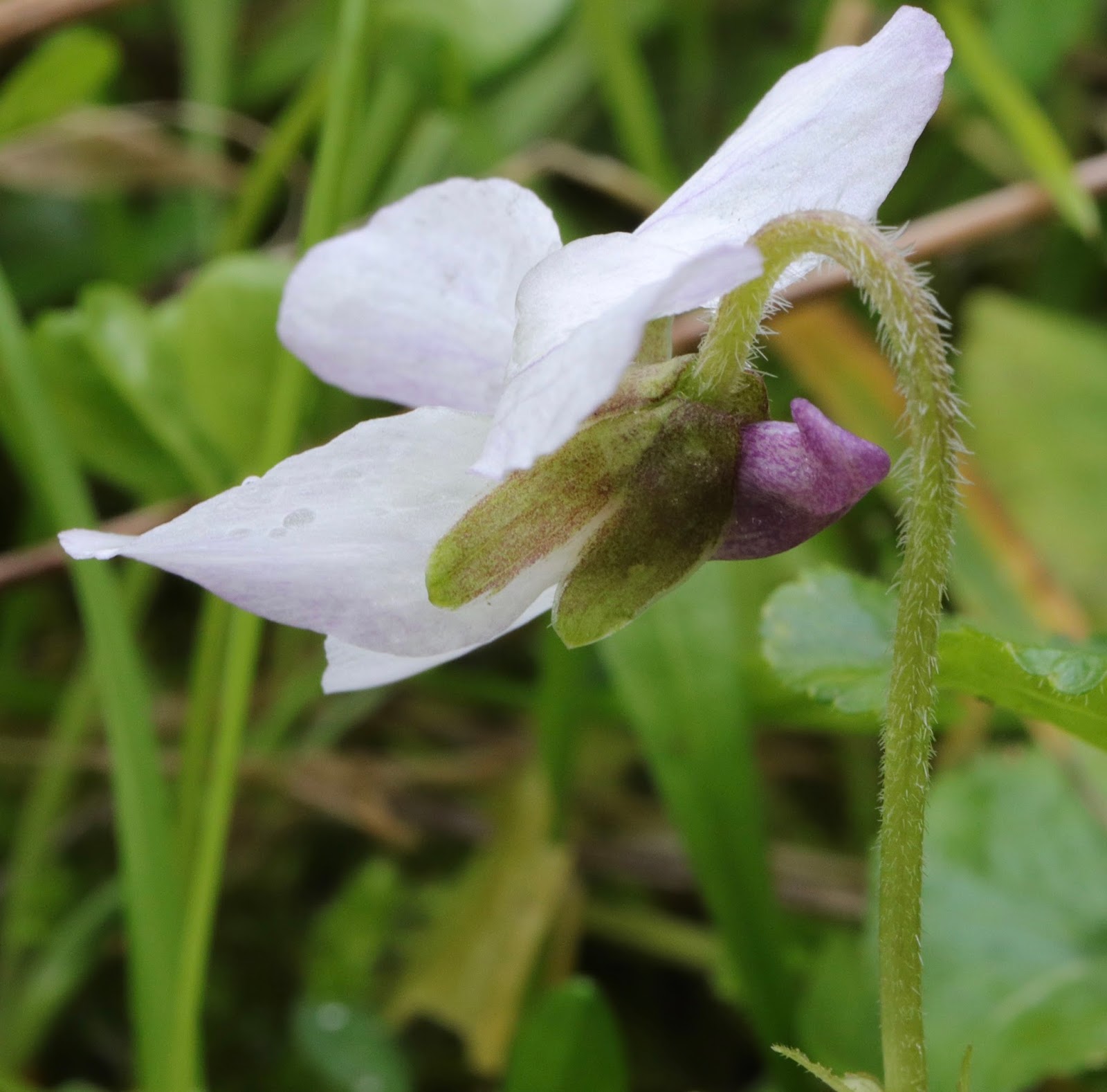
Side View of V. odonata var. imberbis showing pink spur, blunt sepals, pure white petals without any hint of purple streaking and lack of any hairs on the flower stem.


Detail of flower showing lack of inner hairs on side petals.   31st March 2018, Rampton.

Viola odorata f. lilacina (a form, possibly a mix of the above variants?)

A form rather than a variant. This particular flower was selected as it is at the palest end of the range present and grows about 20m from the normal violet and white types present in Rampton. Other plants have a more purple flushed appearance. This intermediate form may not be related to the presence of purple and white types nearby, all I can say is that they have been present for at least six years and were not planted while I have lived in the house ( 25 years).


Viola odorata f. lilacina , a pale example showing inner white hairs to side petals and hairs on flowering stem. Almost white with a few purple streaks. Spur is purple.   1st April  2018, Rampton.


Same flower but side view showing slightly distorted spur ( odd shaped spurs are often a feature of Hairy Violet  (Viola hirta ) but this may be in this case due to this form being a mixture of two variations ?. )  , purple spur colour, quite hairy stem and of course the blunt round ended sepals.


Different flower showing more purple streaking to show a more typical example. Note the inner hairs are prominent on the side petals.


Viola odorata var. dumetorum  


Not in Rampton but photographed on the Devils Ditch near Stetchworth, Newmarket. 25th March 2018.  Similar to ver. imberbis with pure white petals but different as this var. has inner side petal hairs.  Spur colour is purple and flower stem with some hairs.


Side view of same flower.

Conclusion.
Sweet Violet has several variants which have consistent characteristics and these are covered in the BSBI Handbook.  The examples covered here are more likely to be native, with other colour types probably likely to be either introductions or escapes from horticulture. Sweet Violet also hybridises with Hairy Violet ( Viola hirta ). Hairy Violets 'always' have some new leaf stems with longer and often more patent hairs however it is not always easy to separate them. The hybrids have intermediate hairs and are often vigorous but the real problem is that the hybrid can backcross and form types that range from Sweet to Hairy in their characteristics.

 Quite how two variants came to be in the field behind my house in Rampton is not known, but the intermediate form was one of the first plants I attempted to identify when I started getting into botany and this lead onto my attempts to understand Violets. I thought this would be an easy group but was totally wrong as the Dog Violets are a very complex group.  See previous blogs for more on Dog Violets.


Peter Leonard
2nd April 2018


Reference.
Michael Porter and Michael Foley.  Violas of Britain and Ireland  BSBI Handbook No 17

Sunday, 21 January 2018

Leontodon saxatilis in Portugal

Lesser Hawkbit ( Leontodon saxatilis)  in Portugal (Atlantic Coast of Algarve)

Several yellow 'Dandelion' type flowers were seen in Portugal, some remained un-identified but Lesser Hawkbit was given away by its split hair tips and similarity to the plants seen in Britain.
Part 1 


Bracts quite hairy but well within limits seen in Britain and inner bracts have quite a nice dark edging which is often a good feature of L.saxatilis, whereas Rough Hawkbit ( Leontodon hispidus) tends to have less distinct brown edging where if present the brown merges into the green centre.  Grey petal underside banding typical of saxatilis is present. However underside petal banding can be absent in both saxatilis and hispidus giving all yellow petals, also both can show grey and red banding.
Outer bracts are adpressed typical of saxatilis and with red tips.  Stem thickens to meet the flower head, which is common in both saxatilis and hispidus.


Second photo shows the plant with its many flowers and leaves tending to stay close to the ground, which you would expect as surrounding vegetation is sparse and does not compete for light.
The leaves are sparsely hairy and this plant does not show any red based hairs on the midribs of the leaves, which can be a good feature of saxatilis if present.
Plant structure has the flowers on un-branched stems and no leaves on the stems.


Leaf shape typical in shape and could be either more or less lobed.


Main feature of the leaf is the split ended hairs which is the distinctive feature of hispidus and saxatilis.  Hairs are quite sparse and some are simple without the split end, whereas many have the tip split into two ( occasionally 3 or 4).

The plant photographed was growing in a rural setting about a kilometre from the sea and seems to conform to a typical L.saxatilis that could be growing in the UK.  Move to a more extreme habitat of the sea facing cliff top and things get more difficult.

Part 2


Habitat shot of cliff edge. Not much competition here but some nice small yellow flowers to look at.


First thing to stand out was the very fleshy nature of the leaves. They were much thicker than normal and very strange. First thing to check was the presence of the split hairs to at least confirm we have a Leontodon.


Good news is that split ended hairs are present so I was pretty sure these plants are Leontodon despite the very fleshy leaves. One other variation is that some split hairs have the very tips hooked, more like the split ends of Hawkwed Oxtongue. I have never seen this in the UK when looking for 3 and 4 tipped hairs. See near the top of the photo.

Having decided that these plants are Leontodon next step is to look at the flowers and see what features they have.


First impression is this looks more like saxatilis than hispidus with limited hairiness on the bracts and outer bracts adpressed. These outer bracts are shorter that normal and red in colour, but the whole plant was small due to the habitat so one might expect some odd features. The longer inner bracts are not showing the dark brown edging that can be typical of saxatilis but it is not a 100% feature and this is Portugal.

 Another flower showing no hairs showing that the amount of hairiness within this cliff top population does vary. Some dark edging present at bract tips but not as distinct as often seen in the UK.


Rosette of leaves staying low to the ground typical of saxatilis but even hispidus will do this when competition is low which is certainly true at this site.


Example of small but very fleshy leaf. Might just be red based hairs on the mid-rib.


Post flowering head showing a lot of red on both lower and inner bracts that was a common feature of plants in this population.


A final photo shows a new flower bud and the fleshy leaves.  Of course, the one thing I did not do was to check the main ID feature of the outer achenes, to see if they had the short scales. At the time I thought I had to wait for the seed heads to form, before you could check this feature.   I now know it is possible to see this feature in post flowering heads. These photos were taken back in Mid April 2016 when I had less experience with Leontodons.

These photos were taken on the Atlantic coast between Praia da Arrifana and Monte Clerigo west of Aljezur in Southern Portugal.

Conclusion. The very thick fleshy leaves, of what I think are L.saxatilis are possibly a good example of considerable variation within this species. It may be an adaptation to the exposed coastal habitat including some salt spray. Having said that many of the secondary features are worthwhile, rather than only relying on the main ID feature of the outer achenes having short scales.

Postscript.  Found a rather good site that has some super photos of Leontodon in Portugal at
http://flora-on.pt/#/0vAe8

This Portugal site uses the old name for L. saxatilis, L. taraxacoides and it would appear that in Portugal it splits into two sub-species, L. taraxacoides subs longirostris which is local but widespread throughout Portugal and looks very similar to the first plants I found (http://flora-on.pt/#/0Tjf8)

The second sub-species is called L. taraxacoides subs taraxacoides and that has the fleshy  leaves and conforms to the plants on the sea cllifs , part 2.  ( http://flora-on.pt/#/0vAe8 ). 
This second sub-species is also widespread but more local in distribution, see maps below the photographs on the site. How reliable these sub-species are in terms of features is not known. L.hispidus is very rare in Portugal occurring in just one small area in the middle of the country ref the flora-on site map.  
Subspecies longirostris is found in Southern Europe, but L. taraxacoides.taraxacoides with the fleshy leaves is the same species as found in the UK. The key difference is the length of the beak of inner achenes being 1mm in L. taraxacoides.taraxacoides and 2-3mm in L . taraxacoides subs longirostris. 
I did not find any plants with seed heads to check this feature at the time.  Strange thing is the fleshy leaved plants looked very different to those seen in the UK so we are back to geographical variation and possibly adaptation to a very dry cliff top habitat.  


22nd January 2018
Peter Leonard
Rampton


Friday, 22 December 2017

Hawkbits ( Leontodon )

Rough Hawkbit ( Leontodon hispidus) and Lesser Hawkbit (Leontodon saxatilis)

 As a relatively new convert to botany  I thought I would learn to identify the 'yellow dandelions' , since they are everywhere including several species growing in my garden like Smooth Hawksbeard (Crepis capillaries) and Autumn Hawkbit (Scorzoneroides autumnalis).

Some groups like Crepis have proved difficult but the two Leontodon's seemed at first, to be straight forward. My method of learning is based on taking lots of photos and looking out for variation in features that are given as identification clues in the field guides.

Looking at the involucral bracts of the flower head, hispidus is normally hairy, saxatilis generally has no or few hairs but a couple of photos from Therfield Heath and Devils Ditch broke that pattern and this resulted in a conversation with Dr Alan Leslie. Alan had found several plants that he regarded as hybrids at both Devils Ditch and Chipenham Fen based on the achene pappus having intermediate features. I was keen to take some photographs of these hybrids so a visit was arranged and this resulted in Alan suggesting I put up a display at the BSBI Exhibition meeting.

The following is based on the BSBI exhibit.

1) Title Page.


2) Literature.

The Hybrid Flora of the British Isles by Stace, Preston & Pearman gives a summary of the hybrid, named Leontodon X vegetus.  It was first found as recently as 1945 at Seaton Sluice. Later is was studied by Leontodon specialist R.A. Finch who found it a quite a few other sites across England.
The two species are separated by low F1 fertility when they grow together, however Mr Finch concluded that some 'backcrossed plants occur the the wild, differing from L. hispidus only in the
 pappus of the outer achenes.'

It would appear that the expert botanist takes variation in his stride, whereas the relative newcomer like myself, has a naive expectation that what is written in the field guides has to be true. I am learning that variation is not well covered in the literature. It can be hinted at and a good example being the sentence in Harrap's Wild Flowers, - Most reliably separated by the clock inner seeds with plumes of long hairs , but outer row of seeds tipped by a collar of pale chaffy scales,....In other words all the other features described are useful but  do not rely on them.  Mr Harrap choses his words carefully.

Having taken photos at quite a few sites, separating hispidus from saxatilis is often straight forward since they look quite different. L. hispidus is a 'rough' larger plant with a a shaggy flower head and with very hairy bracts and L. saxatilis has a flower with limited hairs and leaves that stay close to the ground etc.  It is always worth checking the common feature that is key to Leontodons , the split hairs normally looked for by bending a leaf over your finger and using a X15 eyepiece. These split hairs are unlike the hooks of Hawkweed Oxtongue, in that they are not hooks but gentle split ends  that head off with an angle of about 120degrees between them. Sometimes the splits are tiny occurring at the very tip and occasionally both species have some three pointed hairs ( trifid).


3) Variation vs hybrids.

Having taken quite a few photos of these two species, initial thought was they are well separated and that hybrids would fall somewhere between them so, without actually doing any real measurements one might come up with the following type of variation concept.


If the variation, is in fact wider and overlapping, then making any firm identification would be very difficult. Alan had told me that Sell noted that L.hispidus in Eastern Europe has no hairs on its involurcal bracts, so a key feature is highly variable if you travel far enough.

Before we look at hybrids first step is to show some photos of each species pointing out some possible differences that might help in identification.


4) Lesser Hawkbit  (L.saxatilis)


This is a very typical example. The main feature is the lack of hairs. The stem is quite tapering into the flower head and this is very common in both L. saxatilis and L. hispidus. The dark brown and distinct edging to the inner bracts is a distinctive feature of saxatilis but on some plants can be less distinct and become similar to hispidus  that have vague less distinct brown tips. (This feature is less useful in Spain but seems to work in Ireland.)  Outer bracts in saxatilis are tipped red or black.  The pale grey under colour banding of the petals show well in this photo but many plants have just yellow petals and occasionally red banding and these features are shared with L.hispidus .


From the same plant showing the leaf and the low density of hairs. Resolution not quite up to showing that most of these hairs have split ends. The density of hairs is very variable but a feature I will look more at next year is the length of the hairs which seem longer in L. saxatilis.  The leaves were quite upright at Chippenham Fen as these plants were growing in quite long grass which is contrary to the conventional thought that saxatilis has leaves that stay low to the ground.


Just to throw in a bit of geographic range this photo was taken in the very west of the Beara Peninsula  , West Cork, Ireland and conforms very well to what you might expect a L.saxatilis to look like in Cambridgeshire with adpressed red tipped bracts, dark brown edging and no hairs.


The picture above shows a more hairy example but it is not uncommon to see this amount of hairs on the bracts.  Interesting feature of this plant was the density of hairs on the leaves.


Very hairy. Has the red-based hairs on the midrib showing nicely which is a good feature for L. saxatilis,  although not all leaves have it and some plants do not show this feature at all. I have yet to see a L. hsipidus with red based hairs on the midrib (very rare?) although they do have the occasional simple red -based hairs present on the leaves.

The shape of the achene being attenuated/short-beaked is noted in Clapham. Tutin & Warburg and is a good feature for the central florets.  All achenes have the full pappus of hairs  except the very outer row and they have short scales. See photo below.


The outer achenes lie supported by the bracts and can remain long after all the other achenes with pappus hairs have blown away. The short ring of scales rather than the pappus hairs is the number one ID feature to separate saxatilis from hispidus.   These outer achenes can be hard to see until you pull off most of the surrounding seeds. Note they do not have the beaked attenuation and can often be quite curved.


Final shot of Lesser Hawkbit ( L.saxatilis) shows a flower head just after petal stage showing that the outer achene can be seen on the right with its lack of pappus.

5) Rough Hawkbit ( L.hispidus)


Typically not as neat as Lesser Hawkbit. Yellow petals and without any under petal banding that some examples have. Banding grey/red colour is not a reliable feature between these species.
Often so hairy on the bracts, that you can hardy see the outer bracts are not adpressed and stick out before curving inwards.


This example is unusual in that the outer bracts are adpressed just to show that distinction is not a 100% reliable. However it is hairy, the outer bracts do not have the distinct dark brown edging or the red/black tips. Looks good for L.hispidus which was confirmed by looking at the seed heads.

 Example seed head with all achenes have the full pappus and the achenes not having the semi-beaked attenuation of L.saxatilis. Some sterile achenes look very pale.


The achene is thickest at about one third length then tappers down over the next two thirds.

Leaf hairs. Not all plants are this hairy, some have sparse hairs so as usual, the amount of hairs is not a reliable ID feature. The spilt hairs are just about visible in this photo. About 10% or less of the hairs are just simple without a split and if you look hard enough some hairs have three tips (or even 4).
Three tipped hairs have also been found on the leaves of L.saxatilis.


5) Candidate Hybrids


Hybrids occur where both species are present based on the theory that the outer achenes have a mixture of short scales and pappus hairs.  These sites also display plants that have odd features which could just be variation but I think are more likely to indication of being hybrids.
The first plant I found was at Therefield Heath where a flower stood out as being slightly more orange that any of the L.hispidus around it. Going over to get a closer look it showed less hairs on the bracts and a slightly thinner flower head shape that normal.


Apart from the petal colour and the narrow shape of the flower head this example has very few hairs compared to nearby L.hispidus. The inner bracts are not quite normal either with the brown edging  looking a bit more like saxatilis.   The outer bracts are sticking out which is often a feature of L.hispidus. The under petal coloured redish banding occurs in both species. At the time back in 2015, I regarded this as a variation of L.hispidus but  since both species occur at Therfield Heath this could be a hybrid. The stem was not tagged so I could not go back later to check the seeds, so I will never know.


The type of seed head I might have found is shown above. The key feature for hybrids is the mixed short scales and long pappus hairs on the outer achenes. The achenes do not have consistent ends being either like L.saxatilis with just short scales ( most) or to having a mixture (few). The achenes all appear to be not fertile which lines up well with the Hybrid Flora. The bracts and stem show this plant is towards the hairy end of range indicating L.hispidus.  This photo was taken at Chippenham Fen on a trip with Alan Leslie who had found a mixed population growing close together and plants exhibiting mixed features.


Although it would be expected that most hybrids would have sterile seeds in fact it was not difficult to find seed heads that looked viable.  This example has achene ends that fit both species plus the mixed type.


Above photo is an example of flower head that has mixed features , from Chippenham Fen where direct comparison to pure L.saxatilis and L. hispidus is possible since they all grow together.


Habitat shot of Chippenham Fen where both species grow together.

6) Conclusion.

At the BSBI Exhibition I was fortunate to be challenged by no less that Co-author of the Hybrid Flora, Chris Preston, that none of the secondary features that I was recording to identify between the two species would hold if you travelled across Europe. Having photographed plants in Portugal and Spain, I was forced to say I had to agree, however there is more to learn. If you look hard enough and maybe within Britain and Ireland it might be possible to understand the limits of variation, what are really hybrids and determine the reliability of secondary features.

My reference site for L.saxatilis which I thought was pure and without variation is at Waterbeach Cemetery. An extra concern was added, when I found two plants that have hybrid features of mixed scales and hairs. Could this mean that the single recognised feature for hybrids is actually not totally reliable? I don't know of any L. hispidus growing nearby but maybe they do.


I went back the next day to have a closer look and found a flower head on the same plant was not quite as typical for pure saxatilis as one might expect with its red outer bracts and slightly larger size. Maybe it is a hybrid after all and my pure site is not as pure as I believed?

Finally a few preliminary notes on features and problems.

Peter Leonard. Rampton, Cambridgeshire.      2nd December 2017


Friday, 9 June 2017

Hypericum linarifolium . Flax-leaved St.John's Wort

Flax-leaved St. John's Wort in Northern Portugal

9th June 2017

While on a walking holiday a brief rest stop allowed enough time to photograph a St John's Wort that did not did not look familiar. Only when looking through the photos on returning to Cambridge that I realised that I had been looking at a species I had never heard of, but one that does occur in the UK.


  The flower was typical St John's Wort and I was thinking Perforate St John's Wort as the petals had the black glands and the anthers were yellow, but the stem was round without the two ridges and the leaves were very thin. Something odd about this plant so I took some more photos.

It is always good to get a photo of the underside of a flower and this photos shows the sepals are less than half the length of the petals. The sepals have black glands on short stalks and black lines along the veins. The petals have black glands and red lines on the back. The stem is hairless and the narrow leaves are opposite on the stem and have the black glands but no translucent dots.


The leaves on the very upright stem were very narrow, almost like the Irish St John's Wort seen in Glengarriff , West Cork, but they only have three veins which run parallel up the leave and these have a more normal vein pattern.


Final shot of flower shows the five petals and the stamens , over 30 with yellow anthers. You can just make out the two of the three divergent styles with the red tips almost horizontally sticking out each side.

Hypericum linarifolium (  Flax-leved St John's Wort ) has a distribution from the North of Portugal , north through Spain and the western edge of France , especially Brittany and runs out with populations on the Channel Islands and just a few places in England and Wales as its most northern limit. Its stronghold in England is South Devon with a few outposts in Cornwall and Wales. It is also found on Maderia.

A full description of Hypericum linarifolium was found on line in the Journal of Ecology 1963 by R.B. IVIMEY-COOK.

This plant was found on 1st June on the granite hills near Chorense, Northern Portugal, on the old Roman Road.  Thanks to On-Foot Holidays for suggesting the route.
Trailing St John's Wort was also present on this Road.


Peter Leonard  9th June 2017